
If you’ve ever stood at the kitchen sink after dinner — suds up to your elbows and wondering whether that shiny machine beside you might secretly be cheaper than your elbow grease — you’re not alone. It’s one of those everyday debates that quietly affects your household bills without most of us ever checking the numbers.
So today we’re going to settle it once and for all: Dishwasher vs hand washing — which is actually cheaper in the UK? Spoiler: it’s not what most people assume.
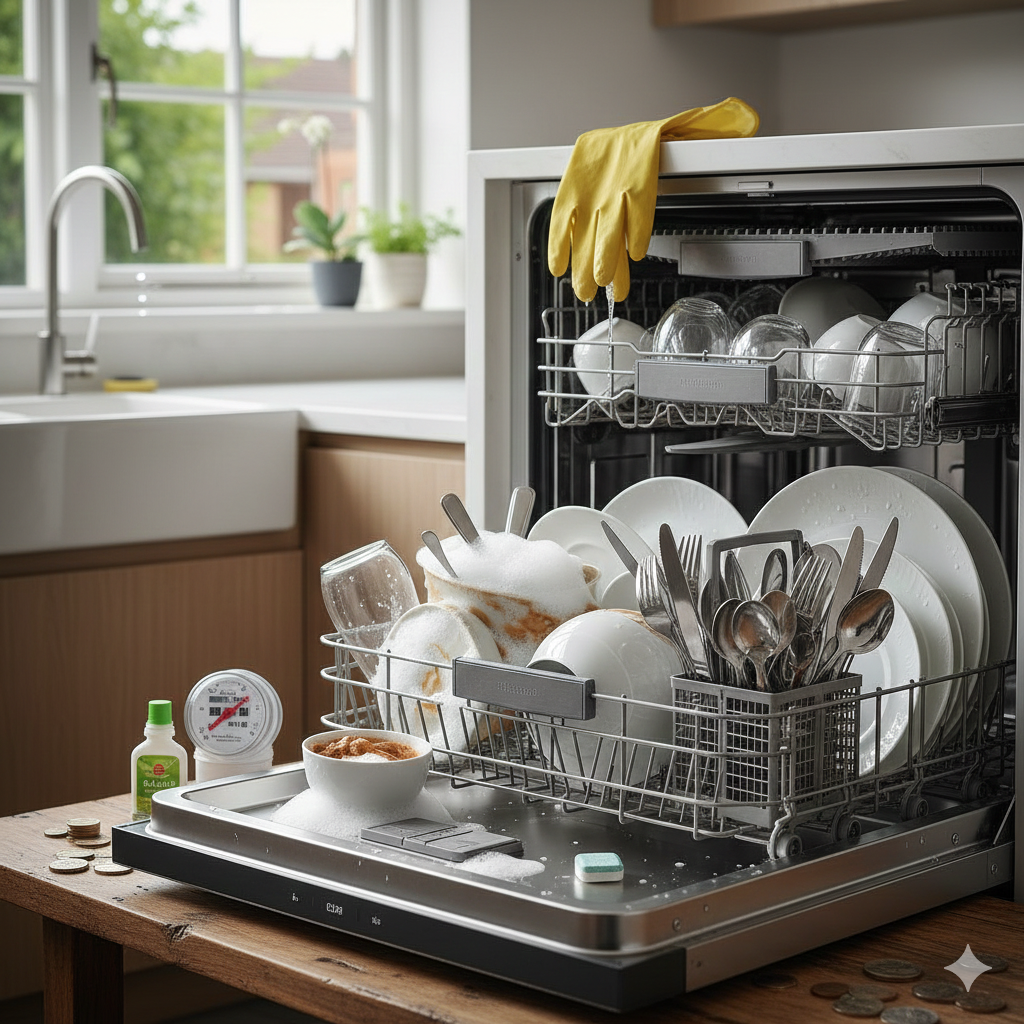
A Quick Note on Water in the UK (Including Scotland)
Here’s a little myth-busting before we dive in:
Some people think that water is free in Scotland because it’s included in council tax rather than billed separately. That’s true in the sense that you don’t get a separate metered bill like in England or Wales, but it’s not actually free — you pay for it via your council tax, and that cost still contributes to running your household. And whether you’re paying water charges directly or indirectly, you still pay to heat that water. The energy cost of heating is the part that really affects your bill when you’re washing dishes.
So for today’s comparison, we’re focusing on what it really costs you — energy + water — to clean those plates.
1. Dishwashers Use a Lot Less Water Than You Think
Modern dishwashers are surprisingly efficient with water. Studies show that a typical dishwasher uses around 10–13 litres of water per full cycle, even on an eco setting. That’s because the machine reuses water inside the cycle and sprays it around under pressure.Scrub Hub
By contrast, hand washing a full load of dishes usually involves:
✔ Filling a basin (or sink) with hot water
✔ Letting the tap run at least a little
✔ Re-filling the water mid-wash
That can easily add up to 60 litres or more of hot water — far more than a dishwasher.Ideal Home
So on water alone, a dishwasher wins hands down — even in Scotland where water is bundled into council tax.
2. The Real Cost Is in Heating the Water
Whether you’re using the dishwasher or washing up by hand, the big cost comes from heating the water, not the water itself.
Here’s how it breaks down:
Dishwasher
Modern dishwashers use electric heating elements to heat the water internally. A typical eco cycle uses somewhere around 0.7–1.1 kWh of electricity, which works out to roughly £0.20–£0.40 per cycle on an average UK tariff. That number changes a bit based on energy prices and the cycle you use, but it’s a good rule of thumb.
Most of that is just heating water — the pump and electronics use very little energy by comparison.
Hand Washing
There’s no engine or motor, but in a hand wash scenario, you’re drawing hot water from your boiler — either gas or electric. Heating 60 litres of water for a big wash-up session can easily cost £0.30–£0.70 or more depending on how long your tap runs and how efficient your boiler is.
So in many cases, hand washing uses more energy overall — because you’re using more water and letting it run hot for longer.
3. Where Each Method Shines (and Where It Doesn’t)
Let’s be honest — neither method is perfect in every situation.
🏆 Dishwasher Wins When:
✔ You wash full loads regularly (family dinners, lots of cups/plates)
✔ You use eco cycles instead of quick or intensive modes
✔ You want less fuss and cleaner results
✔ You’re conscious about water efficiency
Modern dishwashers are built to squeeze the most cleaning power out of every litre of water and every watt of electricity. The fact they use around 1/5 as much water as hand washing for a full load is a big plus.Scrub Hub
🧽 Hand Washing Wins When:
✔ You only have one or two items to clean
✔ You’re not dealing with a full load
✔ You genuinely time yourself and minimise water use
In very light use cases — like rinsing a couple of mugs after breakfast — hand washing can cost less because you’d be running an almost empty dishwasher machine for the same plates. But once you’re talking a full dinner’s worth of dishes, the machine usually wins — both in money and your time.
4. What About Detergent Cost? (We Should Be Honest Here Too)
Dishwashers do need detergent — tablets or powder — which adds a few pence per cycle, but when you factor in the savings in water and energy, that cost is usually offset by the overall efficiency.
A good all-in-one tablet might cost around 20–40p per wash, but if you buy in bulk or on deal days, that number drops. It’s also worth remembering you aren’t buying washing-up liquid constantly.
5. Real Numbers: What This Means for You
Here’s a simplified comparison for a full load of dishes:
| Method | Water (litres) | Estimated Heating Cost | Effort |
|---|---|---|---|
| Dishwasher (Eco Cycle) | ~10–13 L | ~£0.20–£0.40 | Low |
| Hand Washing (Full Load) | ~60+ L | ~£0.30–£0.70+ | High |
Dishwashers win by using less water and consistently heating only what they need — instead of letting a tap run.
Author Insight
It’s amazing what a difference running the numbers can make. I used to wash by hand “for the planet and my pennies”, only to discover the dishwasher quietly saves both water and money — and gives me my evenings back. Who knew? Sometimes the gadget that feels like a luxury ends up being the most sensible thing in the room.
🔗 More Kitchen Energy-Saving Guides You’ll Love
If you’re exploring ways to cut everyday kitchen costs, you’ll find these two guides incredibly useful. For a deeper look at cooking efficiency, How Much Does It Really Cost to Run an Air Fryer Per 15 Minutes in the UK? breaks down exactly what you’re paying each time you crisp up chips or roast chicken.
And if you want to compare savings across appliances, How Much Does a Dishwasher Really Cost to Run Per Cycle in the UK? shows how your machine stacks up in real-world energy use and everyday running costs.
6. Recommended Dishwashers Worth Considering
If you’re thinking of upgrading or adding a dishwasher to your kitchen, here are two options on Amazon UK that combine good capacity, decent energy efficiency, and affiliate potential:
⭐ Bosch Serie 6 Freestanding Dishwasher
A well-regarded model with good energy ratings and cleaning performance, known for quiet operation and efficient water use. It suits families or households that do a lot of dishes.Scrub Hub
👉 Great for daily use and efficiency seekers.
⭐ COMFEE’ Freestanding Dishwasher FD1435E-X
A solid budget-friendly choice with a large capacity and quiet performance, making it ideal for bigger households that want value without sacrificing quality.Cleanify
👉 Good balance of price vs features and suitable for everyday loads.
Both of these are popular with UK shoppers and are typically available on Amazon UK, providing solid affiliate potential when linked in your articles.
7. Bottom Line: Dishwasher or Sink?
For most UK households — especially those washing full loads after family meals — a dishwasher is genuinely cheaper overall than hand washing, once you account for:
✔ Water use
✔ Energy to heat water
✔ Time and effort
Hand washing can be cheaper in very limited scenarios (like washing one mug), but for real-world kitchen loads? The machine usually wins — both in cost and convenience.
So next time you’re facing that mountain of plates, you can load up with confidence knowing it’s not just easier — it’s often the smarter financial choice.
Product Recap
- Bosch Serie 6 Freestanding Dishwasher – A reliable, energy-efficient full-size dishwasher perfect for regular family use. Scrub Hub
- COMFEE’ Freestanding Dishwasher FD1435E-X – A budget-friendly yet spacious dishwasher with quiet operation and strong performance.
Cook smarter and cut everyday kitchen costs with our Smart Kitchen & Appliances Hub your guide to energy-efficient gadgets, smarter cooking habits, and affordable ways to upgrade your home.
Explore simple tips, low-energy tools, and practical UK advice that actually saves money.
For accurate UK guidance on water and energy pricing, see the latest data from Ofgem and Scottish Water, which publish updated information on national tariffs, water charges, and energy consumption standards.

About The Author – Andrew Marshall
Andrew Marshall is a Scottish homeowner and the creator of Save Wise Living. He shares practical ways to reduce energy bills, improve home efficiency, and make everyday household routines cheaper and simpler.