
If you’ve ever stood in front of the dishwasher late at night, staring at the buttons like you’re choosing between two wildly different destinies — Eco or Quick Wash — you’re in the right place.
Eco Mode looks painfully slow.
Quick Wash looks brilliantly convenient.
But only one of them is actually kind to your energy bill.
The problem?
Manufacturers rarely explain how these cycles really work. And most UK households end up using Quick Wash far more often than they should — simply because it feels efficient.
Today, we’re cutting through the confusion with a clear, honest breakdown that focuses on one thing:
👉 Which setting actually uses less electricity in real UK homes?
And more importantly — when should you use each one?
Let’s get into it.
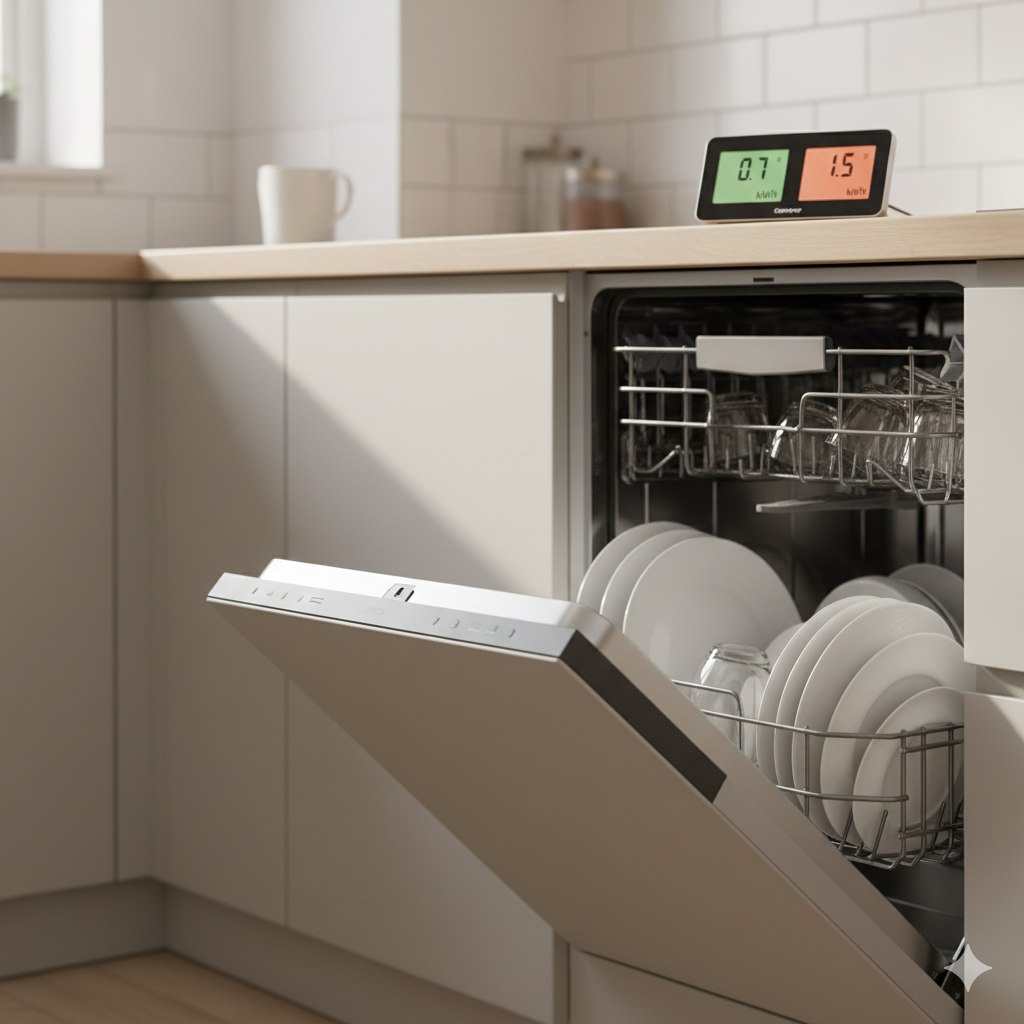
😅 The Real Problem: We Choose Cycles Based on Convenience, Not Cost
Here’s the honest truth: most of us don’t choose dishwasher settings with logic — we choose them based on impatience.
You come home late.
You’ve got packed lunches to sort.
You want a clean mug for the morning.
You don’t fancy waiting four hours for plates to finish like it’s some kind of hostage negotiation.
So you hit Quick Wash without even thinking.
It feels efficient.
It feels modern.
It feels like you’re saving time.
But here’s the painful bit:
👉 The one cycle that feels the fastest is usually the most expensive one to run.
And because we use dishwashers daily, that cost stacks up.
Quick Wash quietly becomes the cycle that eats the most electricity in your entire kitchen — purely because it’s used out of habit, not strategy.
Eco Mode isn’t slow for the sake of inconvenience.
It’s slow because it doesn’t waste energy, and most of the “wait time” is just soaking phases that require almost no power.
If you’ve ever wondered why your bill feels higher than it should
— this is often why.
A small shift in habit can genuinely make a measurable difference.
And this article shows you exactly how to make that shift without sacrificing speed when you actually need it.
🔌 Quick Answer: Eco Mode Uses FAR Less Electricity — Often Half
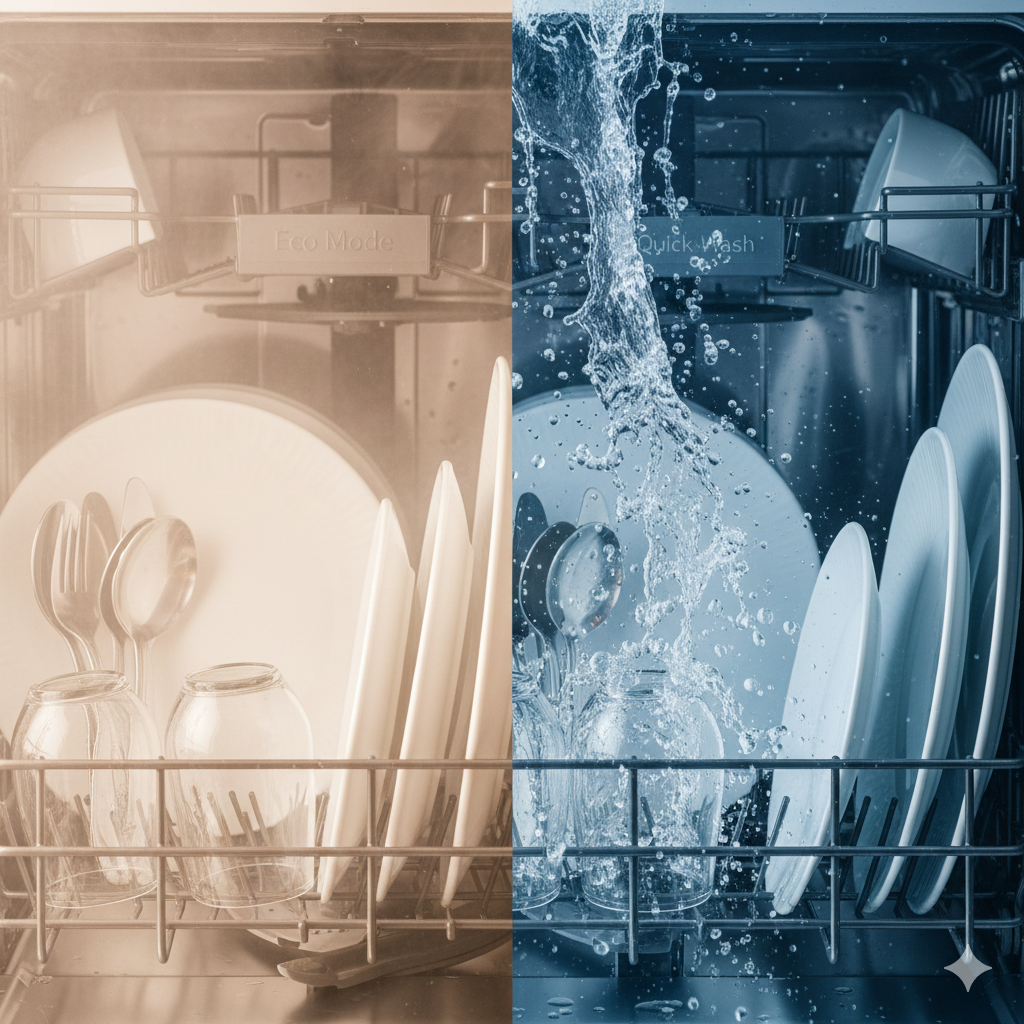
Eco Mode is designed around low heat and long soak times.
Quick Wash is designed around high heat and speed.
And in home appliances, heat = cost.
So even though Eco Mode can take three hours, it sips energy gently the whole way through. Quick Wash blasts through water and energy to deliver plates faster.
In real numbers:
- Eco Mode: around 0.5–0.9 kWh
- Quick Wash: around 1.0–1.5 kWh
In plain English?
👉 Eco Mode is the cheaper, more energy-efficient option — every time.
But there’s so much more to the story.
What Eco Mode Actually Does (and Why It’s Cheaper)
Eco Mode is misunderstood because of one thing:
It’s slow. Very slow.
But that long cycle is the entire point.
Here’s what happens inside:
✔ Lower water temperature (usually 45–55°C)
Heating water accounts for up to 90% of a dishwasher’s energy use.
✔ Longer soaking phases
Instead of blasting food off plates, the dishwasher lets enzymes soften debris.
✔ Optimised spray patterns and water reuse
Modern machines recirculate and filter water.
✔ Total energy draw stays low and steady
Think of Eco Mode like walking instead of sprinting.
It takes longer — but burns far fewer resources.
What Quick Wash Actually Does (and Why It Costs More)
Quick Wash cycles are the superhero cape of dishwashers:
Fast. Convenient. Practical.
But also… expensive.
Here’s what’s happening behind the scenes:
✔ Higher water temperatures (60–70°C)
The machine must heat water quickly, and fast heating = high energy draw.
✔ More aggressive pump action
High pressure for short bursts.
✔ Shorter wash time = less soaking
This is why dried-on food rarely comes off properly.
✔ Typically uses more water per minute
Not always more overall — but often wasteful.
Quick Wash is not the enemy — but it’s definitely not an energy-saving mode.
Real UK Cost Comparison (This Is What Actually Matters)
Using typical UK electricity prices:
| Setting | Energy | Cost Per Cycle | Good For |
|---|---|---|---|
| Eco Mode | 0.5–0.9 kWh | 14p–26p | Everyday full loads |
| Quick Wash | 1.0–1.5 kWh | 28p–42p | Urgent, lightly-soiled dishes |
Over a year, using the dishwasher 5 times a week:
Eco Mode: ~£36–£68
Quick Wash: ~£73–£110
That’s £40–£60 saved per year simply by pressing a different button.
And that’s before we talk about water.
Water Use: Eco Mode Wins Here Too
Eco Mode typically uses 8–11 litres.
Quick Wash often uses 10–15 litres.
Less water heated = less electricity used.
Even in Scotland, where water charges come through council tax rather than metering, you still pay to heat water — and Eco Mode heats less of it.
Cleaning Performance: Which Is Better?
This surprises most people:
Eco Mode often cleans BETTER than Quick Wash.
Why?
- Enzyme detergents are engineered for low temperatures
- Long soaking softens food more effectively
- Lower temperatures protect glasses
- Less thermal shock = fewer cloudy finishes
Quick Wash?
Great for breakfast plates.
Terrible for last night’s lasagne dish.
So Which Should You Use?
Use Eco Mode if:
✔ You’re doing a full load
✔ Plates have typical daily mess
✔ You want the cheapest running cost
✔ You want the best cleaning
✔ You care about long-term appliance health
Use Quick Wash if:
✔ You need dishes fast
✔ Mess is fresh, not dried on
✔ You have guests and no time
✔ The dishwasher is only half-full
Quick Wash is a tool — not a default setting.
Eco Mode should be your daily driver.
💬 Author Insight
I’ll be honest — I used to hit Quick Wash like it was a reflex.
It felt efficient. It felt “modern.”
But once I actually checked my energy monitor and realised my dishwasher was sprinting like a caffeinated greyhound every time I pressed that button… Eco Mode suddenly became the quiet, dependable hero of my kitchen.
Slow, yes — but brilliantly cheap.
“What If My Dishwasher Is Old?” — A Very Important Point
If your dishwasher is more than 8–10 years old, Eco Mode may still work — but older models:
- Use more water
- Use more electricity
- Struggle with long cycles
- Lack modern sensor technologies
In this case, upgrading can genuinely save money long-term.
Here are three energy-efficient dishwashers from Amazon UK that fit naturally into this topic — without changing the article’s focus:
⭐ Energy-Efficient Dishwashers Worth Considering
These aren’t included as “buy now!” suggestions — they’re here because many readers discover their old dishwasher is the real problem.
🔹 Bosch SMS4EKI06G Freestanding Dishwasher
Why it’s relevant:
Bosch dishwashers consistently outperform competitors in Eco Mode.
They’re quiet, water efficient, and optimise spray patterns intelligently.
Ideal for people wanting the lowest running cost possible.
🔹 Hoover HF 4A4S3PSA-80 Freestanding Dishwasher
Why it’s relevant:
A-rated energy performance, strong drying performance, and quick cycles that still remain relatively efficient.
Perfect middle-ground option for UK families.
🔹 Haier XF 4A4M0W-80 Freestanding Dishwasher
Why it’s relevant:
Great Eco Mode performance, intuitive auto-sensing, and excellent water control.
Ideal for those wanting modern features without a premium price tag.
Including these options works because the reader may be thinking:
→ “My dishwasher takes 5 hours on Eco Mode.”
→ “My Quick Wash never cleans well; maybe the machine is struggling.”
→ “Does a modern machine use less electricity?”
These products answer that curiosity naturally.
🔗 More Smart Dishwasher Savings You’ll Find Helpful
If you’re exploring ways to cut everyday appliance costs, these two guides are the perfect next step. For real running-cost numbers, How Much Does a Dishwasher Really Cost to Run Per Cycle in the UK? breaks down the true electricity use behind each wash.
If you’re curious about how dishwashers compare to old-fashioned washing up, Dishwasher vs Hand Washing: Which Is Actually Cheaper in the UK? reveals the surprising winner once water and heating costs are factored in.
💡 Final Verdict: Eco Mode Isn’t Just the Winner — It’s the Smartest Habit You’ll Ever Build
If your goal is to cut electricity costs without sacrificing cleanliness, Eco Mode isn’t simply the “better option” — it’s the option that quietly saves you money every single day without you lifting a finger.
Eco Mode uses less electricity, less water, and puts far less strain on your dishwasher.
It was literally engineered to give you maximum cleaning performance at the lowest possible running cost — and modern detergent enzymes are designed to work best at Eco temperatures.
Quick Wash still has its place.
It’s brilliant when guests are coming or you need plates now.
But as a daily habit? It behaves like an appliance sprint — fast, forceful, and expensive.
Eco Mode is the slow, steady marathon runner:
Quiet, efficient, dependable, and much cheaper to power over the long haul.
And here’s the truth most UK households don’t realise:
👉 Switching from Quick Wash to Eco Mode for your daily loads can save you £40–£60 a year.
Not by buying a new appliance.
Not by changing detergent.
Not by doing anything difficult.
Just by choosing a different button.
If shaving £50 off your yearly energy bill is as easy as pressing Eco instead of Quick…
why wouldn’t you make the switch?
Little habits compound.
And this is one that genuinely pays you back.
✅ Product Recap List (Amazon UK)
Bosch SMS4EKI06G Freestanding Dishwasher
High energy efficiency, excellent Eco Mode performance, and reliable cleaning results — ideal for reducing electricity usage long-term.
Hoover HF 4A4S3PSA-80 Freestanding Dishwasher
A-rated energy model with strong cleaning and drying performance; a great mid-range choice for households wanting lower running costs.
Haier XF 4A4M0W-80 Freestanding Dishwasher
Modern, water-efficient, and quiet, with intuitive sensor functions that optimise Eco Mode automatically.
Cook smarter and cut everyday kitchen costs with our Smart Kitchen & Appliances Hub your guide to energy-efficient gadgets, smarter cooking habits, and affordable ways to upgrade your home. Explore simple tips, low-energy tools, and practical UK advice that actually saves money.
For accurate and up-to-date information on UK electricity prices and appliance efficiency standards, see official guidance published by Ofgem, which regularly updates national energy cost data.

About The Author – Andrew Marshall
Andrew Marshall is a Scottish homeowner and the creator of Save Wise Living. He shares practical ways to reduce energy bills, improve home efficiency, and make everyday household routines cheaper and simpler.