
Last Updated: 6th April 2026
The moment a set of AA batteries dies in an Xbox controller mid-game is one of those small household irritations that escalates faster than it should. Particularly when the kitchen drawer that’s supposed to contain spare batteries contains exactly two AAA cells, a dead 9V from 2019, and a pen that doesn’t work.
We switched most of the house to rechargeable batteries a couple of years ago — the kids’ VR headsets and controllers go through batteries at a rate that makes disposables genuinely expensive rather than just slightly annoying. The upfront cost of a decent set of rechargeables and a charger felt significant at the time. Within three months it had paid for itself. The Lighting & Power Saving Tech Hub covers the broader range of power-related upgrades worth making at home — this article focuses specifically on rechargeable AA and AAA batteries, which for most UK households represent the single easiest and most immediately cost-effective switch available.
The Financial Case — Before Getting to the Products
This is SWL so the numbers matter. A pack of 24 AA disposable alkaline batteries costs roughly £8–12 depending on brand. A household that gets through two packs per month — realistic with active kids, multiple remotes, wireless keyboards, smart sensors, and gaming controllers — spends £192–288 per year on disposables.
A quality set of 8 rechargeable AA batteries costs £15–20. A smart charger costs £15–25. Total upfront investment: £30–45. At a household disposal rate of two packs per month, that investment pays back in six to eight weeks. Everything after that is saving.
The saving compounds further because rechargeable batteries typically last 1,000–2,000 charge cycles over three to five years. If you’re working through the same kind of cost calculation for lighting at the same time, how much an LED bulb actually costs to run per hour in the UK covers the numbers in the same detail — useful context for households replacing both bulbs and batteries as part of the same efficiency overhaul.
At 24p per kWh, charging a set of 8 AA batteries costs roughly 1–2p in electricity. That’s the running cost. For a household charging batteries weekly, annual electricity cost is under £1. The five-year cost comparison between disposables and rechargeables for a typical UK family household is not close.
What the Specifications Actually Mean
Battery specifications look more complicated than they are. Three numbers matter for most buying decisions.
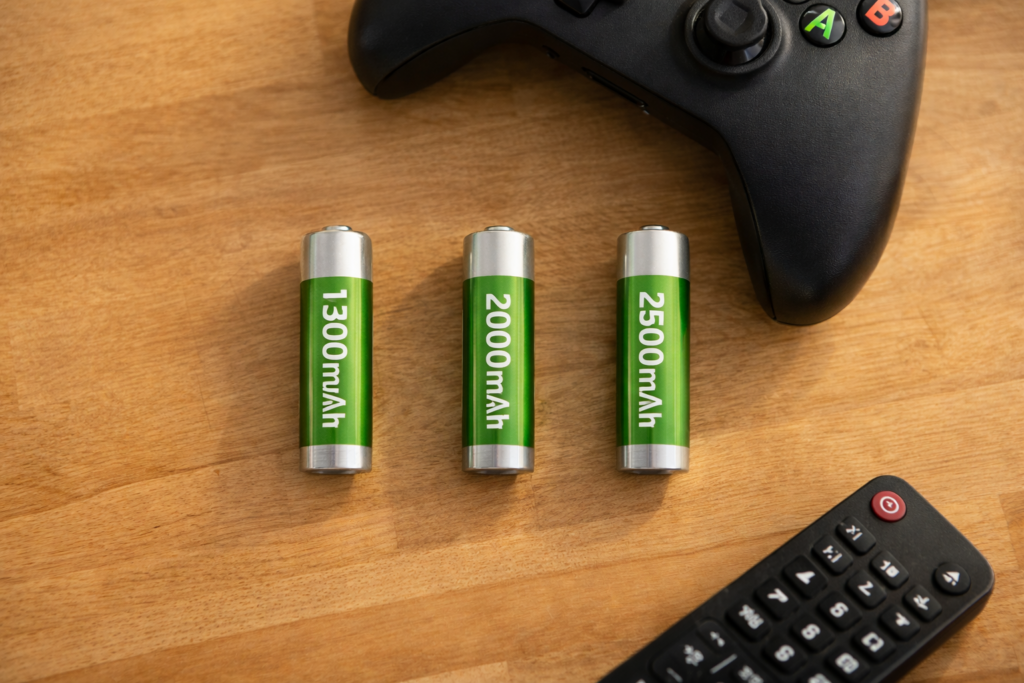
mAh — milliamp hours is the capacity of the battery — how much charge it holds. Higher mAh means longer runtime between charges for the same device. A 2500mAh AA battery runs a wireless gaming controller for longer than a 1300mAh AA battery in the same controller. For high-drain devices — VR headsets, gaming controllers, strong torches — capacity matters significantly. For low-drain devices — remote controls, clocks, smoke alarms — the difference between 1300mAh and 2500mAh is much less noticeable in practice.
Self-discharge rate determines how long a battery holds its charge when not in use. The self-discharge problem became obvious to us the first winter we switched — a set of NiMH rechargeable batteries that had been sitting in the emergency torch in the hallway cupboard for four months were flat when we needed them during a power cut. Low self-discharge batteries — sometimes marketed as “ready to use” or “pre-charged” — are worth paying for if batteries sit unused for weeks between top-ups.
Cycle life is the number of times a battery can be charged before its capacity drops below useful levels. Most quality rechargeables manage 1,000–2,100 cycles. At one full charge per week, 1,000 cycles represents nearly twenty years of use — the cycle life number is rarely the practical limiting factor for normal household use.
Five Rechargeable Battery Packs Worth Buying
Energizer Recharge Universal AA 4-Pack
The Energizer Universal is the entry point on this list and the right starting point for households replacing disposables in low to medium drain devices — remote controls, clocks, wireless keyboards, basic torches. The 1300mAh capacity is lower than the higher-spec options below, but for devices that don’t draw heavily it’s entirely sufficient and the lower capacity means a faster charge time.
Leak protection is the feature that earns Energizer its reputation — the chemistry and construction prevent the corrosion damage that ruins battery compartments, which is a genuine risk with cheaper alternatives. We use these in every remote control in the house — three television remotes, a soundbar, and a set-top box — and haven’t replaced a set in over a year. Pre-charged and ready to use out of the box.
For a household that wants to start replacing remotes and low-drain devices without a significant upfront spend, this is the right first purchase.
Duracell Rechargeable AA 2500mAh 4-Pack
The Duracell 2500mAh is the high-capacity option on this list and the one that suits exactly the situation that prompted us to switch to rechargeables in the first place — gaming controllers, VR headsets, and any device that drains a battery quickly enough that you’re replacing disposables more than once a week.
At 2500mAh this is the highest capacity AA on the list and the runtime difference in a demanding device is noticeable compared to the Energizer Universal. Duracell’s Duralock technology is designed for charge retention — these batteries hold their charge during storage more reliably than some competitors, which matters for devices that sit unused between sessions. The kids’ VR headsets run noticeably longer per charge on the Duracell 2500mAh than they did on the 2000mAh pack we tried first — not dramatically longer, but enough to stop the mid-session flat battery complaint that had become a reliable feature of weekend gaming.
Pre-charged out of the box. For households with children who use battery-powered gaming peripherals regularly, the Duracell 2500mAh is the correct specification rather than an unnecessary upgrade.
HiQuick AA & AAA Combo Pack — 16 Batteries
The HiQuick combo pack is the practical answer for households that need both AA and AAA batteries regularly — 8 of each in one purchase at a price point that makes the per-battery cost lower than buying the two sizes separately from premium brands.
The 2800mAh AA and 1100mAh AAA specifications are competitive for the price. Low self-discharge chemistry means the batteries hold charge reasonably well between uses. CE and ROHS certified — relevant if you’re putting these into children’s toys and want confirmation the manufacturing standards meet UK requirements.
The honest caveat: HiQuick is a less established brand than Energizer or Duracell and the cycle life in real household use may not reach the manufacturer’s stated figures over several years. For a household that wants a cost-effective rechargeable battery pack to replace disposables across a range of devices without a premium brand investment, this is a sensible choice. For devices where battery reliability is critical — a security sensor, a smoke alarm, a medical device — stick with Energizer or Duracell. If home security devices are part of why you’re switching to rechargeables, the smart home security cameras worth considering for UK homes covers the options that work best with rechargeable power setups.
Energizer Power Plus AA 8-Pack
The Energizer Power Plus is the option for households that want to replace disposables at scale across multiple devices simultaneously — 8 batteries in one pack at a specification that suits medium to high-drain devices.
The 2000mAh capacity sits between the Energizer Universal and the Duracell high-capacity — sufficient for gaming controllers and VR headsets while charging faster than a 2500mAh cell. Made with 22% recycled materials, which is relevant for households where the environmental argument for switching to rechargeables is as important as the financial one. Up to 1,000 recharge cycles.
This is the pack we’d buy if starting from scratch with the full household switch — 8 batteries covers the controllers, the headsets, and the remotes in one purchase without needing to top up immediately.
Energizer Power Plus AA 4-Pack
The 4-pack version of the Power Plus suits households that want to start with one device category rather than switching everything at once. Same 2000mAh specification and 1,000 cycle life as the 8-pack — the smaller pack simply costs less upfront and is the right entry point if the budget for a full household switch isn’t immediately available.
Pre-charged and ready to use. The approach of starting with the highest-drain device — typically a gaming controller or VR headset — and expanding from there as the original pack pays back in disposable savings is a sensible way to manage the upfront cost without committing everything at once. It’s how we did it, and the payback from the first pack funded the second without any additional outlay.
Don’t Forget the Charger
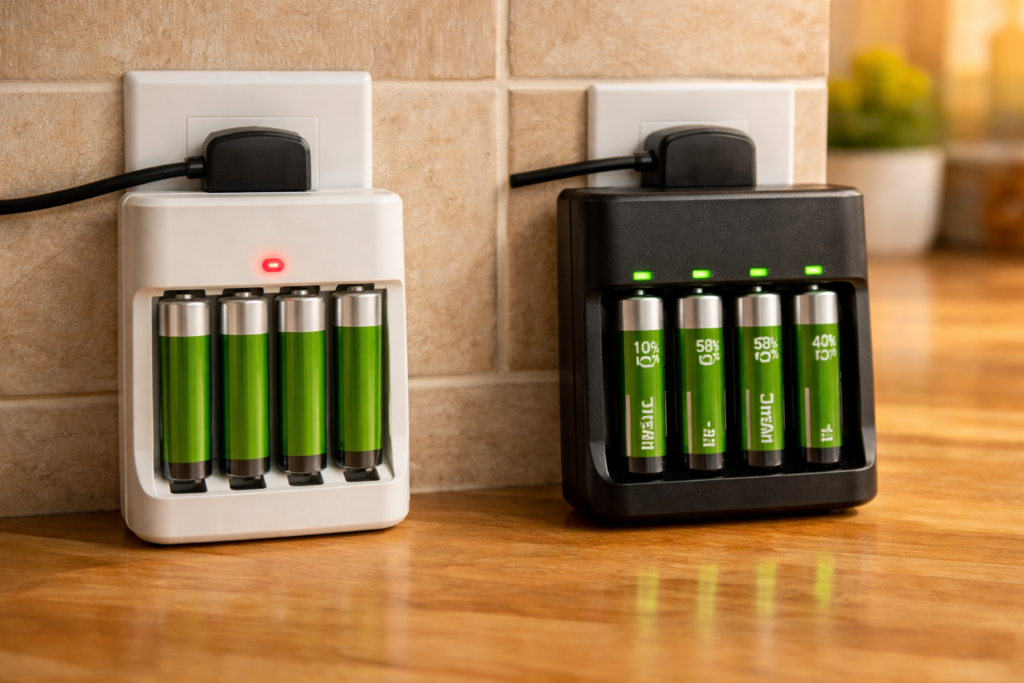
A smart battery charger is required alongside any of the above — and the charger matters more than most people expect when first switching to rechargeables.
A basic charger charges all batteries at the same rate regardless of their individual charge level — which can lead to overcharging, which shortens battery life. A smart charger charges each battery individually, cuts off when full, and often displays the charge level per slot. The difference in battery longevity between a basic charger and a smart charger over five years of use is meaningful.
We used a basic charger for the first six months after switching and noticed the batteries weren’t lasting as long as the specification suggested. Switching to a smart charger — specifically one that showed individual charge levels per slot — made the difference immediately visible. Two batteries in the same pack that had been draining unevenly were being overcharged on the basic unit. On the smart charger each one charges to exactly what it needs and stops.
If you’re also thinking about how to extend the life of other rechargeable devices around the home beyond just batteries, the practical tips for extending battery life on rechargeable devices covers the habits and charging practices that make a genuine difference to how long rechargeable kit lasts.
For a household that has made the financial case for switching to rechargeables, spending an additional £15–20 on a smart charger rather than a basic one is the correct decision. A AAA rechargeable battery pack alongside AA is worth buying at the same time — AAA cells power many of the same household devices and the switching logic is identical.
Which Pack Is Right for Your Household
For gaming controllers, VR headsets, and high-drain devices — Duracell 2500mAh for the highest capacity in a single pack, or Energizer Power Plus 8-Pack to equip multiple devices at once.
For remote controls, clocks, and low-drain devices — Energizer Universal 4-Pack covers the requirement at the lowest entry cost. If smart home devices like motion sensors, smart locks, or security cameras are among the devices you’re powering with rechargeables, the smart motion sensors worth considering for UK hallways and stairs covers the specific battery requirements of those devices — useful for sizing which capacity pack suits your setup.
For households that need both AA and AAA across multiple devices — HiQuick Combo Pack gives the best per-battery cost for a mixed household need.
For households switching everything at once — Energizer Power Plus 8-Pack is the most cost-efficient single purchase for a full household switch.
For households starting with one device category and expanding from there — Energizer Power Plus 4-Pack keeps the upfront cost manageable while the first pack pays back in saved disposables.
FAQ
Are rechargeable batteries worth it for low-use devices like TV remotes?
Yes — the payback period is longer for devices that drain batteries slowly, but a remote control that goes through four AA batteries per year switching to rechargeables still pays back the battery cost within the first year and costs nothing for the following four. The argument is stronger for high-drain devices but it holds for low-drain ones too.
What voltage are rechargeable AA and AAA batteries?
Standard NiMH rechargeable batteries output 1.2V compared to 1.5V for alkaline disposables. Most devices are designed to work across this range and function identically on 1.2V rechargeables. A small number of devices — some older battery-powered clocks in particular — perform less well on 1.2V. Check the device manual if performance issues occur after switching.
How many times can rechargeable batteries be charged?
Quality rechargeable AA and AAA batteries typically manage 1,000–2,100 charge cycles before capacity drops significantly. At one charge per week, 1,000 cycles represents nearly twenty years — the batteries will rarely be used to their full cycle life in normal household conditions.
Can I mix rechargeable and disposable batteries in the same device?
No — mixing battery types in the same device causes uneven discharge that can damage the device and reduces the effective life of both battery types. Use one type consistently per device.
Do rechargeable batteries lose charge when stored?
Yes — all batteries self-discharge during storage. Quality low self-discharge batteries like the Energizer and Duracell options on this list retain 70–80% of their charge after a year of storage, which is sufficient for most household situations. Charge fully before storing if the batteries won’t be used for an extended period — and check anything that’s been sitting in a cupboard before relying on it in an emergency.
Are rechargeable batteries safe in children’s toys?
Yes — NiMH rechargeable batteries are safe for children’s toys and are the standard recommendation for high-drain toy applications. The CE and ROHS certification on options like the HiQuick pack confirms they meet the relevant safety standards. In practice the main benefit is that flat batteries during play stop being an event — you charge overnight and they’re ready the next morning rather than requiring a trip to buy replacements at the worst possible moment.
Related Guides

About The Author – Andrew Marshall
Andrew Marshall is a Scottish homeowner and the creator of Save Wise Living. He shares practical ways to reduce energy bills, improve home efficiency, and make everyday household routines cheaper and simpler.