
Last Updated: 31st March 2026
Most households waste electricity not because their bulbs are inefficient but because lights stay on longer than needed. The hallway left on all evening. The living room lamp nobody thought to switch off before bed. The kitchen light running through an entire afternoon when everyone was elsewhere in the house.
Smart bulbs solve this quietly in the background. A schedule turns the living room lamp off at 11pm whether or not anyone remembers. A dimming routine reduces brightness in the evening when full light isn’t needed. A motion trigger means the hallway only lights up when someone actually walks through it. The electricity saving from eliminating those forgotten hours often outweighs what you’d save simply by switching from older bulbs to standard LEDs.
The four bulbs covered here are confirmed available on Amazon UK, span three different price points, and cover the main smart home setups UK households actually use — from hub-free Wi-Fi to the full Philips Hue ecosystem. Honest assessments throughout, including the one thing the Hue listing doesn’t always make clear.
More smart energy saving gadgets for UK homes are covered in our Smart Lighting & Power Saving Tech Hub.
Check Your Fitting Before You Order
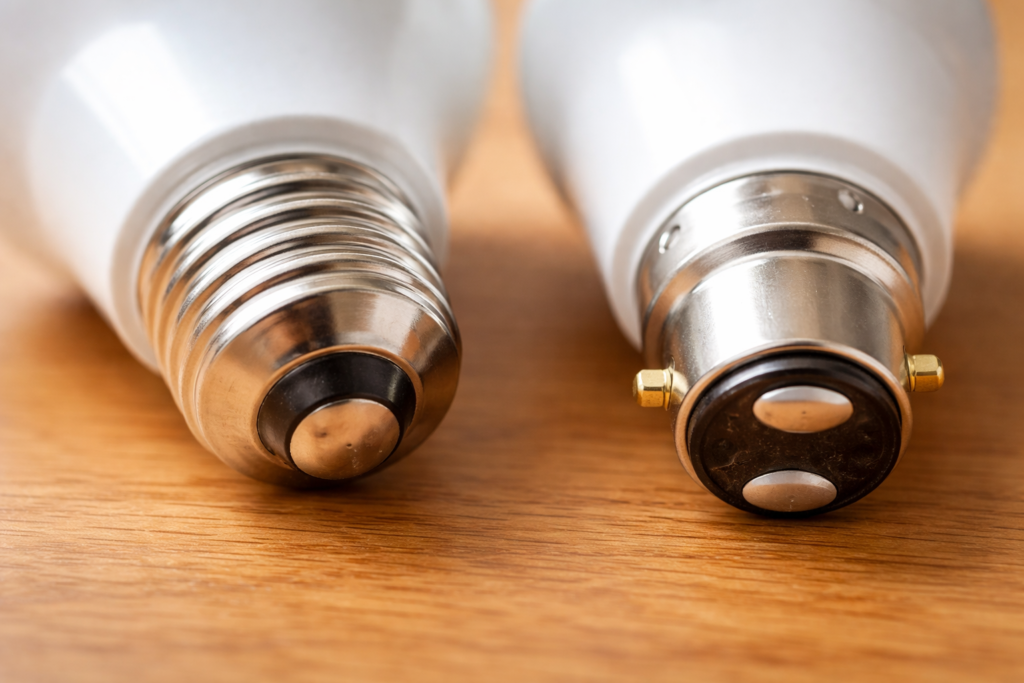
This is the step most buyers skip and then discover too late. UK homes use two main bulb fittings and ordering the wrong one means a return before you’ve even started.
E27 is the screw fitting — the larger threaded base that twists in. Common in table lamps, floor lamps, and pendant lights. The majority of living room and bedroom lamps in UK homes use E27.
B22 is the bayonet fitting — the push-and-twist connection with two small pins on the side. Common in ceiling lights and older UK fittings. If your current bulbs push in and twist to lock, you have B22.
We’ve ordered the wrong fitting more than once — it’s an easy mistake and a frustrating one when the delivery arrives. Thirty seconds checking the old bulb before ordering saves the return.
Take an old bulb out and check the base before ordering. All four products below are available in both fittings — the Tapo L530B covered here is the B22 version, with the E27 equivalent (Tapo L530E) available at the same price.
Hub or No Hub — Decide Before You Browse
Hub-free is right for most households. The Tapo, Lepro, and Avatar Controls bulbs all connect directly to your home Wi-Fi and are controlled through their own apps — no additional hardware needed, no extra cost, works straight out of the box.
A hub adds range, reliability, and ecosystem depth. The Hue Bridge is the reason Hue users end up replacing every bulb in the house over a few years rather than just one room. If you already own a hub or know you want to build a wider smart home system, Hue is the obvious choice. If you’re starting fresh and just want the living room lamp on a schedule, you don’t need one. For households who do want to build a wider connected setup, choosing the right smart hub covers which bridge or hub suits different ecosystems and budgets.
How Much Do Smart Bulbs Actually Save?
A 9W LED smart bulb replacing a 60W incandescent saves approximately 51W of electricity every hour it’s running. At 24p per kWh that’s around 1.2p per hour saved per bulb — which sounds minimal until you multiply it across multiple lights running several hours per day.
A living room lamp running 5 hours daily costs approximately £3.94 per month with a 9W smart LED. The same lamp with a 60W incandescent costs approximately £26.28 per month. That’s the LED efficiency saving — around £22 per bulb annually.
The scheduling and automation saving on top of that depends on your household, but eliminating even one unnecessary hour per day per bulb adds around £0.87 per month per bulb at current rates. Across three or four lights that’s a meaningful additional reduction on top of the efficiency gain. For a precise breakdown of what any individual LED bulb costs per hour at current UK rates, the exact running cost per hour is worth checking before making any lighting decisions.
The real-world saving from switching a whole living room and hallway to smart LEDs with basic scheduling runs to £80–120 per year for a typical UK household — enough to cover the cost of several bulbs within the first year.
The Four Smart Bulbs Worth Buying
1. Philips Hue White & Colour Ambiance E27 — 2-pack, around £75
Best for: households who want the most polished, reliable smart lighting ecosystem available — and are prepared to pay for it.
Philips Hue is the benchmark every other smart bulb is measured against, and after years of use across the house it earns that status. The app is the most intuitive available in this category, the ecosystem integrations are broader than any competitor, and the bulbs themselves have a build quality that shows in daily use over years rather than months.
The important clarification the listing doesn’t always make obvious: these bulbs work straight out of the box with Bluetooth and the free Philips Hue Bluetooth app — no Bridge required to get started. Bluetooth gives control of up to 10 bulbs in a single room from your phone or via Alexa and Google. Adding a Hue Bridge (sold separately, around £45–55) unlocks the full ecosystem — away-from-home control, routines across multiple rooms, third-party integrations, and the ability to expand to 50+ bulbs across your home.
For households already using Hue the two-pack slots straight into an existing setup. For new buyers the Bluetooth-only option is a perfectly functional starting point — you can add the Bridge later when you’re ready to expand.
The colour range — 16 million colours plus tunable white from warm to cool — is the most impressive on this list. Film night warm amber, cool daylight for working from home, gentle sleep-ready warmth in the evening. We’ve had Hue bulbs in the living room for years and the ability to change the character of a room with a single tap is one of those features that sounds trivial until you use it every day.
The honest caveat: at around £37 per bulb these are significantly more expensive than the alternatives. For households who want smart lighting purely for energy saving, the Tapo below delivers the same core scheduling functionality for a fraction of the cost. Hue earns its premium through ecosystem depth and reliability — not through fundamentally better energy efficiency.
A Philips Hue Bridge is worth adding to the order if you’re planning to expand beyond one room — the full ecosystem is considerably more useful than the Bluetooth-only version once you’re living with it.
2. TP-Link Tapo L530B Smart Wi-Fi Bulb B22 — around £8–12
Best for: households who want reliable smart lighting with scheduling and voice control without paying for a hub or a premium ecosystem.
The Tapo L530B is the smart bulb most UK households should start with. No hub required — it connects directly to your home Wi-Fi and is controlled through the Tapo app, which is one of the most straightforward smart home apps available. Setup takes around three minutes: screw in the bulb, open the app, connect to Wi-Fi. Done.
The energy monitoring feature is the detail that makes this bulb particularly relevant for anyone trying to cut their electricity bill — the Tapo app shows real-time power consumption and tracks historical usage, so you can see exactly how much each bulb costs to run and whether your scheduling changes are actually making a difference. Most competitors don’t include this at anywhere near this price point.
Scheduling, dimming, 16 million colours, Alexa and Google Assistant compatibility, and Away Mode — which randomly toggles lights while you’re out to simulate occupancy — are all included. The 8.7W LED delivers 806 lumens equivalent to a 60W incandescent, and colour temperature is adjustable from warm white at 2,500K to cool daylight at 6,500K.
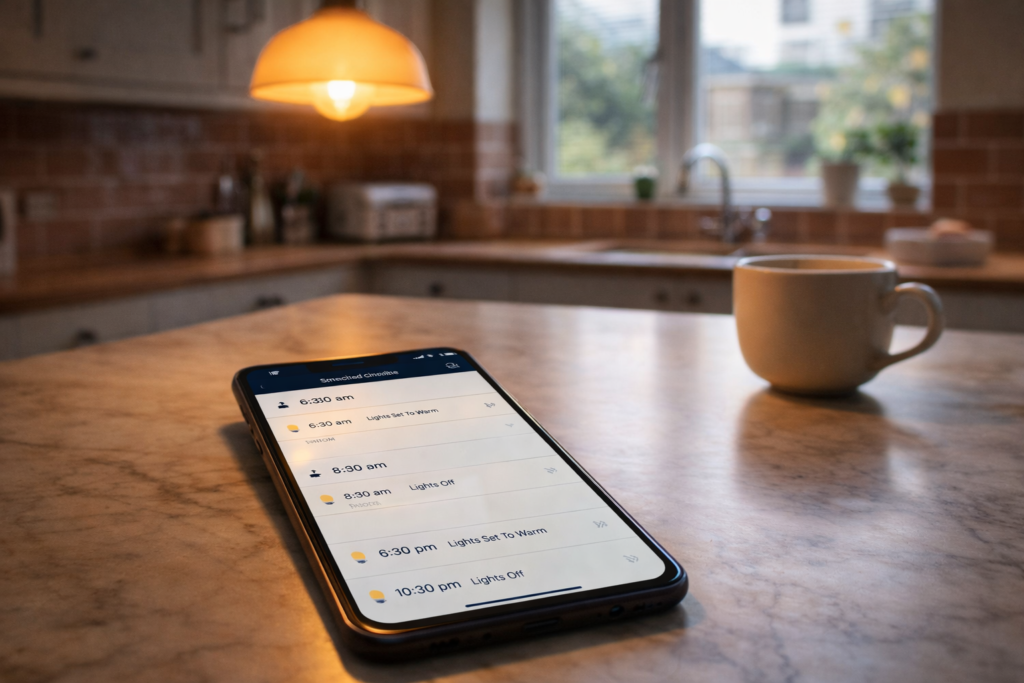
We’ve used Tapo bulbs in the kids’ bedrooms on a schedule for the past year — set to dim gradually from 8pm and switch off at 9pm automatically. The difference in the evening routine is immediate and the fact that the app shows the exact electricity cost of each bulb running through the week is genuinely useful rather than just decorative data. Setting up those schedules takes about five minutes — a step-by-step approach to smart lighting schedules covers the process for anyone doing it for the first time.
With over 7,000 Amazon UK reviews and a brand that’s been making reliable networking hardware for decades, the Tapo L530B is about as low-risk a smart home purchase as exists. The L530E is the identical bulb in E27 fitting at the same price.
3. Lepro B1 AI Smart Bulb E27 — around £12–15
Best for: households who want something more interesting than a standard smart bulb — music sync, AI-generated lighting, and a genuinely different feature set at a mid-range price.
The Lepro B1 is the most interesting bulb on this list and it doesn’t get the credit it deserves in most smart lighting comparisons. The AI lighting engine — Lepro calls it LightGPM — is genuinely impressive in use. Tell the app you want a cosy Sunday morning atmosphere and it adjusts colour temperature, brightness, and transition speed in a way that would take ten minutes to set up manually. Take a photo of your room and it generates lighting that suits the actual space rather than a generic preset. It sounds like a gimmick right up until you use it.
Music sync is genuinely responsive rather than the approximate beat-matching most budget competitors offer. For living rooms and kitchens where music is regularly playing, the bulb adjusts dynamically with the rhythm rather than just pulsing at a rough interval. At 806 lumens from 8.5W the brightness is adequate for most rooms and the full colour range covers both the practical — warm white for reading, cool daylight for working — and the genuinely atmospheric.
No hub required — connects directly to Wi-Fi through the Lepro+ app. One caveat worth knowing upfront: the Lepro B1 only works with the Lepro+ app, not Smart Life or Tuya. If you’re already running other devices on Smart Life this bulb sits on a separate app. If you’re starting fresh or replacing all bulbs in a room together, the dedicated app is clean and straightforward.
At around £12–15 for a single bulb with no hub required, it’s the smart bulb that surprises people most — including us.
4. Avatar Controls WiFi Smart Bulb E27 — 2-pack, around £14–18
Best for: budget-conscious households who want colour-changing smart bulbs across multiple rooms without significant upfront spend.
Avatar Controls has been making smart lighting for UK homes since 2015 and the E27 2-pack is consistently one of the most purchased smart bulbs on Amazon UK at this price point. At around £7–9 per bulb with no hub required, it’s the most affordable genuine smart bulb on this list and the natural entry point for households who want to try smart lighting across several rooms without committing much.
9W output delivers 900 lumens — slightly brighter than the Tapo and Lepro at this wattage. Colour range covers 16 million options across RGB plus warm and cool white. Music sync is present and responsive enough for casual use. The bulb works with both the AvatarControls app and Smart Life — which means it integrates into an existing Smart Life or Tuya setup without adding another app.
Alexa and Google Assistant voice control work reliably. Scheduling, timers, group control across multiple bulbs, and scenes are all included. The app experience is functional but less refined than Tapo or Philips — for households who want the most polished daily experience the Tapo is worth the marginal price difference.
For households who’ve been putting off smart lighting because the cost felt unjustifiable — two bulbs for under £18 with scheduling, voice control, and music sync is a reasonable answer to that hesitation. Try one room first and see whether the scheduling change alone is worth it. It usually is.
What We’d Actually Buy
For a living room — the Philips Hue. The evening dimming routines, the Bluetooth simplicity to start with, and the film night colour scenes make it the most enjoyable daily experience on this list. The cost per bulb stings initially but the quality shows over years of use.
For a kids’ bedroom or hallway — the Tapo L530B. Reliable, affordable, excellent app, energy monitoring built in, and the Away Mode is a genuinely useful bonus for households that travel. The scheduling feature alone pays back the cost within a few months.
For a living room that doubles as an entertainment and music space — the Lepro B1. The AI lighting genuinely changes how the room feels for film nights and music sessions in a way that a standard smart bulb set to a fixed colour doesn’t. Worth every penny of the marginal price difference over the Tapo for rooms where atmosphere matters.
For covering multiple rooms on a tight budget — Avatar Controls. Two bulbs for under £18 with no hub required and Smart Life compatibility is exceptional value if the primary goal is getting smart scheduling across the whole house affordably.
Frequently Asked Questions
Do smart bulbs work with standard light switches? Yes — but with one important caveat. If the wall switch is turned off the bulb loses power and can’t respond to app or voice commands until the switch is turned back on. The most common solution is to leave the switch permanently on and control the bulb through the app, voice, or schedule. A smart switch cover keeps the wall switch accessible without disrupting the bulb’s power. For households who want proper wall control without compromise, smart lighting switches covers dedicated switch replacements that give physical control without affecting the bulb’s smart features.
Do I need a hub for these bulbs? The Tapo, Lepro, and Avatar Controls bulbs connect directly to your Wi-Fi — no hub required. The Philips Hue bulbs work via Bluetooth without a hub for basic in-room control, but full features including away-from-home control and multi-room routines require the Hue Bridge. For most households starting out, hub-free is the right and simplest choice.
Will smart bulbs work if my internet goes down? Schedules that have already been set up will continue to run locally even if your internet connection drops — you just won’t be able to control them remotely or change settings until the connection returns. The Hue with Bridge uses Zigbee locally so it’s even more resilient to internet outages than Wi-Fi bulbs.
How long do smart LED bulbs last? Most are rated for 15,000–25,000 hours — roughly 10 years at four hours daily use. The LED itself will likely outlast the smart components, which is why choosing a brand with a track record of firmware updates matters more than it might seem when buying a bulb.
Can I dim smart bulbs using a standard dimmer switch? No — smart LED bulbs should not be used with traditional dimmer switches and can be damaged by them. Dimming is handled entirely through the app or voice command. If you currently have a dimmer switch, replace it with a standard on/off switch before installing a smart bulb.
Which fitting do most UK homes use? It varies by fixture. Ceiling lights commonly use B22 bayonet. Table lamps, floor lamps, and pendant lights typically use E27 screw. Check the base of your existing bulb before ordering — it will be clearly marked. All four products here are available in both fittings.
Which Bulb Should You Buy?
New to smart lighting and want simplicity — Tapo L530B. Reliable brand, no hub, energy monitoring included, works exactly as advertised from day one.
Already using Hue or want the best ecosystem — Philips Hue E27. Start with Bluetooth, add the Bridge when you’re ready to expand across the house.
Want something genuinely different with AI lighting and music sync — Lepro B1. The feature set justifies the mid-range price for households who’ll actually use it.
Covering multiple rooms on a budget — Avatar Controls 2-pack. Smart Life compatible, no hub, two bulbs for under £18.
Whichever you choose, setting a schedule on day one is the single change that makes the biggest difference to your electricity bill. A smart plug with energy monitoring on any lamp that’s not easily converted to a smart bulb gives you the scheduling benefit without changing the bulb — worth knowing for floor lamps and older fittings.
Related Guides

About The Author – Andrew Marshall
Andrew Marshall is a Scottish homeowner and the creator of Save Wise Living. He shares practical ways to reduce energy bills, improve home efficiency, and make everyday household routines cheaper and simpler.