
Drying clothes indoors is a fact of life for most UK homes — especially through autumn and winter. But once you add a dehumidifier into the mix, a very common question comes up:
How long should you actually run it for?
An hour? All day? Overnight? Until the clothes feel dry?
The honest answer is: it depends — but not in a vague, unhelpful way. There is a sensible range, and running it longer than needed can waste electricity, while running it too little defeats the point.
Let’s break it down properly.
This article is part of our Laundry & Drying Efficiency hub, focused on practical UK advice for drying clothes indoors faster, avoiding damp, and keeping energy use low.
Why a Dehumidifier Helps When Drying Clothes Indoors
When you dry clothes inside, every load releases litres of moisture into the air. That moisture doesn’t disappear — it settles into walls, windows, wardrobes, and soft furnishings.
A dehumidifier helps by:
- Pulling excess moisture directly out of the air
- Speeding up evaporation from wet clothes
- Reducing condensation and damp smells
- Lowering mould risk in the long term
Used correctly, it’s one of the cheapest and safest ways to dry laundry indoors in UK homes.
The Short Answer (If You Just Want a Rule of Thumb)
For most UK homes:
👉 Run a dehumidifier for 4–8 hours when drying clothes indoors.
That range covers:
- A normal washing load
- Average UK humidity
- A standard 10–12 litre domestic dehumidifier
But let’s go deeper, because this is where most people get it wrong.
What Actually Determines How Long You Should Run It?
1. How Wet the Laundry Is
A fast spin (1,200–1,400 rpm) makes a huge difference. Clothes straight from a weak spin cycle can hold nearly double the water.
- High spin → shorter run time
- Low spin / hand-washed → longer run time
If your clothes feel heavy and dripping, expect the dehumidifier to run longer.
2. Room Size & Airflow
A small box room dries faster than a large open-plan space — but only if airflow is decent.
Best setup:
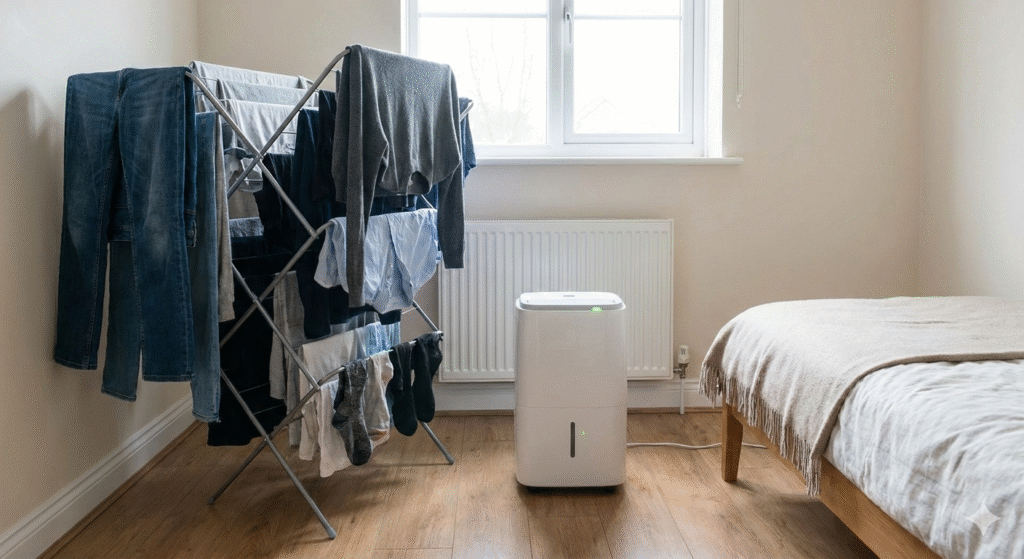
- Clothes airer in a closed room
- Door shut
- Dehumidifier placed 1–2 metres away
- Small gap between clothes
Trying to dry laundry in a whole house with the dehumidifier stuck in a hallway is inefficient and slow.
3. Dehumidifier Capacity
Not all dehumidifiers are equal.
Typical UK models:
- 8–10L/day → small flats, light laundry
- 12–16L/day → most households (sweet spot)
- 20L+ → large homes, constant damp issues
A smaller unit may need 8–10 hours.
A mid-range unit may only need 4–6 hours.
4. Current Indoor Humidity
This matters more than most people realise.
- Above 65% RH → moisture hangs in the air
- Around 50–55% RH → ideal drying conditions
If your home already sits at 70%+ humidity (very common in winter), the dehumidifier has more work to do before drying even begins.
A Realistic Time Guide (UK Homes)
Here’s a practical, honest guide, assuming normal indoor drying conditions:
- Small load (few items): 3–4 hours
- Full washing load: 5–7 hours
- Thick items (jeans, towels): 6–8 hours
- Cold, damp winter day: add 1–2 hours
If clothes are still slightly cool or clammy after that, another hour usually finishes them off.
Should You Run a Dehumidifier Overnight?
Yes — as long as it’s safe and sensible.
Most modern dehumidifiers:
- Have auto shut-off
- Use humidity sensors
- Are safe for unattended use
That said:
- Don’t block airflow
- Empty the tank beforehand (or use continuous drainage)
- Avoid running it for 12+ hours unnecessarily
If clothes are dry at 2am but the unit runs until morning, that’s just wasted electricity.
When to Turn the Dehumidifier Off
A simple rule:
Turn it off when either:
- Clothes feel dry and room humidity drops to ~50–55%
- The unit starts cycling on/off repeatedly
At that point, it’s done its job.
Running beyond this won’t dry clothes faster — it just dries already-dry air.
Does Running It Longer Dry Clothes Faster?
This is where people misunderstand dehumidifiers.
A dehumidifier:
- Removes moisture from air
- It does not add heat
- It does not force-dry fabric
Once the surrounding air is dry enough, evaporation slows naturally. Leaving it running longer doesn’t magically speed things up.
If drying stalls:
- Improve airflow (crack a window slightly or use a fan)
- Space clothes out more
- Flip thicker items halfway through
How Much Electricity Does This Actually Use?
Rough UK figures:
- Average dehumidifier: 200–300 watts
- 6 hours running: ~1.2–1.8 kWh
- Typical cost: 30–55p depending on tariff
That’s often cheaper than a tumble dryer, and far safer than blasting the heating just to dry clothes.
According to guidance from Energy Saving Trust, controlling indoor humidity is one of the most effective ways to prevent condensation and damp without excessive heating use.
Common Mistakes That Make Drying Take Longer
❌ Running it in the wrong room
❌ Packing clothes too tightly
❌ Using it in a draughty space
❌ Forgetting to empty the tank
❌ Expecting it to replace ventilation entirely
A dehumidifier works best with airflow, not instead of it.
Best Setup for Fast, Efficient Drying (UK Tested)
If you want the sweet spot:
- Spin clothes at 1,200–1,400 rpm
- Use a 12–16L dehumidifier
- Dry in a single room
- Space clothes evenly
- Run for 5–7 hours
- Turn off once humidity stabilises
This setup works consistently across flats, terraces, and semi-detached homes.
Is It Better Than a Heated Airer or Tumble Dryer?
Each has its place:
- Tumble dryer: fastest, highest energy use
- Heated airer: gentle, but slower without moisture control
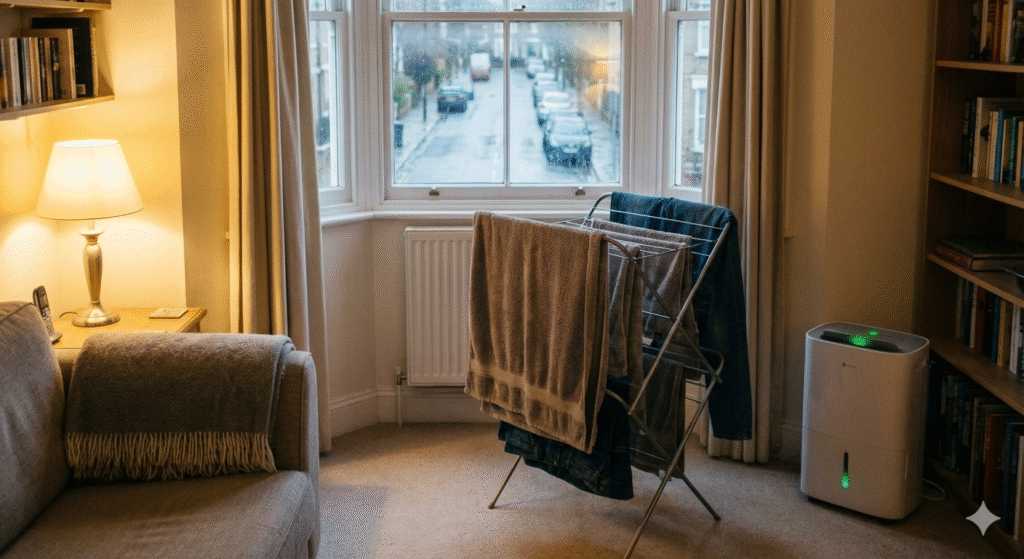
- Dehumidifier: best balance of cost, safety, and damp prevention
Many UK households actually use a heated airer + dehumidifier together, which can cut drying time dramatically without mould risk.
🔗 Related Reads You’ll Find Useful 🧺
If you’re drying clothes indoors regularly, moisture control doesn’t stop once laundry feels dry.
Damp air that lingers can quietly cause musty smells in wardrobes, towels that never feel truly fresh, and slow-building condensation issues around the home.
To go deeper, these guides build perfectly on what you’ve just learned:
- Why Clothes Smell After Being Put Away (UK Wardrobe Moisture Explained) — what’s really causing that “clean but stale” smell, and how to stop it for good.
- How to Dry Towels Indoors Without That Musty Smell (UK Winter Method) — thicker fabrics need a slightly different approach to avoid trapped moisture.
- Best Dehumidifiers for Laundry Drying — if you’re unsure whether your current model is up to the job, this guide breaks down the most effective options for UK homes.
Together, they’ll help you dry laundry faster and keep the rest of your home fresh and moisture-free.
The Bottom Line
So — how long should you run a dehumidifier when drying clothes indoors?
Most of the time: 4–8 hours is exactly right.
Enough to:
- Dry clothes properly
- Remove excess moisture
- Prevent damp and condensation
- Avoid wasting electricity
If you’re running it all day or all night every time, something in the setup needs tweaking — not more runtime.
Get the balance right, and a dehumidifier becomes one of the most useful low-energy tools in a UK home.
If you’re trying to get better control over laundry costs, drying times, and moisture in your home, our Laundry & Drying Efficiency Hub brings everything together in one place. It covers smarter indoor drying methods, moisture control tips, and energy-saving tools that help UK homes dry clothes faster without damp, mould, or wasted electricity — especially through the colder months.

About The Author – Andrew Marshall
Andrew Marshall is a Scottish homeowner and the creator of Save Wise Living. He shares practical ways to reduce energy bills, improve home efficiency, and make everyday household routines cheaper and simpler.