
Air fryers have taken over UK kitchens in the last few years, marketed as a cheaper alternative to ovens and faster than traditional cooking. But microwaves have quietly held the “cheap to run” crown for decades.
So when it comes to everyday UK electricity costs, which appliance actually wins?
Most people assume microwaves are always cheaper because they’re smaller and quicker. That’s true in some cases — but once you compare real cooking time, energy draw, and how often each appliance needs to run to achieve the same result, the answer becomes far more interesting.
This guide looks at the genuine running costs of both appliances using UK electricity prices and realistic home cooking scenarios — not marketing claims.
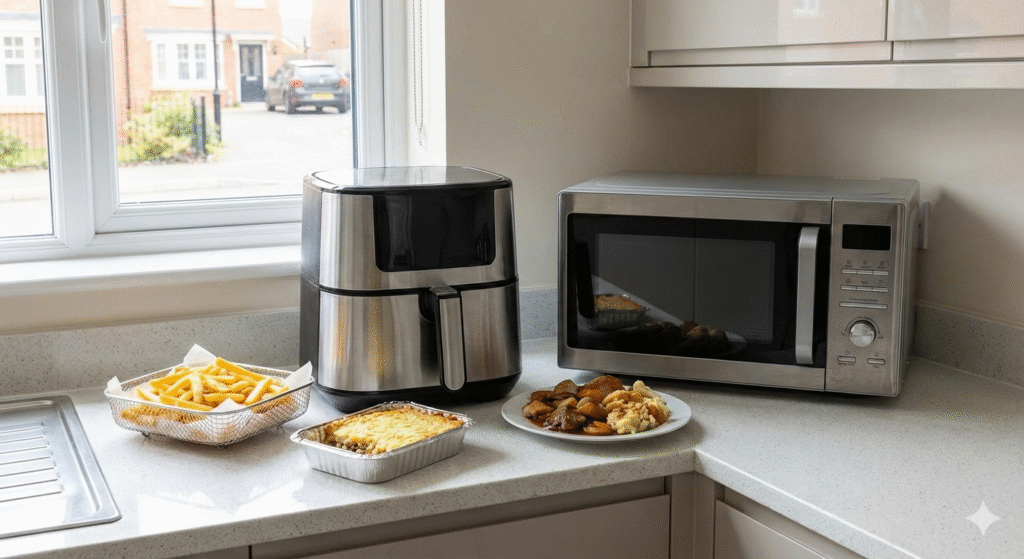
⚡ The Power Difference (Why It’s Misleading)
Microwaves usually run at 700–900 watts.
Air fryers typically use 1,400–2,000 watts.
That sounds like the microwave should always win — but power alone doesn’t equal cost. What matters is:
- How long each appliance runs
- Whether it fully cooks or just heats
- If another appliance is needed afterwards
- Overall energy used (kWh), not wattage
Air fryers use more power, but they often replace the oven completely. Microwaves use less power, but they sometimes need longer cooking or don’t give the same finished result.
So the real comparison is energy used per job, not per minute.
🍽 Real UK Kitchen Scenarios
Reheating Cooked Meals
Microwave: 3–4 mins → ~1–2p
Air fryer: 6–8 mins → ~3–4p
Microwave wins easily here. It’s designed for fast reheating.
Frozen Oven Food (Chips, Nuggets, etc.)
Microwave: technically heats but leaves food soft and uneven. Often still cold in the middle and usually followed by oven or air fryer.
Air fryer: fully cooks, crisps, and replaces a 30–40 min oven cycle.
Microwave might look cheaper at first glance, but in reality it often leads to double cooking.
Air fryer wins in real-life usage.
Ready Meals
Microwave: ~3–4p
Air fryer: ~7–8p
Microwave cheaper — but many people prefer texture from the air fryer.
Meat & Proper Cooking
Microwave struggles with raw food and safety.
Air fryer cooks full portions safely and cheaply compared to an oven.
Air fryer wins massively here.
💷 What This Means for UK Electricity Bills
Microwave = cheapest for short heating
Air fryer = cheapest for actual cooking
The trap most people fall into is comparing appliances without factoring in what they replace. An air fryer might cost 8p to cook chips, but an oven doing the same job could cost 35–45p.
That’s where the savings really happen.
🔌 Best Energy-Efficient Picks for UK Kitchens
If you’re deciding between an air fryer and microwave to keep running costs low, these popular UK models offer strong performance without heavy electricity use.
Keplin 4.5L Digital Air Fryer (Compact Budget Pick)
A low-cost, space-saving air fryer ideal for small kitchens and flats. Fast heat-up and efficient cooking make it a strong upgrade from oven use.
Tefal Easy Fry Dual Zone Digital Air Fryer 8.3L (Family-Size Value)
Large capacity with clear viewing windows so you can cook efficiently without repeatedly opening the basket and losing heat.
Russell Hobbs RHM2076B Digital Microwave (Reliable Budget Model)
Simple, efficient and well-suited for reheating meals quickly while keeping electricity use low.
Hisense H20MOBP1HIUK Microwave (Compact Energy-Smart)
Small footprint and automatic programmes make it perfect for flats or kitchens where you want quick heating without wasted energy.
🧠 The Bigger Energy Truth
Microwaves are:
✔ efficient for quick heat
✔ low power
✔ cheap per use
Air fryers are:
✔ efficient replacements for ovens
✔ faster cooking = less total energy
✔ better for frozen and fresh meals
Comparing them directly is like comparing a kettle to a hob. They serve different roles — but the air fryer wins whenever it replaces longer cooking methods.
✍️ Author Insight
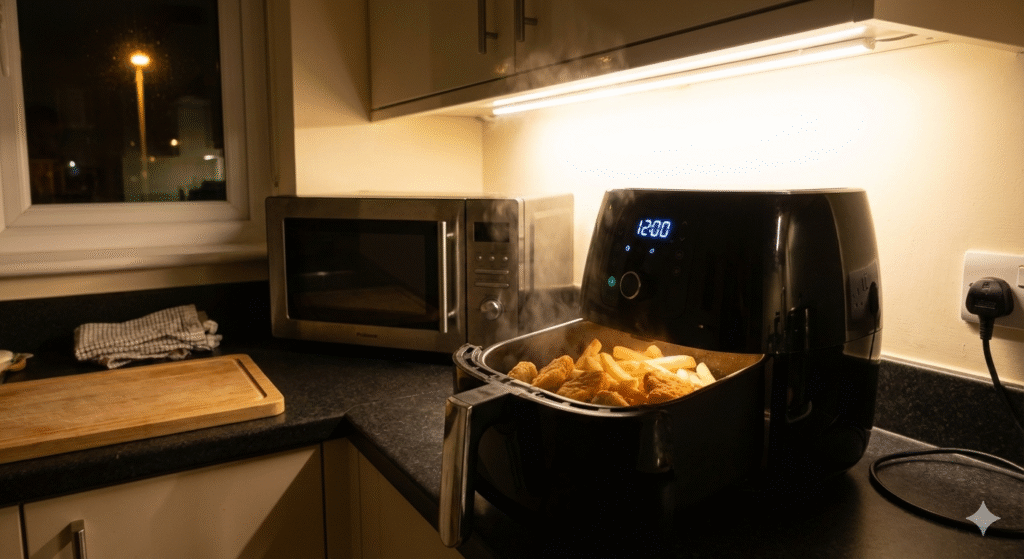
What surprised me most while testing this wasn’t the numbers — it was behaviour. In real homes, microwaves often end up being used first and then followed by the oven or air fryer to “finish” food properly. That double usage quietly cancels out any savings people think they’re making. Using the right appliance from the start almost always reduces overall electricity use.
Read This Next Before Choosing Your Main Cooker 🔥
If you’re comparing appliance running costs, it’s worth looking at how air fryers stack up against full-size cooking too — because that’s where the biggest savings usually appear.
These guides break down the next step for UK households:
- Best Energy-Efficient Built-In Ovens UK (A-Rated & Above) — the lowest-cost ovens for homes that still cook traditionally.
- Is It Cheaper to Use the Oven or the Air Fryer for Family Meals? — a real-world comparison showing when air fryers massively cut cooking costs.
Together they show whether upgrading your oven or relying more on the air fryer will make the biggest dent in your bills.
✅ The Final Verdict
If you only ever warm leftovers or heat drinks, the microwave is the clear low-cost winner.
But for actual meal cooking, frozen foods, batch cooking, or replacing the oven, the air fryer delivers far bigger savings across a week, month, and year.
That’s why so many UK households now rely on air fryers — not because they’re lower wattage (they’re not), but because they massively reduce cooking time and eliminate the need to heat a full oven.
Microwave = cheapest for heating
Air fryer = cheapest for cooking
And in real UK homes trying to cut energy bills, cooking savings outweigh reheating savings every time.
Cook smarter and cut everyday kitchen costs with our Smart Kitchen & Appliances Hub your guide to energy-efficient gadgets, smarter cooking habits, and affordable ways to upgrade your home. Explore simple tips, low-energy tools, and practical UK advice that actually saves money.
For official, trusted UK advice on reducing energy use, the Energy Saving Trust has clear, practical guidance on saving electricity at home.

About The Author – Andrew Marshall
Andrew Marshall is a Scottish homeowner and the creator of Save Wise Living. He shares practical ways to reduce energy bills, improve home efficiency, and make everyday household routines cheaper and simpler.