
If you’re trying to cut your electricity bill, lighting is one of the easiest wins. Not because it’s the biggest part of your bill (it usually isn’t) — but because it’s simple, cheap to improve, and doesn’t require changing your routine.
So let’s answer the question properly:
An LED bulb costs pennies per hour to run — and once you know the simple formula, you can work out the cost for any bulb in your home in about 10 seconds.
The quick answer (UK)
Most LED bulbs use 4W to 10W.
Using the current Ofgem price cap unit rate (Jan–Mar 2026) of 27.69p per kWh for typical direct debit customers :
- 6W LED → about 0.17p per hour
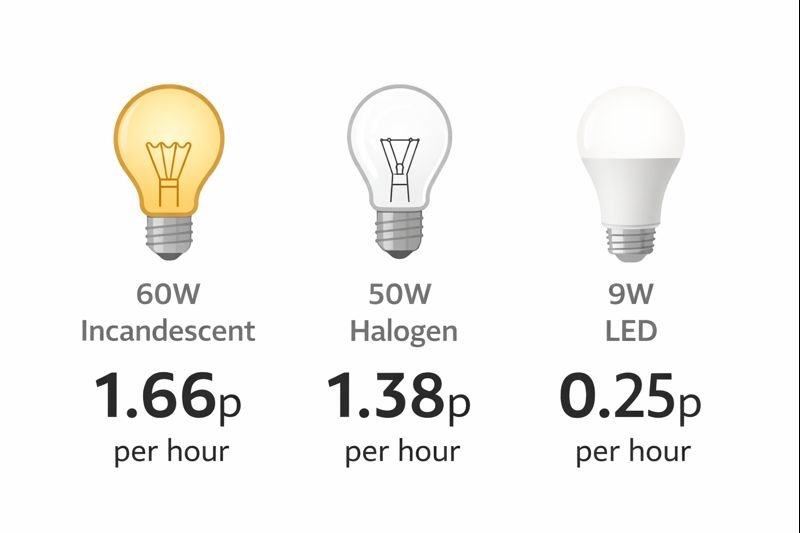
- 9W LED → about 0.25p per hour
- 10W LED → about 0.28p per hour
That’s not £0.28 — that’s 0.28 of a penny.
(Your own tariff may be a bit higher or lower by region and plan, so I’ll show you how to calculate it exactly for yours.)
The Energy Saving Trust highlights LED lighting as one of the simplest and most effective ways for UK households to reduce electricity use without changing brightness or comfort.
The simple formula (works for every bulb)
Cost per hour = (Watts ÷ 1000) × unit rate (per kWh)
Where:
- Watts = the bulb’s power (printed on the bulb or packaging)
- Unit rate = what you pay per kWh (from your bill/app)
Example (9W LED at 27.69p/kWh)
- 9W ÷ 1000 = 0.009 kWh per hour
- 0.009 × 27.69p = 0.249p per hour
≈ 0.25p per hour
Cost per hour table (common LED bulb wattages)
Using 27.69p/kWh as the example rate :
- 4.5W LED → 0.0045 × 27.69p = 0.12p/hour
- 6W LED → 0.006 × 27.69p = 0.17p/hour
- 8W LED → 0.008 × 27.69p = 0.22p/hour
- 9W LED → 0.009 × 27.69p = 0.25p/hour
- 10W LED → 0.010 × 27.69p = 0.28p/hour
- 13W LED → 0.013 × 27.69p = 0.36p/hour
- 15W LED → 0.015 × 27.69p = 0.42p/hour
Even a “powerful” LED is still well under ½ a penny per hour.
What about per day, per month, and per year?
Per-hour costs are tiny, so it helps to see it as “hours used”.
Let’s take a typical LED bulb used 3 hours per day.
9W LED (0.25p/hour)
- Per day: 0.25p × 3 = 0.75p/day
- Per month (30 days): 0.75p × 30 = 22.5p/month
- Per year: 0.75p × 365 = £2.74/year
So one regularly-used 9W LED bulb costs roughly a few quid a year.
Now multiply across a home — especially if you’ve got older bulbs still hanging on like grim little electricity vampires.
The real savings: LED vs old bulbs (why this matters)
LED bulbs are cheap to run because they produce the same brightness using far fewer watts.
Very rough “equivalents” (varies by brand and lumens):
- Old 60W incandescent ≈ 8–10W LED
- Old 40W incandescent ≈ 5–6W LED
- 50W halogen spotlight ≈ 5–7W LED spotlight
So the comparison is where the money is.
Example: 60W old bulb vs 9W LED (3 hours/day)
Using 27.69p/kWh :
60W bulb
- 0.06 kWh/hour × 27.69p = 1.66p/hour
- 3 hours/day → 4.98p/day → £18.17/year
9W LED
- £2.74/year (from above)
✅ Saving from swapping one bulb: ~£15/year
Swap 10 bulbs and you’re suddenly talking ~£150/year depending on usage.
Energy Saving Trust also highlights LED lighting as a low-cost way to reduce electricity use without changing brightness.
“But my electricity bill is still high…”
Yep — because lighting usually isn’t the biggest hitter.
Your biggest electricity costs tend to come from:
- electric heating / immersion heating
- tumble dryers
- ovens/hobs
- dishwashers/washing machines
- always-on electronics (routers, consoles, TV boxes)
- anything that heats water or air
But LED swaps are still worth doing because:
- it’s quick
- it’s cheap
- it’s permanent
- it removes a chunk of waste you’ll never need to think about again
How to calculate your exact cost (using your own tariff)
Step 1: Find your unit rate
Check your supplier app or bill for “electricity unit rate” (pence per kWh).
If you’re on the price cap, the typical direct debit unit rate for Jan–Mar 2026 is 27.69p/kWh (regional variation applies).
Step 2: Find the bulb wattage
Look for W on the bulb base or packaging (e.g., 6W, 8.5W, 10W).
Step 3: Do the 2-second maths
Watts ÷ 1000 × unit rate = cost per hour
If you want it in pounds:
- pence ÷ 100 = pounds
Do LED bulbs use power when “off”?
No — not in any meaningful way.
If the switch is off at the wall, the bulb isn’t drawing power.
The tiny “standby drain” stuff usually comes from:
- smart bulbs that remain connected to Wi-Fi/Zigbee
- smart switches/bridges
- devices with transformers left plugged in
If you’re using smart bulbs, they can draw a small standby amount to stay connected — usually still very low, but it exists.
A practical way to prioritise (so you feel the difference)
If you want the fastest payoff:
- Replace the most-used lights first
- kitchen main light
- living room main light
- hallway light (often on constantly)
- outside/security lights
- Replace high-wattage halogen spotlights
If you’ve got a ceiling with 8–12 halogen GU10s, swapping those can noticeably cut usage. - Check outdoor lights
Outdoor lights left on for long periods can quietly rack up hours.
Quick sanity check: why per-hour costs look “too small”
Because they are small — lighting is low wattage.
A 9W LED is 0.009 kWh per hour.
Even at 30p/kWh, that’s:
- 0.009 × 30p = 0.27p/hour
That’s correct.
Where people get stung is:
- many bulbs
- lots of hours
- old inefficient bulbs
- lights left on all evening
- outdoor lights running overnight
💡 Explore Smarter Lighting Choices
If you’re already looking at LED running costs, it’s worth thinking about how lighting fits into the bigger picture of your home.
👉 Do Smart Lights Increase Your Home’s Resale Value? What UK Buyers Actually Care About looks at whether upgrading lighting is something future buyers actually notice — or ignore.
👉 Smart Lighting for Renters: Wireless Options That Don’t Break Tenancy Rules shows how you can improve lighting efficiency and control without drilling holes or upsetting your landlord.
These guides help you go beyond cheap bulbs and think about lighting as part of a smarter, more efficient home.
✍️ Author Insight
One thing that surprises most people is how small the hourly cost of LED lighting really is. The savings don’t feel dramatic hour by hour — but over months and years, especially when replacing older bulbs, it quietly becomes one of the easiest long-term wins for cutting electricity waste without changing how you live.
🏁 Final Verdict
LED light bulbs are one of the easiest, cheapest upgrades you can make to cut everyday electricity waste in your home. While the cost per hour is tiny, the long-term savings become significant when you replace older bulbs and high-wattage spotlights that run for hours every day.
Understanding the simple maths behind LED running costs gives you confidence that your lighting isn’t quietly pushing your bill up — and shows why switching to LEDs is a permanent, low-effort way to make your home more energy-efficient without sacrificing light quality or convenience.
Brighten your home and lower your bills with the Smart Lighting & Power Saving Tech Hub explore smart bulbs, motion sensors, and rechargeable gadgets that make efficiency easy.

About The Author – Andrew Marshall
Andrew Marshall is a Scottish homeowner and the creator of Save Wise Living. He shares practical ways to reduce energy bills, improve home efficiency, and make everyday household routines cheaper and simpler.