
Last Updated: 23rd March 2026
The oil-filled radiator in my home office used to run constantly. It didn’t matter whether the room was already warm — it just kept going, drawing full power until I physically switched it off. The electricity meter didn’t care either way. A plug-in thermostat changed that entirely. The radiator now cuts out when the room reaches temperature and kicks back in when it drops. Same warmth, noticeably lower running cost, and after the first five minutes of setup I haven’t thought about it since.
If you rely on a portable heater anywhere in your home — bedroom, office, conservatory, or spare room — a plug-in thermostat is one of the most straightforward cost-saving purchases available this winter. For more on keeping heating costs down across the whole house, the smart heating and home warmth section of the site covers everything from thermostatic valves to draught proofing in one place.
How a Plug-In Thermostat Actually Works
The principle is simple enough to explain in one sentence: it sits between the wall socket and your heater, switches the heater on when the room drops below your target temperature, and switches it off once that temperature is reached.
No rewiring. No installation. No smart home hub or Wi-Fi needed. The heater itself stays on its highest setting — the thermostat controls the power supply. What you end up with is a heater that only runs when the room actually needs it rather than drawing full wattage continuously until you remember to switch it off.
The saving is real and easy to calculate. A 2,000W portable electric heater running for four hours costs £1.92 at 24p per kWh — if you want to see how those running costs stack up across different heater types, the breakdown is worth reading before you commit to any heating setup. A thermostat that cuts even one unnecessary hour of runtime per day saves roughly 48p — around £14.40 over a 30-day month. Over a four-month heating season that’s nearly £58 back from a single room, which more than covers the cost of the thermostat. For broader guidance on home energy efficiency, the GOV.UK energy section is a reliable and up-to-date reference.
What’s Worth Knowing Before You Buy
The most important check is wattage compatibility — and it’s the one most people skip. I know because I nearly did. A thermostat rated at 2,900W or 3,680W covers most portable heaters comfortably, but running a heater beyond the thermostat’s maximum load rating is a safety risk worth taking seriously. Check the wattage on the back of your heater before buying anything.
Sensor placement matters more than the spec sheets suggest. The first thermostat I set up had its built-in sensor sitting near the floor by the socket — which happens to be the coldest part of most rooms. The reading was consistently lower than the actual room temperature, which meant the heater was running longer than it needed to. Moving the sensor, or choosing a model with an external probe, solved it immediately. For most standard bedrooms and living rooms a built-in sensor works fine once you’re aware of this. For larger or unevenly heated spaces, a probe on a cable makes a real difference to accuracy.
A plug-in timer socket alongside the thermostat adds another layer of control if your pattern is predictable — set power available to the thermostat only during the hours you’re actually in the room and the running cost drops further. If you’re unsure whether a plug-in thermostat is the right level of control for your home or whether something more permanent makes sense, understanding the difference between smart and standard heating controls is a useful starting point. And always plug directly into the wall rather than an extension lead, particularly with heaters above 1,500W.
The Best Plug-In Thermostats for UK Homes
1. SENSTREE Wireless Temperature Controlled Outlet
Best for: bedrooms, living rooms, and anyone who wants remote temperature control without leaving the sofa
The SENSTREE is the one I’d point most people towards without hesitation. The remote sensor is what sets it apart from simpler options — the temperature being read is the actual room temperature at occupant level rather than the air near a warm wall or down by the skirting board. Set your target, the room reaches it, the heater cuts off. When it drops, it comes back on. That cycling is where the saving comes from and the SENSTREE manages it reliably.
The 100-metre remote range is more than you’d ever need inside a house — the practical benefit is being able to turn a bedroom up from the living room before you go upstairs, which is a small convenience that quickly becomes a habit worth having. Settings save after a power loss, which matters if you’ve spent time dialling in a schedule.
A wireless thermometer in the room alongside it is worth having for the first week — useful for confirming the sensor reading matches what the room actually feels like at the point you’re sitting, before you’ve fully trusted the setup.
One honest caveat: the remote uses AAA batteries that aren’t included. Worth picking up a set before the unit arrives rather than finding out when it’s already on the wall.
2. Digital Thermostat Plug-In Controller with Sensor
Best for: conservatories, garages, and spaces that need timed heating cycles rather than just temperature control
This one suits rooms where you want heating to run on a defined schedule as much as a temperature target. The countdown and cycle timer modes let you set precise heating windows — a conservatory that needs warming for an hour before you use it, or a garden workshop where you want the heater on while you’re working and off when you leave without having to remember to switch it yourself.
A friend uses this exact setup in his garage workshop — heater comes on an hour before he goes out there on weekend mornings and cuts off automatically two hours later regardless of whether he remembers. It’s that kind of set-and-forget reliability that makes it worth considering for spaces outside the main house.
The ±1°C accuracy is solid and the 2,900W maximum load handles most portable heaters comfortably. One thing the listing doesn’t make obvious: you can switch between Celsius and Fahrenheit with a long press — minor detail but useful if you’re working alongside imported equipment with Fahrenheit markings.
A waterproof extension probe is worth checking compatibility on if you’re using this in a greenhouse or any damp outdoor structure — keeping the sensor reading accurate in humid conditions matters more than it does in a standard room.
Honest caveat: the multiple timing modes take a short time to get familiar with. Give the manual ten minutes before concluding something isn’t working correctly.
3. Lowenergie Wireless Digital Plug-In Thermostat
Best for: oil-filled radiators, straightforward plug-and-play control, and anyone who wants minimal setup
The Lowenergie is the simplest option on this list and that simplicity is genuinely its best feature. Plug in, set the temperature, leave it to work. No app, no hub, no account to create. The RF remote adds convenience without any additional complexity — adjust the temperature from across the room with a single button press.
It pairs particularly well with oil-filled radiators because oil radiators hold heat longer than fan heaters. When the thermostat cuts power, the radiator doesn’t cool immediately — it continues releasing warmth, which means longer cycling intervals and less total runtime. I’ve run this combination in the living room and the difference in how the heater behaves compared to running it without a thermostat is immediately obvious. The heater runs noticeably less while the room feels the same temperature — which is exactly the point.
If you’re still deciding between heater types for pairing with a thermostat, oil-filled radiators under £100 covers the options worth considering at the budget end of the market.
Caveat worth knowing: the RF range works best within the same room. It’s a room-level control device rather than a whole-house remote solution, which is exactly what most people need it to be. Remote requires AAA batteries not included.
4. NASHONE Wireless Thermostat RF Plug
Best for: high-wattage heaters, larger rooms, and anyone who wants one device to handle both heating and cooling across different seasons
The NASHONE handles both heating and cooling modes from a single plug-in unit, which makes it the most versatile option on this list across the whole year. In winter it cycles the heater to maintain your target temperature. In summer the same unit controls a fan or cooling device to stop a room overheating. For a home office or conservatory that’s uncomfortably cold in January and uncomfortably warm in July, that dual-season functionality from one device is genuinely useful rather than a box-ticking spec point.
The 3,680W maximum load is the highest here and covers every portable electric heater currently available in the UK without any capacity concern. The built-in sensor is accurate and responsive, and the RF remote works reliably across a room without needing line of sight to the unit. The Energy Class A+++ rating reflects the efficiency gains that come from proper thermostat cycling — cutting runtime by preventing overheating is where that classification is earned in real use rather than in a lab.
A desk fan or tower fan paired with the NASHONE in summer gives you the same automatic temperature control in warm months that you get from the heater in winter — one thermostat managing comfort year-round from a single socket.
One honest caveat: the dual functionality is more than most people need for a single bedroom. If straightforward heating control through winter is all you’re after, the SENSTREE or Lowenergie are simpler and equally effective. The NASHONE earns its place when higher load capacity, dual-season control, or year-round use from one device makes practical sense.
5. Digital Temperature Controller Plug with 1.7m Sensor
Best for: rooms with uneven temperature distribution, DIY setups, and anyone who needs the probe positioned away from the unit
The external 1.7m sensor cable is the feature that makes this one worth considering for specific situations. The thermostat unit sits near the plug socket and the probe runs to wherever temperature measurement matters most — mid-room at sitting height, inside an enclosure, or away from a persistent draught near the window.
Our back bedroom has a radiator at one end and a single-glazed window at the other — the temperature at socket level near the radiator is consistently higher than where anyone actually sits. A probe positioned at the desk rather than at the wall means the thermostat reads the temperature where it counts. The difference in comfort and efficiency compared to a built-in sensor near the socket is noticeable within a few days of use.
The 3,680W maximum load and flame-retardant casing are both practical features worth noting. Settings memory after power loss means your programmed schedule stays intact through any interruptions. A cable clip set is useful for running the probe wire neatly along the skirting board rather than leaving it trailing across the floor — small detail, but it makes the setup look considerably tidier.
Honest caveat upfront: this is a more technical unit than the others. Calibration and cycle modes are genuinely useful but take patience to set up. If you want to plug in and have it working in five minutes, one of the simpler options above is the better fit. If you want precise control with the sensor exactly where you need it, this is the one.
If You’d Rather Not Use a Separate Thermostat
For anyone who’d prefer a single unit rather than a plug-in thermostat paired with an existing heater, the Dreo ceramic heater with built-in thermostat is worth considering as an all-in-one alternative.
The 1,500W ceramic element heats a room quickly, the ECO mode adjusts output automatically to maintain the target temperature without running at full power continuously, and the 34 dB noise level makes it genuinely suitable for overnight bedroom use. Remote control, child lock, and a 5–35°C range with ±1°C precision make it a well-specified unit at a mid-range price point.
The trade-off is straightforward: you’re replacing your existing heater rather than upgrading it. If your current heater is a good quality oil-filled radiator or ceramic panel heater you’re happy with, a plug-in thermostat is the more economical route. If you’re buying a new heater anyway, the Dreo removes the need for a separate device entirely and the built-in ECO mode handles the thermostat work automatically.
Which One Should You Actually Buy?
For most people with a portable heater in a bedroom or living room, the SENSTREE is the pick. Remote sensor, reliable cycling, and a remote control that means you adjust the temperature from the sofa rather than crouching by the plug socket every time. It’s the one I’d buy without much deliberation if I was starting from scratch — and the one I’d recommend to anyone who asked me in person.
If your heater is an oil-filled radiator and you want the cleanest possible setup, the Lowenergie pairs naturally with it and gets completely out of the way once configured. If you need the probe positioned away from the unit, the Digital Controller with 1.7m sensor is the better fit. If you’re running a higher wattage heater, want dual heating and cooling control, or need one device to earn its keep across both winter and summer, the NASHONE is worth the small extra cost.
The honest version of this recommendation is simple: most people reading this article need the SENSTREE. Buy it, spend five minutes setting the temperature, and stop paying to heat rooms that have already reached temperature.
Getting the Most Out of Your Thermostat
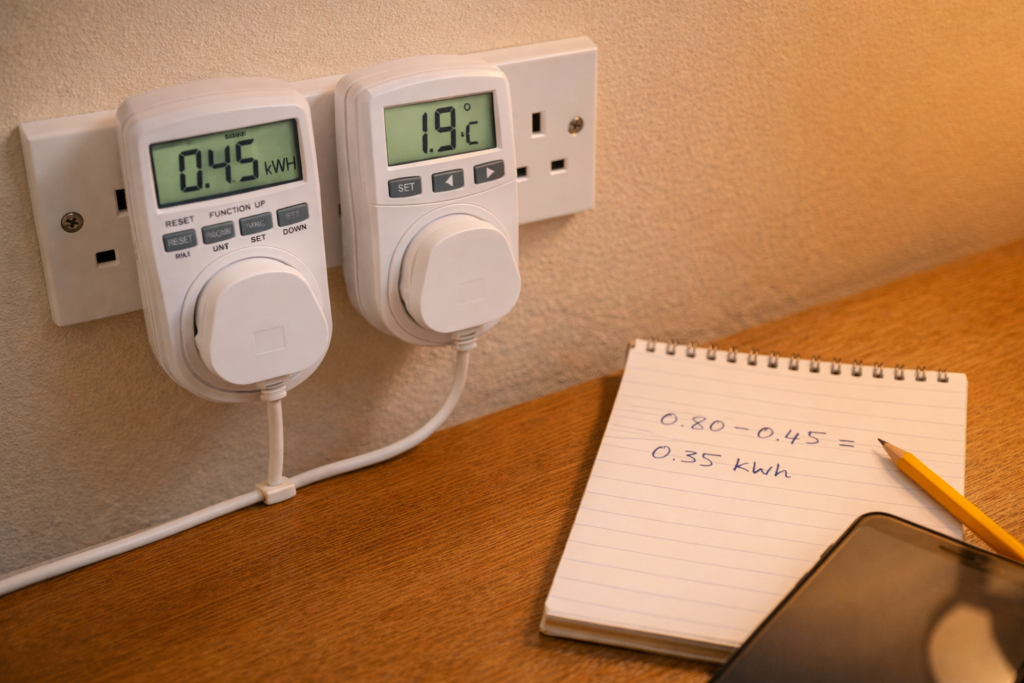
The first thing worth doing when you fit one is plugging a plug-in energy monitor into the circuit for a week before and a week after. The before-and-after comparison in actual kWh used makes the saving concrete in a way that arithmetic doesn’t quite manage — seeing the number drop on a screen is more convincing than any calculation, and it helps you fine-tune the target temperature to find the exact point where comfort and efficiency meet.
That target temperature is where most people start wrong. My first instinct was to set it higher than necessary — 22°C when 19°C turned out to feel the same once the room was holding that temperature consistently rather than cycling wildly. Set it 1–2°C lower than your first instinct, live with it for two days, and adjust from there. The runtime reduction from that small change is significant.
Position the sensor away from the heater, away from windows, and away from external walls where cold draughts can skew the reading. A room thermometer on the wall confirms what the thermostat is reading and helps you trust the target — useful for the first week until you’ve verified the sensor placement is working as expected in your specific room.
Ceramic panel heaters and oil-filled radiators work best with thermostat cycling because they hold heat after the power cuts — if you’re still running a basic fan heater, the difference in running costs between heater types might be worth considering before next winter. Fan heaters cool faster which means shorter off cycles and more frequent switching — not a problem, just worth knowing when setting the differential on the more advanced models.
FAQ
Do plug-in thermostats work with any heater?
They work with most portable electric heaters — oil-filled radiators, ceramic heaters, convector heaters, and panel heaters. The key check is wattage — confirm your heater’s wattage sits within the thermostat’s maximum load rating before buying. Fan heaters with their own built-in thermostats will work but two temperature controllers interacting can sometimes cause erratic cycling — a heater without built-in temperature control is the cleaner pairing.
Do I need Wi-Fi or a smart home setup?
No — every option on this list works independently with no hub, no app, and no Wi-Fi required. They plug in, you set a temperature, and they work. If remote monitoring via a smartphone app is something you specifically want, Wi-Fi enabled plug-in thermostats are available — but for standard home heating control none of that is necessary and the simpler options on this list are more reliable in everyday use.
How much can a plug-in thermostat realistically save?
At 24p per kWh, cutting one unnecessary hour of runtime per day from a 2,000W heater saves roughly £14.40 per month. Over a four-month heating season that’s around £58 from one room — enough to cover the thermostat cost comfortably. The saving increases the more the heater was previously over-running, which for most households is more than people realise until they fit an energy monitor alongside it.
Are these safe to use overnight?
Yes, provided the heater is rated for continuous use and the thermostat’s maximum load matches or exceeds the heater’s wattage. Always plug directly into the wall socket rather than an extension lead with heaters above 1,500W. The thermostat adds a layer of safety by cutting power once the target temperature is reached rather than allowing continuous unmonitored running.
What’s the difference between a built-in sensor and an external probe?
A built-in sensor reads temperature at the unit itself — usually near the floor by the socket, which is often the coldest point in the room. An external probe lets you position the sensor at sitting height in the middle of the room, which gives more accurate and consistent readings. For most standard rooms a built-in sensor works well once you’re aware of its position. For larger rooms, conservatories, or spaces with uneven temperature distribution, a probe makes a meaningful difference.
Will it work with a heater that has its own temperature dial?
Yes — set the heater’s own dial to maximum and let the plug-in thermostat manage the cycling. The thermostat controls the power supply to the heater. The heater’s dial just determines how hard it runs when power is on, which at maximum setting means the thermostat has full control over the room temperature.
Is there any setup involved or is it genuinely plug and play?
For the SENSTREE, Lowenergie, and NASHONE — genuinely plug and play. Five minutes to set the target temperature and it works. The Digital Controller timing modes and the Digital with 1.7m sensor require slightly more patience but nothing that needs technical knowledge. The most involved setup on this list takes fifteen minutes and the instructions are clear enough to follow without prior experience.
Related Guides

About The Author – Andrew Marshall
Andrew Marshall is a Scottish homeowner and the creator of Save Wise Living. He shares practical ways to reduce energy bills, improve home efficiency, and make everyday household routines cheaper and simpler.