
Last Updated: 23rd March 2026
The coldest our front room gets isn’t in the middle of the night — it’s that window between getting home and the central heating kicking in. Everyone’s cold, coats are still on, and the thermostat is calling. It took a couple of winters of doing the obvious thing before I started actually thinking about whether there was a better way to handle it. Turns out there is — several of them, most costing very little. If you’re looking for the broader picture on keeping heating bills down, the smart heating and home warmth section of the site covers everything from thermostatic valves to draught proofing in one place.
1. Layer Up Properly — Not Just More
Everyone knows to put a jumper on. What fewer people think about is the order and type of layers, which makes a bigger difference than the number of them.
The principle is simple: trap warm air close to your body before adding bulk on top. A good thermal base layer — long sleeve top and leggings in a fleece-lined or heat-retaining fabric — does that job quietly under whatever you’d normally wear. I started wearing one around the house last winter and the difference was immediate enough that I ordered a second set within a week. You don’t feel like you’re dressed for an expedition. You just feel consistently warmer without being able to explain why.
On top of that, a mid-layer like a hoodie or thick jumper, then an oversized cardigan or robe for indoor use. The robe sounds indulgent but on a cold Saturday morning when nobody’s going anywhere it’s genuinely one of the most practical things in the wardrobe. Thermal socks complete the picture — cold feet make the whole body feel colder regardless of what else you’re wearing, and a decent pair of wool or fleece-lined socks is one of those changes that works immediately and costs almost nothing. A fleece-lined dressing gown is worth adding if you don’t already own one — it’s the single most-reached-for item in our house from November onwards.
2. Use a Heated Throw Instead of Heating the Room
This is the tip that makes the biggest practical difference for the least running cost if you spend evenings on the sofa — and it’s the one I’d recommend first to anyone who asked.
A heated electric throw warms the person using it directly rather than raising the temperature of an entire room. The running cost is typically 15 to 40 pence per hour depending on the setting, compared to the pound or more per hour that central heating costs to run across the same space. At 24p per kWh, a 200W heated throw on a medium setting costs around 5 pence per hour. The maths makes itself.
We’ve had one for two winters now and it gets used most evenings from October through to March. It’s changed how often we reach for the thermostat more than any other single thing we’ve done. Most models have auto shut-off timers and multiple heat settings — both worth checking before buying. A heated throw storage bag keeps it tidy between seasons and protects the wiring from damage when it’s not in use — worth the small extra if you’re putting it away for summer.
If you want to extend the principle into the bedroom, a heated blanket pre-warms the bed in twenty minutes and then gets switched off — the retained warmth lasts well into the night without anything running while you sleep.
3. Seal Draughts Before You Do Anything Else
If there’s one thing on this list that makes everything else work better, it’s this. A room with significant draughts loses heat faster than any throw, curtain, or layering strategy can compensate for. Fix the draughts first and the rest of the list becomes more effective.
The common entry points are the bottoms of external doors, window frames, letterboxes, keyholes, and in older properties, unused chimneys and gaps around skirting boards. None of these are expensive or difficult to address.
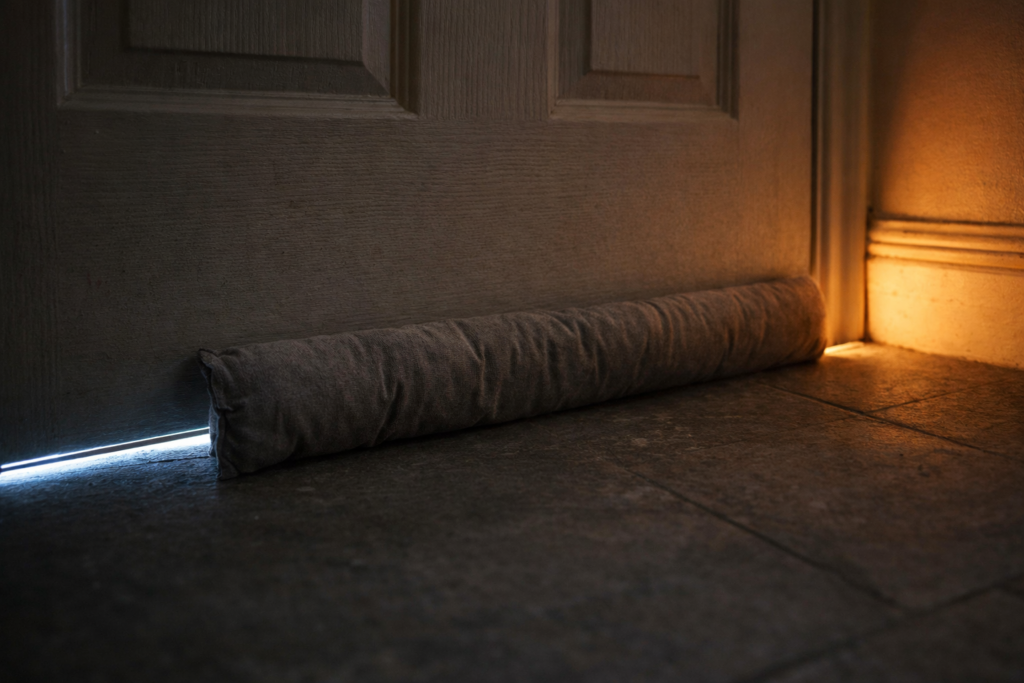
A door draught excluder at the base of an external door is one of the highest-impact purchases available for under a tenner — if you want to see the full range worth considering, the draught excluders worth looking at under £20 covers the best options without the guesswork. Our front door had a gap you could feel standing two feet away — a basic excluder fixed it the same evening and the hallway felt noticeably different within an hour. Self-adhesive draught seal tape around window frames costs a few pounds and takes ten minutes. A letterbox draught excluder is one people often miss — it’s a surprising source of cold air in older properties and an easy fix. For older properties with original unused fireplaces, a chimney draught balloon is worth knowing about — most people haven’t heard of it but it makes a significant difference to rooms that lose heat through an open chimney.
4. Keep Warm at Your Desk Without Heating the Room
Working from home through winter is where the heating bill quietly spirals. You’re in the house all day, the temperature drops mid-morning, and the easiest answer feels like turning the heating on for a room that contains one person.
I work from home most days and this was the pattern for most of last winter until I changed it. An electric foot warmer under the desk keeps feet and lower legs warm — the part of the body that suffers most when sitting still for hours. Paired with a heated throw over the lap, it’s possible to work comfortably in a room that’s several degrees cooler than you’d otherwise tolerate. The combined running cost of both is well under 50 pence per hour. Heating the whole room to the same comfort level costs several times that.
A heated desk pad is the other option worth knowing about — it warms the surface your arms rest on while working, which sounds like a minor thing until you’ve spent a morning with cold forearms and realised how much it affects how chilly you feel overall. A thermal travel mug on the desk keeps a hot drink warm for longer too — small thing, but holding something warm while you work makes a genuine difference to how comfortable a cool room feels.
5. Hang Thermal Curtains or Add Liners to Existing Ones
Windows are responsible for a significant proportion of heat loss in most UK homes — up to 18% according to the Energy Saving Trust. In older properties with single glazing that figure is considerably higher.
Thermal curtains address this directly. The insulating layer traps warm air between the fabric and the glass, reducing the cold that radiates inward on winter nights. We put thermal curtains up in the living room two winters ago and the difference in how quickly the room cools down after the heating goes off is noticeable — it holds warmth for longer in a way that thin curtains simply don’t. If you’re not sure whether curtains or blinds are the better fit for your windows, how the two compare for keeping heat in is worth a look before you buy anything.
If replacing curtains feels like too much commitment, thermal curtain liners clip onto existing curtains and achieve a similar effect for a fraction of the price. Either way, close them before sunset rather than after dark. Once the temperature outside drops below room temperature, every minute the curtains stay open is heat leaving the room. Curtain thermal tape along the edges where curtains meet the wall helps close the gap that lets cold air in at the sides — an easy addition most people don’t think about.
6. Put Rugs Down on Hard Floors
Bare floors — tile, laminate, or wood — don’t just feel cold underfoot. They conduct heat away from the room faster than carpeted surfaces, making the whole space feel cooler than the thermometer suggests.
A thick pile rug adds genuine insulation as well as comfort. The living room in our house had bare floorboards for the first couple of years we were here — putting a large rug down changed how quickly the room warmed up and how long it stayed that way in a way I hadn’t expected. It’s a permanent improvement that costs nothing to run and works every single day without any maintenance.
For rental properties or rooms where committing to a large rug feels like too much, layering smaller mats near the sofa, desk, or bed achieves much of the same effect for less outlay. A non-slip rug underlay underneath is worth adding — it keeps the rug in place and adds a thin extra layer of insulation between the rug and the floor.
7. Use a Hot Water Bottle Every Single Evening
This sounds old-fashioned until you’ve used one consistently through a winter and noticed how much less the bedroom heating has been on.
A hot water bottle placed in the bed twenty minutes before you get in makes the entire sleeping environment warm without heating the room at all. In a hot water bottle cover — which retains heat significantly longer and prevents burns — it stays warm for several hours. The cost of boiling a kettle once is around 2 to 3 pence. The cost of heating a bedroom for the same period of warmth is considerably more.
I keep one in the living room for sofa evenings too, tucked against the side that always feels colder. It sounds like something your gran would suggest and it works better than half the gadgets I’ve bought over the last two years. Don’t skip this one on the grounds that it seems too obvious — it’s one of the most consistently effective things on this entire list.
Microwaveable wheat bags are worth having alongside one — useful for warming a specific part of the body quickly, or for children where a hot water bottle feels like too much responsibility to leave unsupervised.
8. Heat the Rooms You’re Actually In — Not the Whole House
In our house the daily pattern is clear: kitchen in the morning, home office through the day, living room in the evening, bedroom overnight. For a long time the heating was on across all of those spaces simultaneously, warming rooms that were empty for hours at a stretch.
Zonal heating — concentrating warmth in the spaces you’re actually occupying rather than maintaining a consistent temperature throughout — is one of the most effective ways to reduce heating costs without feeling any less comfortable. The principle is simple: keep internal doors closed, focus warmth where people are, and stop paying to heat empty rooms.
Smart thermostatic radiator valves manage this automatically and are worth considering for a longer-term setup. But even without any technology, the habit of closing doors and thinking about where you actually spend time makes a real and immediate difference. It’s one of those changes that feels too simple to matter until you look at the meter and realise it does.
If you have a room that stays stubbornly cold regardless of how long the heating runs, cold rooms that never seem to warm up is worth reading before you spend anything trying to fix it — the cause is usually something specific and addressable.
9. Fit Reflective Panels Behind Your Radiators
This is the tip that surprises most people — because it’s not obvious, most people haven’t heard of it, and in older UK homes especially it makes a measurable and immediate difference.
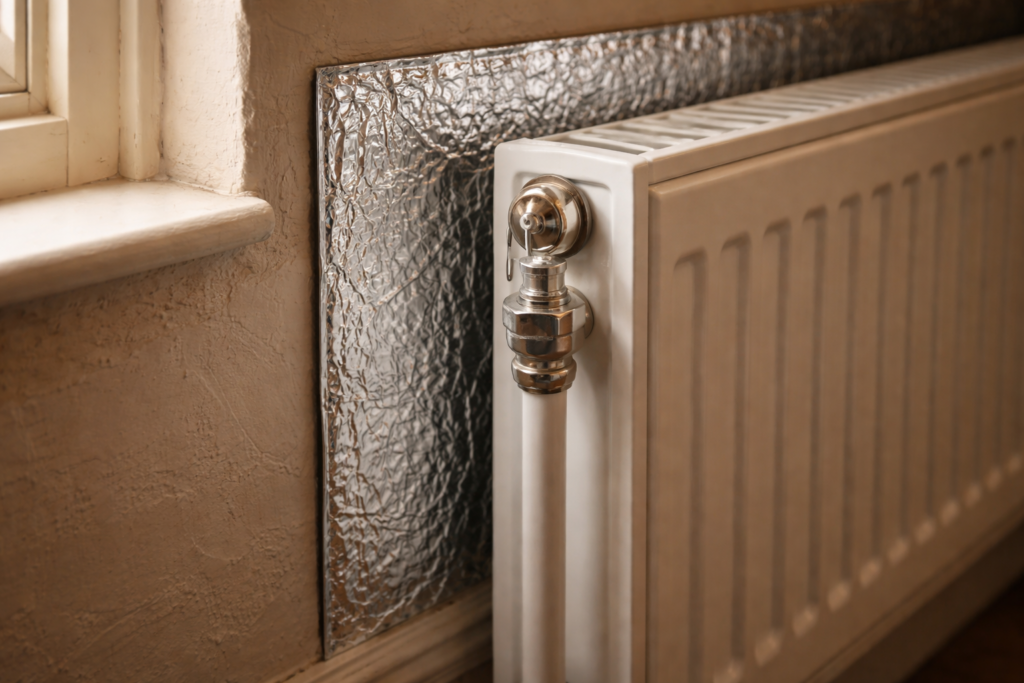
In any room where a radiator sits against an external wall — which in most UK homes means most rooms — a significant proportion of the heat produced goes directly into that wall rather than into the room. The wall absorbs it, and it’s gone. Reflective radiator panels are thin foil-backed insulating sheets that fit in the gap between the radiator and the wall, redirecting that heat back into the room instead of letting it disappear.
I fitted them in three rooms of our house last winter — the living room, the hallway, and the back bedroom, all of which have radiators on external walls. The fitting process for all three took under half an hour total. No tools needed beyond scissors. The panels cost a few pounds per radiator and the effect is one of those things that’s difficult to quantify precisely but clearly present — rooms reaching temperature faster, staying warmer for longer after the heating goes off. If you want to go further than panels alone, radiator foil versus thermal curtains puts both options head to head with some results that are worth knowing before you decide where to spend first.
In a stone-built or solid-wall older property the difference is more pronounced than in a cavity-wall modern home because the external walls absorb heat more aggressively. If you’ve got an older house and haven’t done this yet, it’s probably the highest-impact low-cost improvement you haven’t tried. A radiator booster fan is worth considering alongside the panels if you have a room that still struggles to warm up — it circulates the heat coming off the radiator more effectively around the room rather than letting it rise straight to the ceiling.
10. Make the Most of Free Passive Solar Heat
On a clear winter day, south-facing windows let in a surprising amount of passive solar heat — enough to raise the temperature of a room by several degrees if the curtains are open and nothing is blocking the glass.
Open curtains wide on sunny winter mornings, particularly on south and west-facing windows. Clean glass transmits significantly more heat than dirty glass — worth knowing if the windows haven’t been cleaned since October. A window vacuum cleaner makes keeping glass clean through winter significantly less effort than a cloth and bucket, and cleaner windows genuinely do let more heat in on the days when it matters. The moment the sun drops and the temperature outside falls below room temperature, close the curtains immediately to trap what’s been gained.
It costs nothing beyond the habit, and on a crisp clear January day it genuinely works. The honest caveat — living on the west coast of Scotland, those days are not exactly plentiful. But when they arrive, making use of them rather than leaving curtains half drawn is worth the small habit shift. On the days it works, the room is noticeably warmer by mid-morning without anything switched on.
A Few More Worth Knowing About
Two additions that didn’t quite make the main list but are worth a mention.
Insulating window film is worth considering for single-glazed windows in older properties. It’s a thin transparent layer that adds a modest but real insulating effect to glass that would otherwise be a significant cold source — more effective than curtains alone, less intrusive than secondary glazing, and removable if you rent.
A heated seat cushion for a desk chair or sofa is useful for anyone who finds a throw doesn’t quite reach the right place — it warms from underneath which is often exactly where the cold comes from when sitting still for long periods.
What I’d Actually Do First
Fix the draughts before anything else. Door excluders and window tape cost under £20 combined, require no installation, and make every other tip on this list more effective by stopping heat from escaping as fast as it’s produced.
After that: heated throw for evenings, thermal curtains or liners, and a decent base layer for around the house. That combination costs under £100 for most households and changes how warm the house feels through winter without touching the thermostat once.
The hot water bottle in the bed every night. The reflective panels behind the radiators. These two cost almost nothing between them and deliver a disproportionate return for the effort involved.
Start with the draughts. The rest follows naturally.
FAQ
Will these tips actually make a difference to my energy bill?
Yes, meaningfully — but the impact varies by tip. Draught proofing and switching to a heated throw for evening use make the biggest measurable difference to the bill. Layering and the hot water bottle cost nothing and improve comfort immediately without directly affecting the meter.
Are heated throws safe to leave on overnight?
Most modern heated throws have auto shut-off timers — typically one to three hours — which makes them safe for use while falling asleep. For sleeping with one switched on throughout the night, a heated blanket designed specifically for in-bed use is the better option. Check the product specifications before buying if overnight use is the intention.
Do thermal curtains actually work or are they overhyped?
They work, particularly in rooms with large windows or single glazing. The difference is most noticeable in older properties where windows are a major source of heat loss. In a well-insulated modern home the effect is smaller but still present — and thermal curtain liners on existing curtains are cheap enough that it’s worth trying before committing to replacing anything.
How much does a heated throw cost to run?
At 24p per kWh, a 200W heated throw on a medium setting costs around 5 pence per hour. A higher wattage model on full power might reach 15 to 20 pence per hour. Either way it’s significantly less than central heating covering the same room.
Is reflective radiator foil worth fitting?
Yes — particularly in any room where the radiator sits against an external wall, which covers most rooms in most UK homes. It costs a few pounds per radiator, takes minutes to fit, and redirects heat that would otherwise be absorbed by the wall back into the room. Worth doing once and then forgetting about entirely.
What’s the most effective tip for a cold rented property?
Draught proofing first — foam tape and a door excluder are both removable and leave no trace, so they’re suitable for any rental. After that, a heated throw and thermal curtain liners, both of which require no permanent changes. Those three together make a meaningful difference without risking a deposit.
Do rugs actually help with warmth or is it more of a comfort thing?
Both, genuinely. The insulating effect on heat loss is real but modest. The bigger benefit is that a warm floor surface stops cold from conducting upward into the room, which improves how warm the space feels even when the thermometer hasn’t moved. In an older property with bare floorboards the difference is more pronounced than in a modern home with underfloor insulation.
How long do reflective radiator panels take to fit?
Under ten minutes per radiator with no tools required — just scissors to cut the panel to size. The panels slide into the gap between the radiator and the wall. Most kits include enough material for two to three radiators and cost under £15.
Related Guides

About The Author – Andrew Marshall
Andrew Marshall is a Scottish homeowner and the creator of Save Wise Living. He shares practical ways to reduce energy bills, improve home efficiency, and make everyday household routines cheaper and simpler.