
Heating an entire house just to warm one room can feel wasteful — especially with UK energy prices still high. Many households now focus on keeping a bedroom, living room, or home office comfortable while leaving the rest of the house cooler. But is heating one room actually cheaper, and which method costs the least to run?
In this guide, we compare the real running costs of the most common options, from central heating to portable electric heaters and heated blankets, so you can make a smart choice for your home and budget. This article is part of our Smart Heating & Home Warmth hub, where we share practical UK advice on staying warm, reducing heat loss, and cutting heating bills without expensive upgrades.
👉 In This Guide
Quick Answer: Cheapest Ways to Heat One Room
For most UK homes:
- Cheapest overall: Heated blankets or throws
- Best balance of comfort and cost: Oil-filled radiators
- Fastest heat (but expensive): Fan heaters
- Most efficient long sessions: Low-wattage smart heaters
Typical UK Energy Price Assumption
To keep comparisons realistic, this guide uses an electricity price of around 29p per kWh, which is typical under current UK price caps.
Actual costs will vary slightly depending on your tariff and region, but these estimates are close enough for real-world decisions.
Gas central heating costs vary widely by boiler efficiency and home size, so figures below reflect typical conditions rather than ideal ones.
Heating Options Compared (Real Running Costs)
Central Heating (Whole System On)
- Typical output: 8–24 kW boiler heating multiple radiators
- Approx cost: £0.80–£1.80 per hour (whole system)
Strengths
- Even warmth throughout the home
- Prevents damp and cold spots
- Comfortable long-term heating
Weaknesses
- Inefficient if you only need one room
- Slow to heat up
- Heats unused spaces
Best for: Homes where multiple rooms are occupied or insulation is poor.
If you’re unsure how to fine-tune system settings, this guide on How to Use Your Thermostat Properly in the UK (And Stop Wasting Heating Money) explains how small adjustments can reduce costs significantly without sacrificing comfort.
Oil-Filled Radiator
- Typical wattage: 1,500–2,000 W
- Approx cost: £0.43–£0.58 per hour
Strengths
- Retains heat after switching off
- Quiet and stable
- Comfortable background warmth
Weaknesses
- Slower to warm up
- Not ideal for instant heat
Best for: Bedrooms, living rooms, overnight heating.
A quality oil-filled radiator is often the most economical traditional heater for long sessions.
Fan Heater
- Typical wattage: 2,000–3,000 W
- Approx cost: £0.58–£0.87 per hour
Strengths
- Very fast heat
- Compact
- Cheap to buy
Weaknesses
- Expensive to run
- No heat retention
- Can be noisy
Best for: Short bursts of heat, cold mornings, bathrooms.
A fan heater is convenient but rarely the cheapest option for extended use.
Panel / Convector Heater
- Typical wattage: 1,000–2,000 W
- Approx cost: £0.29–£0.58 per hour
Strengths
- Slim wall-friendly design
- Even heat distribution
- Silent operation
Weaknesses
- No heat storage
- Less cosy than radiators
Best for: Home offices and small living areas.
An electric panel heater works well where space is limited.
Electric Fire
- Typical wattage: 1,000–2,000 W
- Approx cost: £0.29–£0.58 per hour
Strengths
- Visual “fireplace” effect
- Quick heat
- Comfortable for sitting areas
Weaknesses
- Mostly directional heat
- Decorative models may waste energy
Best for: Living rooms where ambience matters.
Heated Blanket or Electric Throw
- Typical wattage: 50–150 W
- Approx cost: £0.01–£0.04 per hour
Strengths
- Extremely cheap to run
- Direct warmth to the body
- Ideal for sedentary activities
Weaknesses
- Doesn’t heat the room
- Not suitable for movement
Best for: Watching TV, reading, desk work.
An electric throw blanket can be up to 30–50× cheaper than running a room heater.
Low-Wattage Smart Heater
- Typical wattage: 400–800 W
- Approx cost: £0.12–£0.23 per hour
Strengths
- Energy-efficient
- Smart scheduling and thermostats
- Designed for small spaces
Weaknesses
- Slower heat output
- Limited coverage area
Best for: Offices, bedrooms, small insulated rooms.
Modern low-wattage space heater models are designed specifically for single-room efficiency. This guide to Best Smart Heaters for Small Rooms (Low-Wattage Options UK) explains how they work and when they outperform larger heaters.
Daily & Weekly Cost Examples
Scenario 1 — Bedroom Heated 5 Hours Each Evening
- Oil-filled radiator: ~£2.15–£2.90 per night
- Fan heater: ~£2.90–£4.35 per night
- Electric throw only: ~£0.05–£0.20 per night
Weekly cost
- Radiator: £15–£20
- Fan heater: £20–£30
- Electric throw: Under £1
Scenario 2 — Working From Home All Day (8 Hours)
- Panel heater (1.5 kW): ~£3.50 per day
- Oil-filled radiator: ~£3.50–£4.60 per day
- Low-wattage heater: ~£1–£2 per day
Scenario 3 — Overnight Heating (8 Hours)
- Oil-filled radiator: £3.50–£4.60 per night
- Low-wattage heater: £1–£2 per night
- Heated blanket only: £0.08–£0.30 per night
For sleeping comfort without overheating the room, many households combine low room heating with an electric blanket.
💡 Is It Cheaper to Heat One Room or the Whole House?
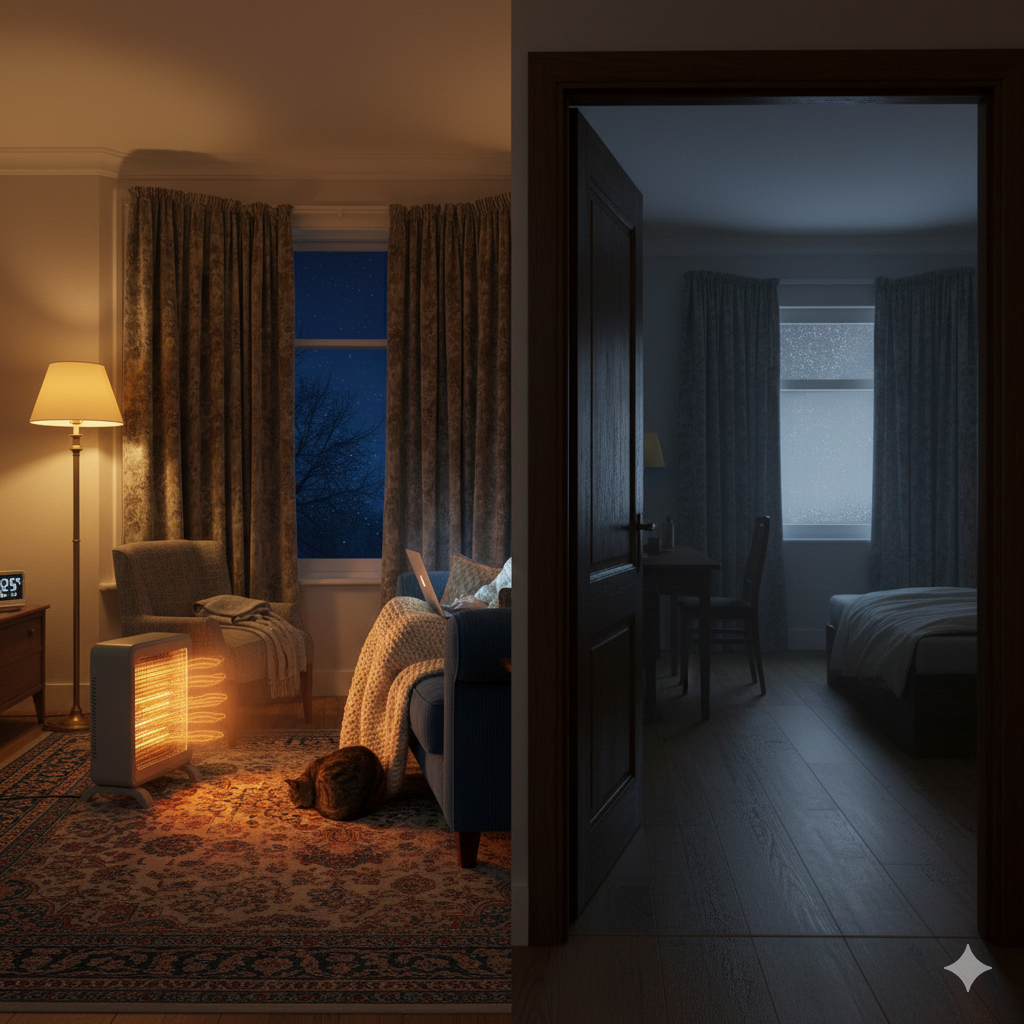
In some homes, heating just one room saves a lot of money — but not always. Central heating systems are designed to distribute heat efficiently, so running the boiler for only one room may still heat pipes, hallways, and adjacent spaces. If your home has poor insulation or open-plan layouts, heat can quickly escape, meaning your heater works harder and runs longer.
Single-room heating tends to be cheapest when:
- The room has a door that can be closed
- Windows and draughts are well sealed
- The room is used for long periods (home office, bedroom)
- You use a low-wattage heater or heated blanket
However, if multiple rooms need heating or your home loses heat quickly, running central heating at a moderate temperature can sometimes be more efficient overall. The key is matching the heating method to how your home actually retains warmth, not just choosing the lowest-power device.
When Heating One Room Is NOT Cheaper
Single-room heating isn’t always the money-saving solution people expect.
Poor Insulation
If walls, windows, or floors lose heat quickly, the heater will run constantly, wiping out savings.
Open-Plan Homes
Large connected spaces allow heat to escape into unused areas.
Central Heating Inefficiencies
Some systems struggle to heat only one radiator efficiently without rebalancing.
Risk of Damp and Condensation
Unheated rooms can become cold and humid, leading to mould growth and long-term damage.
In very cold homes, maintaining low background heat throughout the property can sometimes cost less than repeatedly reheating a single cold room.
How to Keep Heat Inside That Room
Reducing heat loss is often cheaper than upgrading your heater.
Close doors firmly
Stops warm air escaping to cooler areas.
Seal draughts
Door snakes, seals, and letterbox covers help immediately.
Use curtains or blinds at night
Windows are major heat loss points.
Position the heater correctly
Avoid placing it behind furniture or in direct drafts.
Maintain a steady temperature
Constant low heat is often cheaper than repeated full warm-ups.
Author Insight
Many UK homes — especially older ones — aren’t designed for zoned heating, which is why single-room heating has become so common during colder months. In practice, the biggest savings usually come from combining a modest heat source with simple heat-retention steps like closing doors, blocking draughts, and keeping temperatures steady rather than blasting heat intermittently. Small behavioural changes often make as much difference as the heater itself.
Final Recommendation: What Most UK Homes Should Do
For the majority of households trying to cut heating costs:
- Use central heating only when multiple rooms are occupied
- For single rooms, choose an oil-filled or low-wattage heater
- Add an electric blanket for ultra-cheap personal warmth
- Focus on reducing heat loss first
Heating the person rather than the entire space is usually the biggest money saver.
Related Heating Guides
If you’re trying to stay warm without overspending, the way you heat your home matters just as much as how much heat you use. These guides explore the cheapest ways to heat different spaces, fix cold rooms that never seem to warm up, and stop heat escaping through common problem areas — helping you build a warmer, more efficient home overall.

About The Author – Andrew Marshall
Andrew Marshall is a Scottish homeowner and the creator of Save Wise Living. He shares practical ways to reduce energy bills, improve home efficiency, and make everyday household routines cheaper and simpler.