
(A Proper UK Winter Method That Actually Works)
Let’s be honest — towels are the hardest thing to dry indoors.
Not jeans. Not hoodies. Towels.
You wash them, hang them up, wait what feels like forever… and then somehow they still smell faintly damp once folded. Even worse, the smell often appears after you’ve put them away or used them again, which makes it feel like you imagined it.
You didn’t.
That smell is the result of slow drying in damp UK air, not poor hygiene or bad detergent. And the fix isn’t blasting the heating or buying a tumble dryer — it’s changing how towels dry indoors.
This article gives you a slightly different, more realistic approach — one that works in small UK homes, flats, and winter conditions without turning your living space into a sauna.
This article is part of our Laundry & Drying Efficiency hub, focused on practical UK advice for drying clothes indoors faster, avoiding damp, and keeping energy use low.
🧠 Author Insight
For a long time, I assumed that musty towels were just part of winter living in the UK — something you tolerated unless you used a tumble dryer. What surprised me most when researching and testing this properly was how little heat actually mattered. Once I focused on airflow and where the moisture was going, towels started drying faster and smelling fresher almost immediately. It completely changed how I think about indoor drying — and it’s one of those small home tweaks that quietly makes everyday life less frustrating.
Why Towels Are So Prone to Smelling (More Than Clothes)
Towels are designed to hold water, not release it.
Compared to clothes, they:
- Are much thicker
- Trap moisture deep in the fibres
- Dry unevenly when folded
- Stay “warm-damp” for longer
That last part is the killer.
When towels sit damp for too long, bacteria multiply before drying finishes. The towel may feel dry on the surface, but moisture remains inside — and that’s where the musty smell is born.
In UK winter conditions, this usually happens because:
- Indoor humidity is already high
- Airflow is poor
- Towels are folded or bunched
- Drying takes longer than a day
So the goal isn’t just “drying” — it’s drying fast enough.
The One Rule That Solves 80% of the Problem
Towels must fully dry within 24 hours.
If they don’t, there’s a high chance they’ll smell — even if they look fine.
Everything in this guide is built around achieving that, without relying on constant heat.
Step 1: Win the Battle Before Towels Even Leave the Machine
If towels come out of the wash heavy and water-logged, you’re already behind.
Do this instead:
- Use the highest safe spin speed (1200–1400rpm is fine for towels)
- Avoid overloading the drum
- Skip quick or eco cycles for towel loads in winter
Removing more water at this stage dramatically shortens drying time indoors.
Step 2: Stop Folding Towels Over Rails (This Traps Moisture)
This is the most common mistake — and it’s understandable.
But when you fold a towel over a rail:
- The centre never gets proper airflow
- Moisture gets trapped
- Drying time doubles
Better approach:
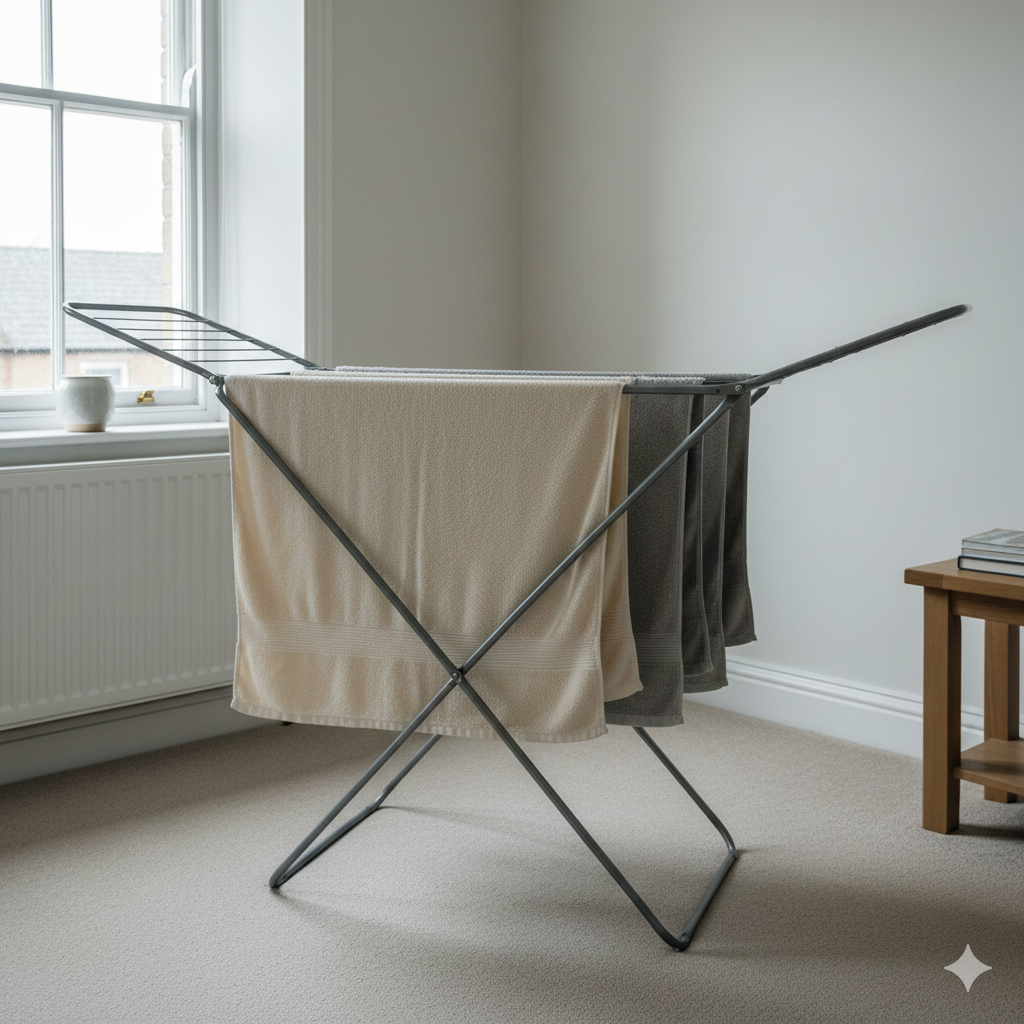
- Hang towels fully open
- Use multiple rails if needed
- Drape evenly rather than neatly
If space is tight, hanging diagonally is still better than folding.
Step 3: Create a “Dry Zone” Instead of Drying Everywhere
Randomly placing an airer in the house rarely works well.
What you want is one controlled drying space, even if it’s small.
The key ingredients:
- Somewhere you can manage airflow
- Somewhere you can control moisture
- Not a bedroom, if possible
Living rooms, bathrooms with extractors, or utility areas usually work best.
The Missing Piece in Most UK Homes: Moisture Control
Here’s the uncomfortable truth:
If the air in the room is already damp, towels can’t dry properly — no matter how warm it is.
This is why radiators alone often fail.
To dry towels indoors without smells, you need:
- Air moving past the towels
- Moisture being removed from the room, not just redistributed
That’s where the right tools make a real difference.
Recommended Products (Amazon UK Only)
These aren’t gimmicks — they’re practical tools that solve the actual problem.
🧺 Airer Option 1: Minky SureGrip 3-Tier Indoor Airer
This is a strong choice if you want:
- Plenty of space for thick towels
- Good airflow between rails
- No noise, no running costs
Because towels can be spread wide across multiple tiers, drying is faster and more even — especially when paired with airflow or a dehumidifier.
Why it works well for towels:
Wide spacing + vertical airflow = less moisture trapped in the fabric.
🧺 Airer Option 2: Status Heated Clothes Airer
If winter drying is a constant frustration, a heated airer can help — when used properly.
This model:
- Gently warms towels (not hot)
- Uses far less energy than a tumble dryer
- Speeds up evaporation when the air is dry
Best used with ventilation or a dehumidifier, not sealed in a room.
Think of it as a helper, not the whole solution.
🌬️ Dehumidifier Pick: Meaco Arete One 10L Dehumidifier
This is the game-changer for indoor towel drying.
Used in the same room as your airer, it:
- Pulls moisture out of the air
- Allows towels to release water faster
- Reduces condensation and damp at the same time
It’s quiet, efficient, and well-suited to typical UK rooms rather than huge spaces.
This is often what turns “two-day drying” into overnight drying.
How to Set It Up (Simple, No Overthinking)
You don’t need a complicated system or loads of gadgets — just a deliberate setup that lets towels dry properly instead of slowly stewing in damp air.
Start by choosing one room and committing to it. Drying towels across multiple rooms usually spreads moisture around your home rather than removing it.
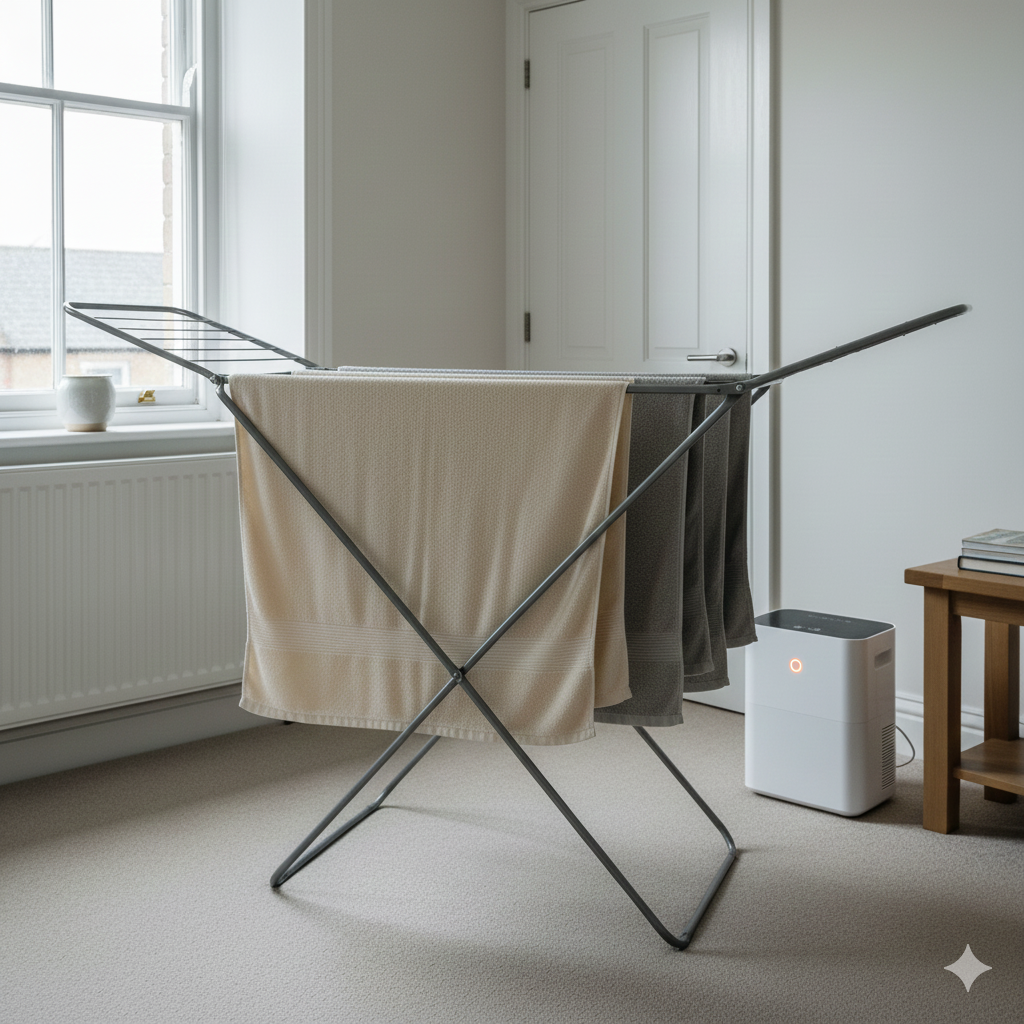
1. Place the airer centrally in the room
Avoid pushing the airer against walls, radiators, or furniture. Towels need airflow on both sides, not just the front. Even a few inches of space around the airer makes a noticeable difference to drying time.
2. Hang towels fully open, not touching
This part matters more than it sounds. Towels should be:
- Fully unfolded
- Draped evenly
- Not overlapping other towels
When towels touch or overlap, moisture gets trapped between layers and slows drying dramatically — especially in the middle of the fabric where smells usually start.
3. Position the dehumidifier nearby (but don’t block it)
Place the dehumidifier in the same room, ideally a short distance from the airer. It shouldn’t be tucked behind the rack or shoved into a corner — it needs space to pull in damp air effectively.
Think of it as clearing the air around the towels, not drying the towels directly.
4. Close the door to that room
This step is often skipped, but it’s key. Closing the door:
- Stops moist air spreading around your home
- Allows the dehumidifier to work efficiently
- Speeds up drying overall
You’re creating a small, controlled drying zone rather than trying to dry towels in the whole house at once.
5. Optional: add gentle airflow with a fan
If towels are still slow to dry, a small fan on a low setting can help. Aim it so air moves past the towels rather than blasting straight at them. This encourages evaporation without cooling the room or making towels stiff.
What This Setup Actually Does
Used together, this approach creates a mini indoor drying environment where:
- Moist air is constantly removed
- Drier air replaces it naturally
- Towels dry evenly — including deep inside the fibres
That’s what stops musty smells forming in the first place.
Washing Habits That Can Sabotage Drying (Even With the Right Setup)
Fabric Softener Is Not Towel-Friendly
It coats fibres and traps bacteria.
If towels smell easily, try:
- Skipping softener entirely
- Using white vinegar in the rinse occasionally
Cold Washes All the Time
Eco washes are great — but towels need a hot wash now and then.
Aim for:
- 60°C every few weeks
- Especially for bath towels and gym towels
This kills lingering bacteria that cause recurring smells.
If Towels Already Smell: How to Fix Them
To reset musty towels:
- Wash at 60°C
- Skip detergent once
- Add white vinegar to the rinse
- Dry using airflow + moisture control
This usually removes the smell completely.
🔌 Laundry Choices & Moisture Control
If you’re weighing up different drying options or still struggling with smells after drying, these guides continue the same theme:
- Are Washer-Dryer Combos Worth It for Energy Savings in Small UK Homes?
A realistic look at whether all-in-one machines actually save money — or just trade convenience for higher running costs. - Why Clothes Smell After Being Put Away (UK Wardrobe Moisture Explained)
Explains why laundry can smell after drying, and how trapped moisture in storage spaces quietly causes the problem.
The Real UK Winter Takeaway
Drying towels indoors isn’t about luck, better detergent, or cranking the heating.
It’s about:
- Speed
- Airflow
- Moisture removal
Once towels dry fully within 24 hours, the musty smell stops appearing — even in cold, damp UK winters.
Get the setup right once, and indoor towel drying stops being one of those annoying household battles you keep losing.
💨 Want to dry clothes faster, cheaper, and smarter—especially in small UK homes?
Explore our Laundry & Drying Efficiency Hub, a curated resource packed with expert tips, energy-saving gadgets, and clever solutions for indoor drying. From heated airers and compact dehumidifiers to smart laundry routines that actually work, this hub helps you cut costs, save space, and stay ahead of the damp.
For official, trusted UK advice on reducing energy use, the Energy Saving Trust has clear, practical guidance on saving electricity at home.

About The Author – Andrew Marshall
Andrew Marshall is a Scottish homeowner and the creator of Save Wise Living. He shares practical ways to reduce energy bills, improve home efficiency, and make everyday household routines cheaper and simpler.