

Written by Andrew Marshall
Scottish homeowner sharing practical ways to reduce energy bills and improve everyday home efficiency.
If you cook most nights, you’ve probably wondered this at some point — usually while staring at a smart meter that seems to jump the second the hob goes on:
“How much is this actually costing me?”
Electric hobs are now the norm in many UK homes, especially in new builds and flats where gas isn’t available. But there’s a lot of confusion around what they really cost to run — particularly when people start throwing around figures without explaining tariffs, hob types, or how people actually cook.
This guide cuts through all of that.
No scare tactics.
No unrealistic “£££ per meal” claims.
Just clear UK-based numbers, real scenarios, and practical ways to keep costs down without changing how you cook.
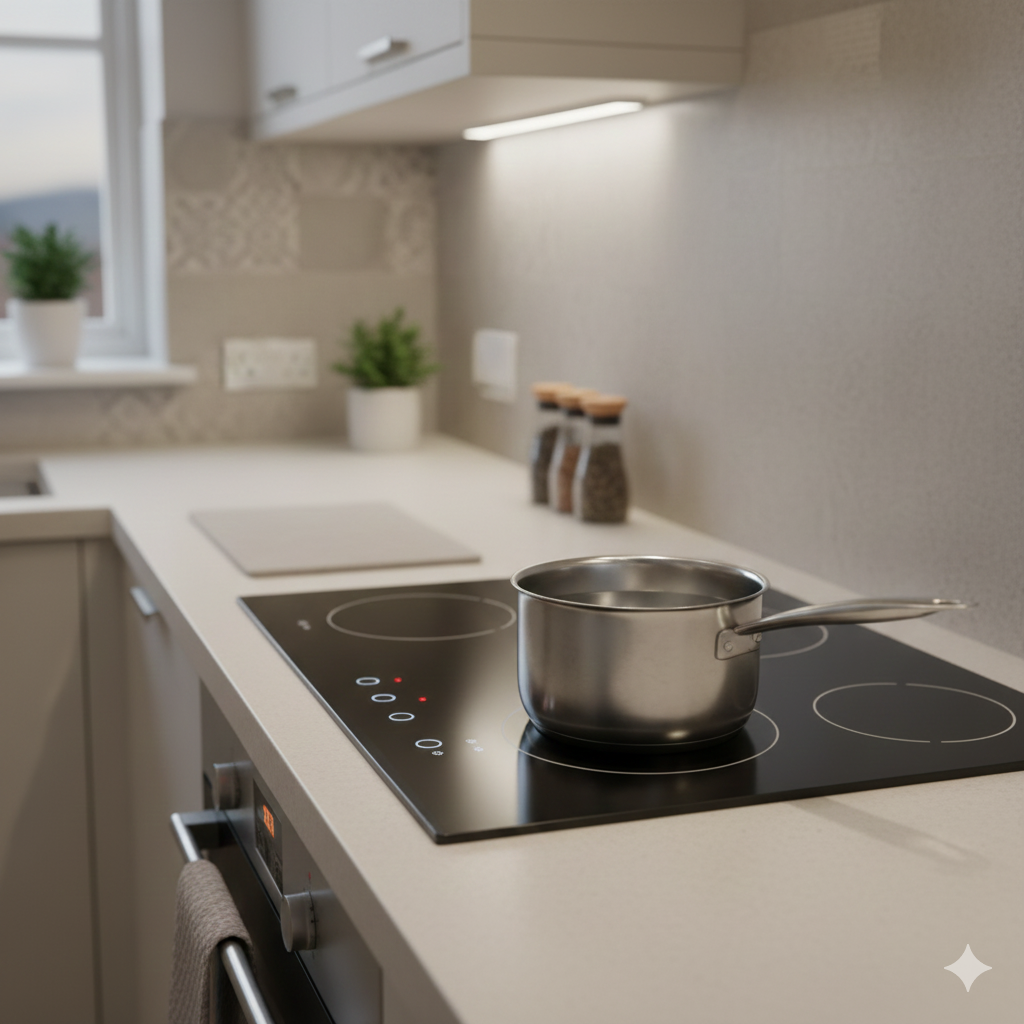
The short answer (for impatient readers)
- Electric hob cost per hour (UK average):
~30p to £1.00 per hour, depending on hob type, power level, and your electricity tariff. - Induction hobs are usually the cheapest to run per meal, even though their hourly power rating can look high.
- Old solid plate hobs are usually the most expensive and slowest.
- Your tariff and how you cook matter more than the headline wattage.
Now let’s break it down properly.
First: what kind of electric hob do you have?
Not all electric hobs behave the same, even if they look similar on the surface.
🔹 Solid Plate Hobs (older style)
- Heavy cast-iron plates
- Slow to heat, slow to cool
- Waste heat into the air
- Often found in older rentals
Running cost: highest
Efficiency: lowest
🔹 Ceramic Hobs (smooth glass surface)
- Heat elements under a glass top
- Faster than solid plates
- Still lose heat around the pan
Running cost: mid-range
Efficiency: decent, but not great
🔹 Induction Hobs (modern, magnetic)
- Heat the pan directly, not the surface
- Very fast heat-up
- Precise control
- Much less wasted heat
Running cost: lowest per cooked meal
Efficiency: highest
This distinction matters more than most people realise.
UK electricity prices (the reality check)
To make this article useful, we need a realistic baseline.
Most UK households are currently paying around 24–30p per kWh on standard tariffs (some more, some less). Smart and time-of-use tariffs can be cheaper or more expensive depending on the hour.
For simplicity, we’ll use 28p per kWh as a reference point and explain where things change.
How much power does an electric hob actually use?
Here’s where confusion usually starts.
An electric hob does not draw full power constantly. It cycles on and off to maintain heat.
Typical power ratings (per ring):
- Solid plate: 1.5–2.0 kW
- Ceramic zone: 1.2–2.2 kW
- Induction zone: 1.4–2.4 kW (but cycles efficiently)
Important:
That number is the maximum, not what it pulls continuously.
Cost per hour: realistic UK examples
Let’s translate this into money.
🔸 Solid plate hob (2.0 kW)
- 2.0 kWh × 28p = 56p per hour
- Often runs inefficiently → feels expensive
🔸 Ceramic hob (1.8 kW average)
- 1.8 kWh × 28p = ~50p per hour
- Moderate efficiency
🔸 Induction hob (1.6 kW effective use)
- 1.6 kWh × 28p = ~45p per hour
- Cooks faster, so total cost per meal is usually lower
This is why focusing only on “cost per hour” can be misleading.
✍️ Author Insight
When I first looked into electric hob costs, I expected the numbers to be either frightening or negligible — and the reality landed somewhere in between. What stood out wasn’t the cost per hour, but how easily small habits stack up over weeks and months without being noticed.
Most people don’t overspend because they cook too much — they overspend because they cook on autopilot. Once you understand what a ring actually costs to run, you naturally start switching off earlier, lowering heat sooner, and being more deliberate without even trying.
That awareness alone is often worth more than replacing the appliance.
Cost per meal (what people actually care about)
Most people don’t cook for an hour straight on full power.
Let’s look at real cooking scenarios.
🍝 Cooking pasta (10–12 minutes on high, then simmer)
- Solid plate: ~20–25p
- Ceramic: ~15–20p
- Induction: ~10–15p
🍳 Frying eggs or stir-fry (5–10 minutes)
- Solid plate: ~10–15p
- Ceramic: ~8–12p
- Induction: ~5–8p
🍲 Simmering a sauce (30 minutes on low)
- Solid plate: ~25–30p
- Ceramic: ~20p
- Induction: ~12–15p
Key insight:
Induction hobs win because they finish the job faster, not because electricity is magically cheaper.
Does time of day matter when using an electric hob?
On a standard flat-rate tariff
- No meaningful difference
- Cooking at 6pm costs the same as 10am
On Economy 7 or time-of-use tariffs
- Cooking during peak hours (often 4–7pm) can cost noticeably more
- If you batch cook or reheat later, you may benefit from cheaper periods
That said — don’t starve yourself for tariffs. Hob use is usually a small slice of total electricity compared to heating or hot water.
Why induction feels cheaper (even when numbers look similar)
People often say:
“My induction hob costs less to run.”
What they usually mean is:
- Water boils faster
- Pans respond instantly
- Less heat wasted into the room
- You turn it off sooner
That’s behavioural efficiency — and it matters.
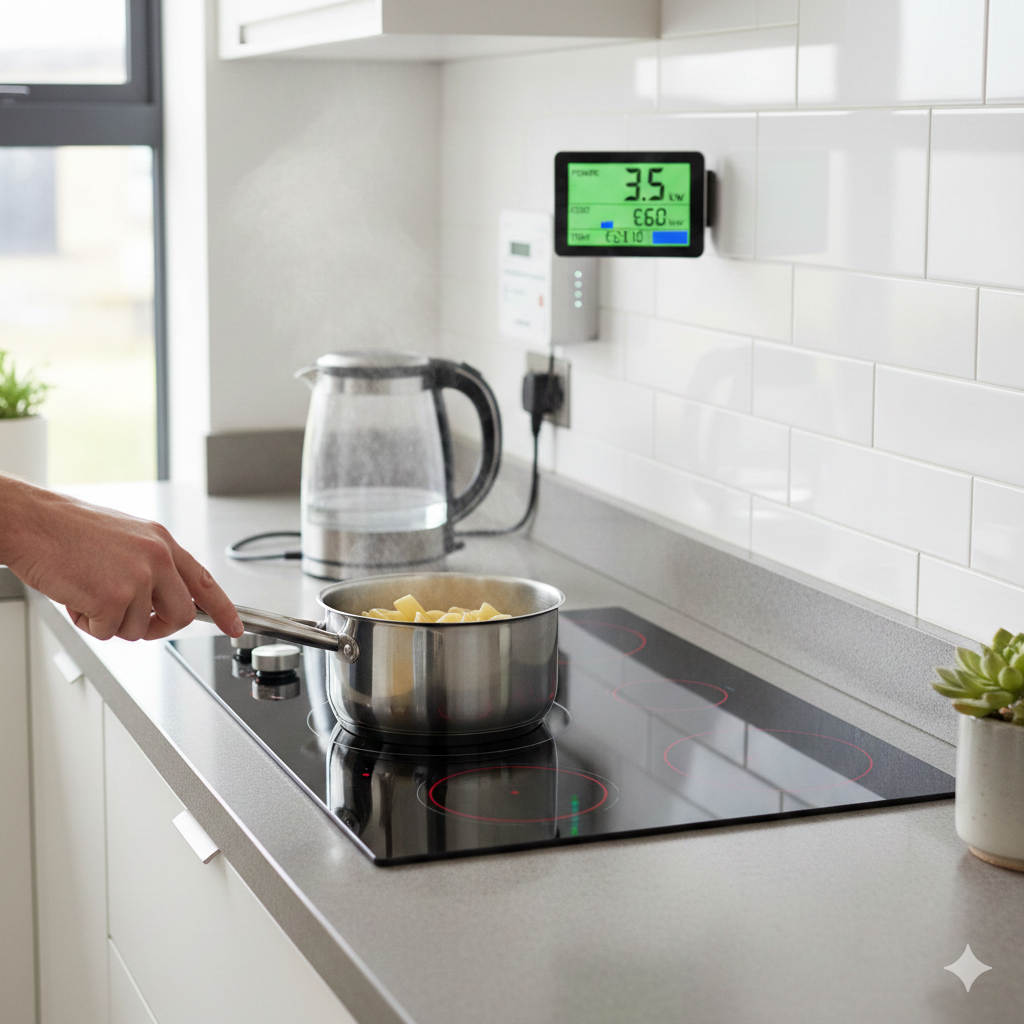
3 common myths that inflate fear around electric hobs
❌ “Electric hobs are insanely expensive”
They’re not. They’re predictable and usually cheaper than people expect.
❌ “Induction uses loads of power”
It uses power intensely, but for less time.
❌ “Gas is always cheaper”
Not anymore — and induction often beats gas when efficiency is factored in.
How to reduce electric hob running costs (without cooking differently)
These are boring — and they work.
- Use the right pan size for the zone
- Keep pan bases flat and clean
- Use lids whenever possible
- Turn heat down once boiling
- Avoid pre-heating empty pans longer than needed
None of this requires lifestyle changes.
Products worth mentioning (relevant, not gimmicky)
🔹 Induction Hob #1: Bosch Series 4 Induction Hob
Why it’s relevant:
- Excellent heat efficiency
- Precise power control
- Good balance between price and performance
Best for: households replacing ceramic or solid plate hobs.
🔹 Induction Hob #2: AEG Induction Hob with PowerBoost
Why it’s relevant:
- Very fast boiling times
- Efficient simmer control
- Helps reduce total “on time”
Best for: people who cook daily and want speed + control.
🔹 Extra: Flat-Base Induction Pan Set
Why it matters:
- Poor pans waste energy
- Good contact = faster cooking
- Often overlooked, but genuinely effective
Best for: anyone switching to induction for the first time.
🔁 Reduce Your Kitchen Energy Costs Further
If you’re looking to cut cooking and cleaning costs across your kitchen — not just the hob — these guides build perfectly on what you’ve learned here:
- Eco Mode vs Quick Wash: Which Dishwasher Setting Uses Less Electricity?
Understand why shorter cycles often cost more, and how Eco settings quietly reduce energy use without sacrificing performance. - Best Time of Day to Run a Dishwasher on UK Energy Tariffs
Learn how timing appliances around off-peak electricity can lower running costs, especially on Economy 7 and smart tariffs.
Together, these guides help you reduce kitchen energy bills by improving how, when, and why your appliances use electricity.
So… how much does an electric hob really cost?
So, how much does an electric hob really cost to run in the UK?
In simple terms, most electric hobs use 1.5–3kWh per hour, depending on the ring size and heat setting. At a typical UK electricity rate of around 28–30p per kWh, that means you’re usually spending 40p to 90p per hour of cooking — and sometimes more if you’re using multiple rings at full power.
That might not sound dramatic on its own, but it adds up quickly.
If you use an electric hob for:
- 30 minutes a day → roughly £6–£14 per month
- 1 hour a day → roughly £12–£27 per month
- Heavy cooking households can easily push beyond £300 per year just on hob usage
The biggest mistake most households make isn’t choosing the “wrong” hob — it’s using more heat than necessary, leaving rings on longer than needed, and cooking during peak-rate periods without realising it.
The good news is that you don’t need to stop cooking properly to save money. Simple habits — like matching pan size to ring size, using lids, switching off early to use residual heat, and avoiding unnecessary peak-time cooking — make a measurable difference over a year.
And if your current hob is older or inefficient, upgrading to a modern induction model can cut cooking costs noticeably while also being faster and more controllable.
Electric hobs aren’t a hidden disaster for your bills — but used carelessly, they quietly drain money in the background. Used smartly, they’re predictable, manageable, and far cheaper than most people assume.
Cook smarter and cut everyday kitchen costs with our Smart Kitchen & Appliances Hub your guide to energy-efficient gadgets, smarter cooking habits, and affordable ways to upgrade your home. Explore simple tips, low-energy tools, and practical UK advice that actually saves money.
For accurate UK energy information straight from the regulator, Ofgem provides clear explanations on tariffs, prices, and consumer rights. https://www.ofgem.gov.uk/
About The Author – Andrew Marshall
Andrew Marshall is a Scottish homeowner and the creator of Save Wise Living. He shares practical ways to reduce energy bills, improve home efficiency, and make everyday household routines cheaper and simpler.