
Last Updated: 23rd March 2026
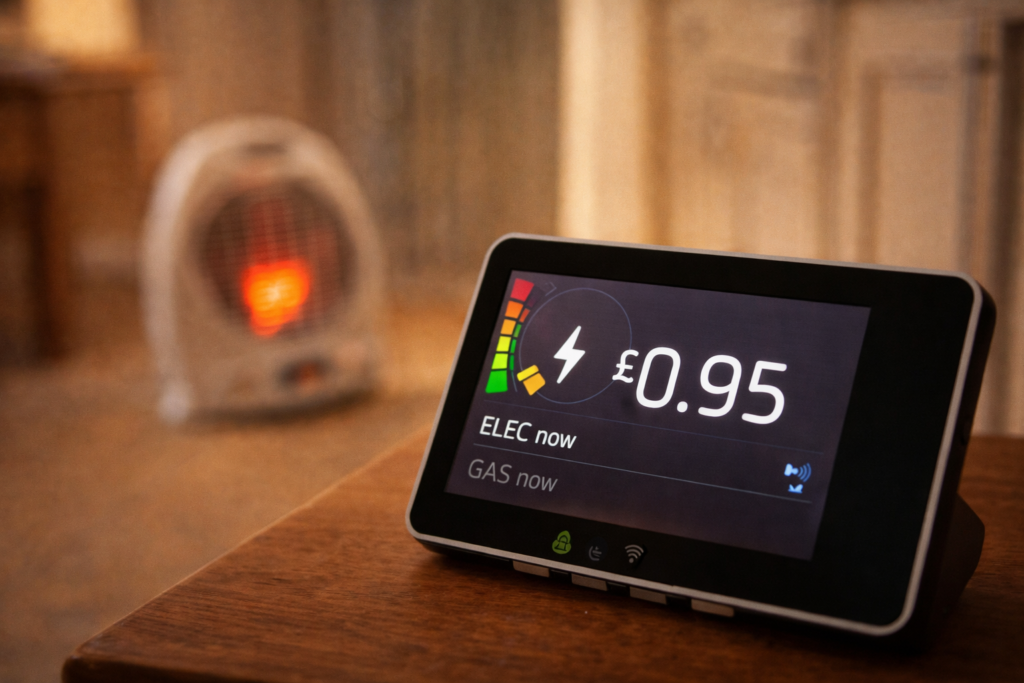
The heating bill that landed in February was the one that finally made me think properly about this. We’d had a fan heater running in the front room most evenings — not all night, just a few hours — and the meter told a story I wasn’t expecting. It wasn’t catastrophic, but it was enough to make me start questioning whether the way we were heating that room was actually the smartest option available. If you’re working through the same question, the smart heating and home warmth section of the site covers the broader picture — thermostatic valves, draught proofing, and everything in between.
How Each One Actually Works
The difference between a smart heater and a fan heater isn’t just about features — it’s about how they draw power.
A fan heater runs at full rated wattage from the moment you switch it on until the moment you switch it off. There’s no thermostat cutting in when the room reaches temperature, no sensor checking whether anyone’s still in the room. A 2,000W fan heater draws 2,000W continuously — every minute it’s on, it’s consuming at full power. If you’ve ever wondered what that actually costs per hour to run, the numbers are more uncomfortable than most people expect.
A smart heater works differently. It uses a built-in thermostat to reach a target temperature and then cycles on and off to maintain it rather than running constantly. Add motion detection — which most decent smart heaters have — and it cuts power automatically when the room empties. The result is a heater rated at 1,500W that rarely draws anywhere near that for a full session. That gap between rated wattage and actual draw is where the saving comes from.
In an old house like mine, where rooms lose heat faster than a modern new-build, the thermostat behaviour makes a particularly noticeable difference. The heater works harder initially and then settles into a rhythm — rather than running flat out all evening regardless of what the room actually needs. On a cold January night with the wind coming off the Clyde, that difference shows up on the meter in a way you don’t forget.
What the Running Costs Actually Look Like
At 24p per kWh the numbers are straightforward enough to run.
A 2,000W fan heater running for three hours each evening uses 6 kWh per day. Over a 30-day month that’s 180 kWh — roughly £43 at current rates. That assumes you switch it off after three hours, which in practice many people don’t.
A smart heater covering the same room for the same period, cycling to maintain temperature rather than running at full draw, uses closer to 3.5 kWh per day. Over the same month that’s around £25. The saving of roughly £18 per month from one room adds up to over £100 across a heating season — and that’s a conservative estimate that doesn’t account for the times a fan heater gets left running in an empty room.
The caveat worth being honest about: that saving assumes the smart heater is set up properly — scheduled to match when you’re actually in the room, with the thermostat at a sensible temperature rather than cranked to maximum. A smart heater used lazily will still outperform a fan heater, but the gap narrows.
Where Fan Heaters Still Earn Their Place
It would be easy to dismiss fan heaters entirely after those numbers, but that’s not quite the full picture.
For quick heat in a small space — a bathroom before a shower, a home office you’re in for an hour, a room you need warm in ten minutes — a fan heater is faster than a panel heater or oil-filled radiator. The airflow heats the space rapidly in a way that slower-warming alternatives can’t match. If your use case is genuinely short bursts of warmth in a small space, a fan heater is a reasonable and inexpensive tool.
The noise is the other side of that. Fan heaters are loud — typically 50 to 70 dB at full power, which is noticeable in a quiet living room or bedroom. Smart heaters, particularly ceramic panel models, run at 24 to 40 dB — background level, or silent entirely. We stopped noticing the constant hum in our front room about a week after switching, which sounds like a small thing until you realise how much it had been quietly grinding in the background every evening.
For renters who can’t mount anything to walls, portable fan heaters or freestanding smart heaters are both practical options — there’s a decent rundown of portable heaters worth considering if that’s the direction you’re going. The TCP panel heater requires wall fixings — worth checking with your landlord before ordering. The Philips and Pro Breeze are freestanding and need no installation at all.
Older Properties — What the Guides Don’t Usually Mention
Most smart heater vs fan heater comparisons are written with modern new-builds in mind. If you’re in an older property — a Victorian terrace, a stone-built semi, a pre-war house with solid walls — the picture is slightly different and worth addressing directly.
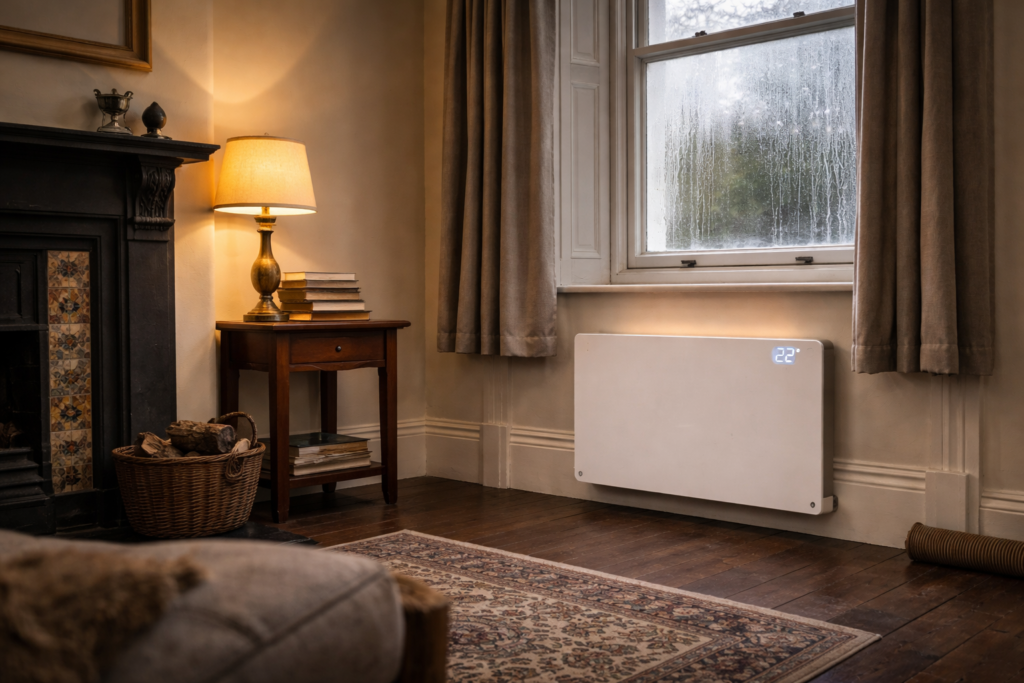
Older homes lose heat through walls, floors, and windows at a rate that newer builds simply don’t. A fan heater in a period property isn’t just inefficient because of how it draws power — it’s fighting a room that’s actively working against it. The heat produced escapes faster than in a well-insulated modern home, which means you end up running it longer and harder to feel the same result.
Smart heaters help here specifically because the thermostat responds to actual room temperature rather than running on a timer. In a room that loses heat quickly, that responsiveness means the heater tops up more frequently but in shorter bursts — which is more efficient than a fan heater running continuously and still losing the battle against cold walls.
That said, no heater fully compensates for a poorly insulated room. In our house, adding door draught excluders to the front room door and putting up heavier curtains made a more immediate difference to how warm the room felt than switching heaters did. The heater choice matters — but the room itself matters more than most people account for when they’re shopping.
The Habits That Cost More Than the Heater Itself
The heater choice matters, but the habits around it often make a bigger difference to the bill than the equipment itself.
I left our fan heater running in the front room for the better part of an hour one evening last winter while we’d all migrated to the kitchen. Came back to a room that was genuinely too warm and a meter that had been ticking away the whole time. It’s an easy thing to do and an expensive one — and it’s exactly the kind of thing a motion sensor quietly prevents without you having to think about it.
Smart heaters with motion detection cut power automatically when the room empties and resume when you walk back in. Over a full winter that behaviour alone accounts for a significant portion of the energy saving — more than most people realise when they’re comparing wattage figures on a spec sheet.
Draught excluders at the base of doors and thermal curtains across windows cost very little and make a measurable difference to how long a room holds heat once it’s warm. Reflective radiator foil behind radiators in older homes redirects heat back into the room rather than letting it disappear into the wall — particularly worth considering in any pre-1980s property. If draughts are a consistent problem rather than an occasional one, sealing gaps around floors and skirting boards is one of the cheapest fixes most people overlook entirely.
Running a 2,000W heater in a small room is also more common than it should be. A 10m² bedroom doesn’t need 2,000W — it needs the right temperature maintained consistently, which is exactly what a thermostat provides and a basic fan heater can’t.
Which Products Are Worth Considering
If you’ve worked through the comparison and a smart heater is the right direction, these are the three worth looking at across different budgets and room types.
Philips 3000 Series Smart Heater
Best for: living rooms, bedrooms, and anyone who wants quiet reliable operation
The Philips 3000 Series smart heater is the pick for most rooms — AI-assisted temperature control, genuinely quiet at 24 dB, and app scheduling that works reliably without fuss. It’s the one I’d point most people towards without hesitation. The upfront cost is higher than a basic fan heater but a single heating season of evening use covers that difference comfortably.
One honest caveat: it takes slightly longer to bring a very cold room up to temperature than a full-power fan heater. If your room regularly drops very low overnight, set the schedule to kick in a little earlier than you think you need.
TCP Ceramic Panel Smart Heater
Best for: homes already running Alexa or Google Home, permanent room installations
The TCP ceramic panel heater suits homes already in the Alexa or Google ecosystem — wall-mounted, motion detection built in, and it slots into an existing smart setup without friction. The slim profile keeps the floor clear in smaller rooms and the auto shut-off means it’s genuinely set-and-forget once you’ve dialled in your schedule. Requires wall fixings — check with your landlord if you rent.
Pro Breeze Ceramic 2000W Fan Heater
Best for: bathrooms, small rooms, short bursts of quick warmth
The Pro Breeze ceramic 2000W fan heater is compact, straightforward, and does exactly what it says. Tip-over protection, simple controls, heats a small space fast. Use it for defined short bursts rather than background heating and it earns its place without running up the bill.
A Couple of Useful Additions
A programmable plug-in timer alongside any heater adds an extra layer of scheduling control if the built-in app feels like more setup than you want. A room thermometer hygrometer is also worth having — knowing the actual temperature rather than guessing helps you set the thermostat correctly from the start rather than adjusting it by feel for a week.
The Honest Verdict
For regular evening heating in a living room or bedroom through a UK winter, a smart heater wins — not marginally, but clearly. The thermostat behaviour, motion detection, and scheduling between them mean it costs significantly less to run over a season than a fan heater left to its own devices. The noise difference alone improves the room in ways that are hard to put a number on but very easy to notice.
Fan heaters aren’t useless — they’re just the wrong tool when used as primary heating. Quick bursts in small spaces, occasional backup warmth, rooms you’re in briefly — that’s where they make sense. Running one for three hours every evening in your main living room is where the bill starts telling a story you don’t want to read.
If the room itself is the problem rather than the heater — cold walls, persistent draughts, condensation — it’s worth reading about rooms that never seem to warm up before spending anything on new equipment. Sometimes the right answer isn’t a better heater at all.
If I were starting again with an empty front room and a cold Scottish winter ahead, I’d buy the Philips, set a schedule, and not think about it again until spring.
FAQ
Are smart heaters actually worth the extra upfront cost?
For regular use yes — the running cost saving over a standard fan heater covers the price difference within one heating season in most cases. The longer you run it through winter, the more the saving compounds.
Can I use a smart heater in a rented property?
Freestanding models like the Philips 3000 Series are fine for rentals — no installation needed. The TCP panel heater requires wall mounting so check with your landlord first before ordering.
How much does it cost to run a 2,000W fan heater per hour?
At 24p per kWh, 48p per hour at full power. Three hours every evening across a 30-day month comes to roughly £43. A smart heater covering the same period typically costs around £25 — a saving of roughly £18 per month.
Do smart heaters work without Wi-Fi?
Most have manual controls as a fallback — the physical thermostat still operates if Wi-Fi drops. You lose app scheduling and remote control but the heater itself keeps working normally.
Is it safe to leave a smart heater on overnight?
Smart heaters with thermostat control and auto shut-off are significantly safer than fan heaters left running overnight. The Philips 3000 Series is the most suitable for overnight bedroom use given its noise level and thermostat behaviour. No heater should be left running near soft furnishings regardless of type.
What’s the most efficient way to heat a single room?
A smart heater with thermostat and scheduling, in a well draught-proofed room with thermal curtains, running only when the room is occupied. That combination gets as close to efficient single-room heating as you can without more significant home improvements.
Do fan heaters use more electricity than smart heaters?
Yes, consistently. A fan heater runs at full rated wattage until switched off manually. A smart heater cycles to maintain temperature, meaning its actual draw over a session is significantly lower than its rated wattage suggests.
Does room insulation really make that much difference to heating costs?
More than most people account for when they’re shopping for heaters. In an older property especially, draught proofing and thermal curtains can make a room feel warmer before you’ve switched anything on — which means the heater runs less and costs less regardless of which type you choose.
Related Guides

About The Author – Andrew Marshall
Andrew Marshall is a Scottish homeowner and the creator of Save Wise Living. He shares practical ways to reduce energy bills, improve home efficiency, and make everyday household routines cheaper and simpler.
Pingback: Smart Heating & Insulation Guide UK 2025 | Cut Bills Fast
Pingback: Smart Radiator Valves vs Standard Thermostats | Save Wise Living
Pingback: Best Oil-Filled Radiators Under £100 UK 2025 | Save Wise Living
Pingback: Smart Heating Hacks to Cut Bills & Stay Warm UK 2025
Pingback: Best Smart Heaters for Small Rooms UK 2025
Pingback: Best Portable Electric Heaters UK 2025 – Efficient Picks