
Last Updated: 20th March 2026
Most UK homes heat every room, every day, whether anyone’s in them or not. The thermostat on the wall doesn’t know your spare bedroom has been empty since last weekend. It doesn’t know you’re still at work. It just does what it’s told — heat the whole house to the same temperature, on the same schedule, regardless of what’s actually happening inside it.
That’s the problem smart radiator valves solve. Whether solving it is worth the money depends on your house, your routine, and how much the upfront cost bothers you. Here’s the real version of that calculation — from someone with a combi boiler, manual TRVs, and a Hive setup that went in on a Saturday afternoon without a plumber in sight.
If you’re working through your heating setup more broadly, the Smart Heating & Home Warmth Hub covers everything from thermostats and radiator upgrades to insulation fixes and room-by-room heating costs.
Why Your Heating Is Probably Wasting More Than You Think
A standard thermostat controls your boiler from one fixed point — usually the hallway. When that spot hits the target temperature, the boiler stops. It has no idea the living room is still cold because it faces north, or that the spare bedroom is overheating in the afternoon sun, or that nobody’s been upstairs since Monday.
Most homes also have manual TRV knobs on individual radiators. In theory they give room-by-room control. In practice, most people set them once and never touch them again. They don’t adjust automatically, don’t respond to your schedule, and don’t know when you leave the house.
The result is a system that heats rooms nobody’s using, runs longer than it needs to, and costs more every month than it should. I’d already looked at other ways to keep heat in without changing the heating system itself, but the room control problem kept coming back. Why is the spare bedroom warm right now? Nobody’s been in it since last Thursday.
That question is what got me looking into smart radiator valves properly.
What Smart Radiator Valves Actually Do
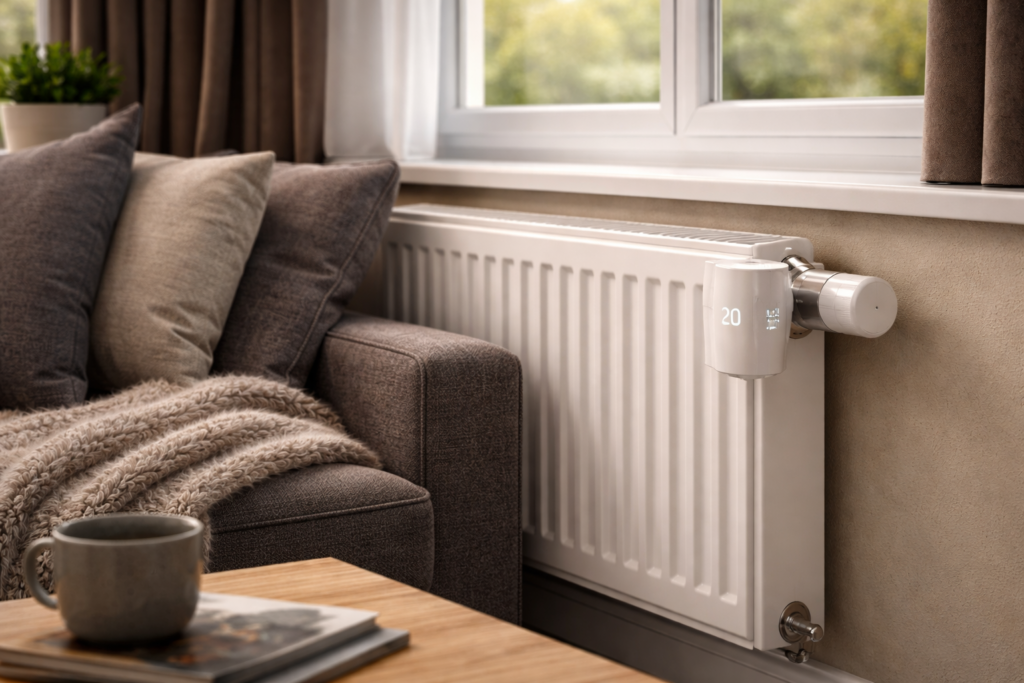
Smart radiator valves replace the manual TRV heads on your radiators with connected devices. Each one has its own temperature sensor and schedule, talks to a central hub, which talks to your boiler. The result is a system that heats the rooms you’re actually using, when you’re actually in them, and leaves the rest alone.
The features that make a genuine difference day to day — not just on a spec sheet:
Room-by-room scheduling — the living room warms up when you get home, the bedroom when you go to bed, the spare room that nobody uses stays off. Not because you remembered to twist a knob. Because the system does it without being asked.
Remote control from your phone — after a full day out, turning the heating on from your phone an hour before you’re home so the house is warm when you walk through the door. That’s genuinely one of those small things that improves daily life more than you’d expect before you have it.
Open window detection — when room temperature drops suddenly the valve pauses heating rather than letting the boiler keep burning gas trying to compensate. In an older draughty house — especially in Scotland where gaps around doors and windows are already a problem — sealing those gaps first makes the smart system work even harder once it’s in.
Away mode — drops everything to frost protection when nobody’s home. If your routine changes week to week, the heating follows your actual life rather than a fixed programme you set months ago.
What smart valves don’t do is worth being straight about. They can’t fix poor insulation or make a struggling boiler efficient. They optimise a working system. If the boiler or the building fabric is the real problem, sort that first.
The Cost — And Why Hesitating Is Completely Reasonable
A proper setup covering three or four radiators runs between £180 and £300. Fit out a larger house with six to eight radiators and you’re looking at £300-400 before you start. The manufacturers claim savings of 15-25% on heating bills — roughly £80-150 per year for a typical household.
When I worked this out for my own house, it was the total upfront figure that gave me pause — not the payback period. I don’t mind spending money if it reduces a recurring bill permanently. Monthly costs I’d rather eliminate than manage. But writing out a couple of hundred pounds before seeing a single penny of saving takes a moment to sit with.
What got me over it was doing the calculation properly rather than guessing.
A simple way to estimate your own saving:
Take your annual gas bill. Heating accounts for roughly 60% of a typical UK gas bill — use that as your working figure. Multiply the heating portion by 0.20 for a conservative saving estimate, or 0.25 if you have several rooms you rarely use. Divide the setup cost by that annual saving. That’s your payback period.
For a Scottish home with a £900 annual gas bill — not unusual when winters run from October to April — that’s roughly £540 on heating. A 20% saving is £108 per year. A £250 setup pays back in just over two years. After that, every year is money back in your pocket.
Which Homes Actually Benefit — And Which Don’t
Most comparison articles skip this entirely. It’s the most important question in the piece.
Worth it if:
You have three or more rooms with different heating needs throughout the day — a home office used during working hours, bedrooms only needed at night, a spare room that’s empty most of the week. The more varied your room usage, the bigger the saving from heating selectively.
You’re in a larger or older property. In Scotland and northern England this matters more than most articles acknowledge — stone-built semis, Victorian terraces, older housing stock that takes more energy to heat and loses it faster. Smart control makes a bigger difference in a house that’s harder to heat than in a modern well-insulated new build.
Your routine means the house is empty for significant parts of the day. If you’re out from 8am to 6pm and the heating is running on a fixed schedule through those hours, the potential saving is real. Remote control means heating on when you’re heading home, off the moment you leave.
You’re staying in the property for at least two to three years. The payback period is real and you need to be there long enough to see it.
Harder to justify if:
You’re in a small flat where all rooms heat quickly and you use most of them at similar times. The room-by-room benefit shrinks significantly when rooms are small, adjacent, and all occupied.
You’re renting — though worth asking rather than assuming. Most smart valve systems clip onto existing TRV heads without permanent modification. Many landlords will agree, particularly in longer tenancies where you’re the one paying the energy bill.
Your boiler is old or inefficient. Smart valves improve how heat is distributed — they can’t improve how efficiently the boiler produces it. Boiler efficiency comes first.
tado° vs Hive — An Actual Opinion
Most articles give you two vague paragraphs and leave you no clearer. Here’s a more direct take.
Hive is what I use and what I’d recommend for most UK households. Setup took fifteen minutes — no engineer, no tools beyond an adjustable spanner, just the app instructions and clicking the valves onto existing radiator fittings. The app is clean and the remote control does exactly what you want it to. If you want something that works without a learning curve and you’re not particularly interested in granular data, Hive is the right answer. It also sits naturally in the British Gas ecosystem if you’re already a customer.
tado° suits households that want more detailed control and energy reporting. The room-by-room data is more comprehensive, the scheduling is more flexible, and it integrates well with other smart home systems. The trade-off is that it’s slightly more involved to configure properly — not difficult, but more to think about than Hive.
For most Scottish homeowners with a combi boiler, a few rooms used inconsistently, and no existing smart home setup — Hive. For households that want maximum detail and optimisation — tado°.
Both work with the majority of modern combi boilers. Both have compatibility checkers worth running with your specific boiler model before you order anything.
The Conversation You’re Probably Having at Home
One person has seen an advert or got a high bill and wants to do something. The other thinks £250 on radiator valves is unnecessary when the heating already works.
The heating works — that’s the reply that ends the conversation before it starts.
The honest response is that working and working efficiently are different things. A boiler that fires up every morning is working. It might still be heating rooms nobody’s in, running longer than it needs to, and costing more every month than it should.
The spare bedroom is the easiest place to start that conversation. Empty most of the week, heated to 20°C every day regardless. That’s not a small inefficiency quietly ticking away — it’s real money spent heating a room nobody’s sitting in. Smart valves fix that specific problem simply, without touching anything else.
Standard Thermostats — When They’re Still the Right Answer
A standard digital programmable thermostat costs £25-50 and is completely adequate for the right household. If you’re in a small flat, use most rooms regularly, and have a consistent daily routine — a decent thermostat set to your schedule does the job without the complexity or outlay.
The only meaningful saving from a standard thermostat comes from using it correctly. Most people have their target temperature set 1-2°C higher than they need — dropping it by one degree reduces heating costs by around 10%. Free and immediate.
Understanding how your heating system actually works before spending money on upgrades is worth doing regardless of which direction you go — it changes what you buy and how you use it.
The straight comparison: a standard thermostat saves money if you use it correctly and consistently. A smart system saves money without you having to think about it. If your discipline is reliable and your routine is consistent, a standard thermostat is fine. If your routine varies — and most people’s does — automation earns its cost.
Installation — What It Actually Involves
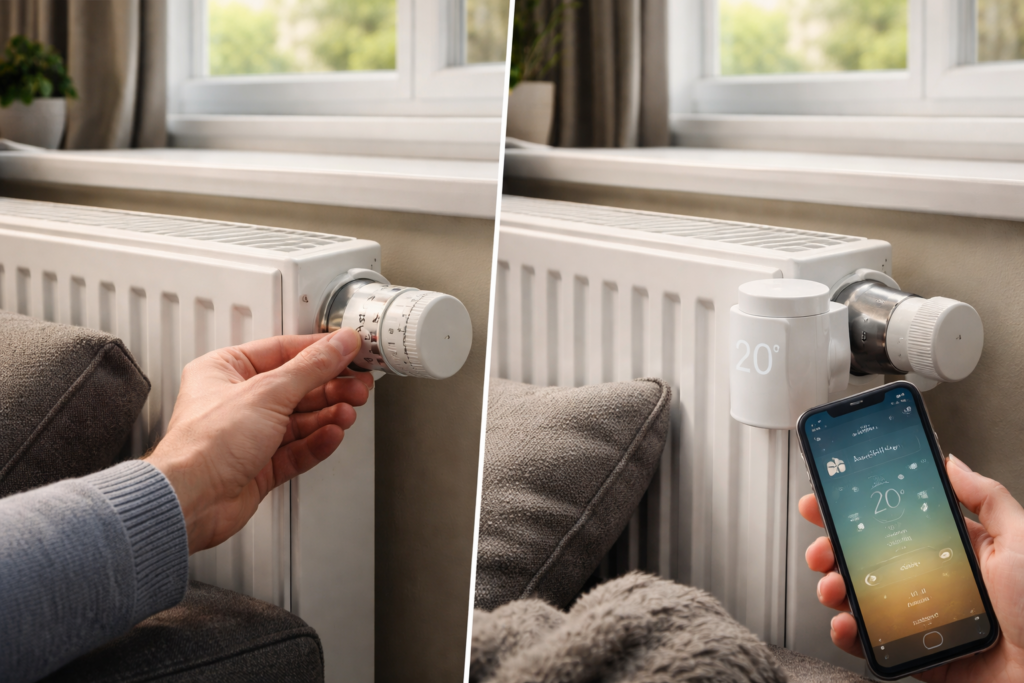
For standard TRV fittings both systems are straightforward DIY. Remove the old valve head, attach the new one, connect the hub to your router, follow the app. The first one takes twenty minutes while you get familiar with it. The rest take five to ten minutes each.
Where it gets more complicated is non-standard TRV fittings — more common in older properties, particularly pre-1980s houses. Check the thread size on your existing valves before ordering. Both manufacturers provide adapter kits for common non-standard fittings.
If you’re not comfortable with basic DIY a heating engineer can fit a full system in a few hours. Add £100-200 for labour and adjust the payback calculation — it still works, just takes a little longer.
FAQs
Do I need a smart thermostat as well as smart valves? The hub communicates with your boiler directly — you don’t necessarily need a separate smart thermostat on top. Both tado° and Hive offer combined packages if you want everything controlled from one app.
Will they work with my combi boiler? Almost certainly yes for any modern combi boiler. Run the compatibility check on the manufacturer’s website with your specific model before ordering.
Can I fit them myself? Yes, for standard TRV fittings. Hive went in in fifteen minutes on a Saturday. No specialist tools, no engineer, just the app instructions.
Do they work without Wi-Fi? They’ll still control temperature manually at the valve but you lose scheduling, remote control, and open window detection — most of the benefit. If your Wi-Fi drops temporarily they maintain the last set temperature until it’s restored.
What about rental properties? Most systems clip onto existing TRV heads without permanent modification to pipework or wiring. Worth asking your landlord rather than assuming the answer is no — particularly in a longer tenancy where the energy bills are yours.
The Honest Call
Smart radiator valves are worth it for the right house. Rooms you don’t use every day, a routine that varies, planning to stay put for a few years — the saving is real, the payback is reasonable, and controlling your heating from your phone while you’re still in the car park is one of those things you don’t realise you wanted until you have it.
The upfront cost is the real barrier — not the maths, just the act of spending £200-300 before you’ve seen a saving. Working out the calculation properly for your own house is what makes that decision easier. For my house the numbers were clear enough once I actually did them rather than guessing.
Hive went in on a Saturday. Fifteen minutes, no engineer. The spare bedroom has been off all week. The house is warm when I get home. A few simple fixes around the windows and doors pushed the saving further without much extra cost.
For a standard thermostat — if you’re in a flat, use every room, and your routine doesn’t change much, it does the job. Set it right and it saves money without spending anything.
But if you’ve got a house with rooms sitting empty and a heating system that heats them anyway — that’s not a small inefficiency. It’s money leaving your account every month for no reason. Smart valves fix it, and they fix it permanently.
For more on heating efficiently, the Smart Heating & Home Warmth Hub covers thermostats, insulation fixes, and practical ways to cut heating bills in UK homes.
Related Guides

About The Author – Andrew Marshall
Andrew Marshall is a Scottish homeowner and the creator of Save Wise Living. He shares practical ways to reduce energy bills, improve home efficiency, and make everyday household routines cheaper and simpler.
Pingback: Best Oil-Filled Radiators Under £100 UK 2025 | Save Wise Living
Pingback: Best Plug-In Thermostats to Cut Heating Costs UK 2025
Pingback: Best Thermal Curtains UK 2025 | Keep Heat In & Cut Bills
Pingback: Smart Heating & Insulation Guide UK 2025 | Cut Bills Fast
Pingback: Smart Heating Hacks to Cut Bills & Stay Warm UK 2025
Pingback: Smart Heating Devices Under £100 UK 2025
Pingback: Smart Home Heating Systems UK – Beginner’s Guide 2025
Pingback: Why Radiators Stay Cold in UK Homes (Cheap Fixes That Work)
Pingback: Cheapest Way to Heat Your Home UK – Room-by-Room Guide