
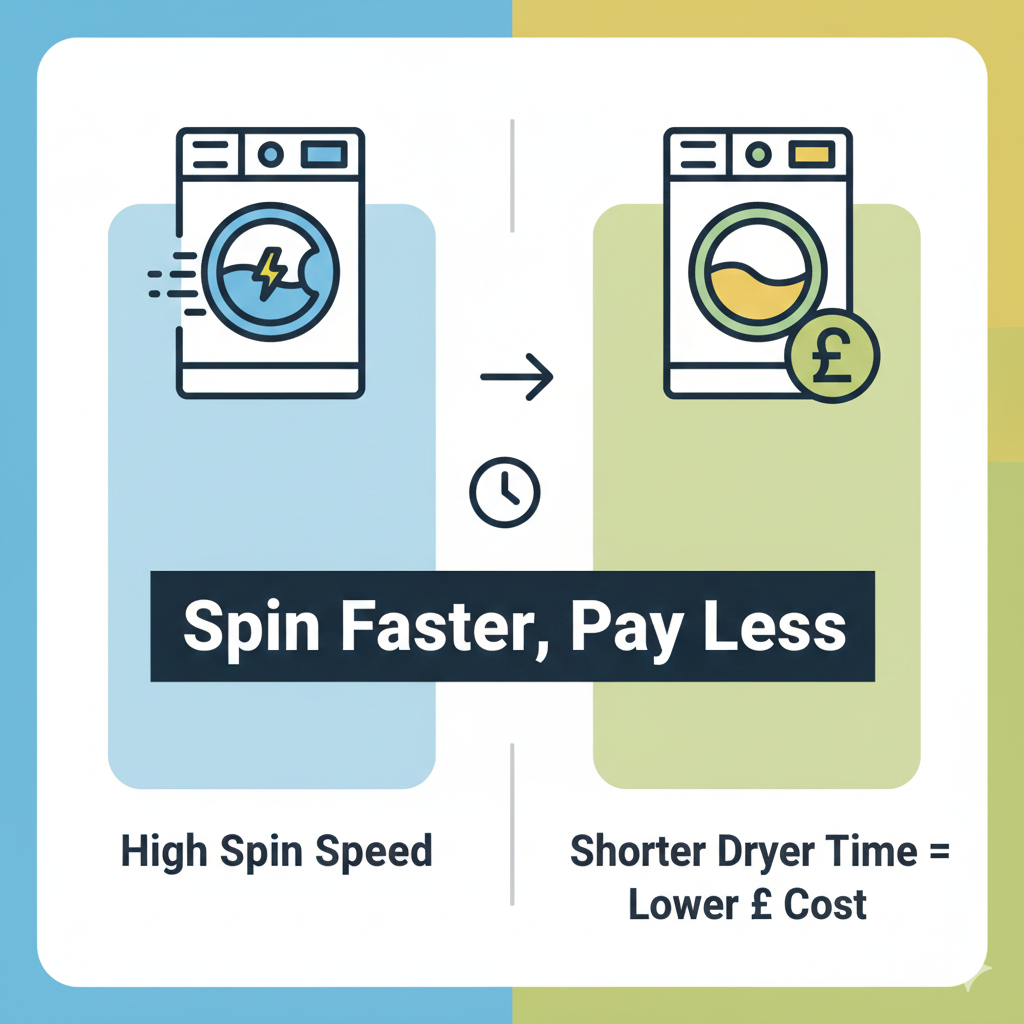
Higher spin speeds don’t just sound impressive — they squeeze more water out of your clothes, which shortens drying times and cuts energy use. That’s the core truth. When laundry leaves the washer with less moisture, your tumble dryer runs for fewer minutes (or your airer needs less time), and your electricity bill goes down. This guide breaks it all down with clear examples, practical tips, and efficient washer/dryer picks for UK households.
This article is part of our Laundry & Drying Efficiency hub, focused on practical UK advice for drying clothes indoors faster, avoiding damp, and keeping energy use low.

Why spin speed matters
- Less moisture after washing: Moving from 1,000 rpm to 1,400–1,600 rpm increases water extraction noticeably. That means clothes start drying from a drier baseline.
- Shorter dryer runtime: Tumble dryers are among the most energy‑hungry appliances. If they run for less time, you save money immediately.
- Better indoor drying: Drier laundry reduces damp and mould risk when you air‑dry indoors, especially in UK flats and small homes.
- Fabric care balance: Use the highest spin that suits the fabric. Everyday cottons tolerate higher rpm; delicates may need lower settings.
A typical 7 kg washing machine used 220 times per year costs roughly £25–£35 annually, and “wet appliances” (washing machines, dishwashers, dryers) account for nearly 10% of a typical household’s energy bills. Reducing the moisture leaving the washer shifts work away from the dryer — where the biggest savings live.
The energy impact in real terms
- Dryer consumption per load: Many tumble dryers use roughly 2.5–3.0 kWh per load. At 28–29p/kWh, that’s about £0.70–£0.87 per full drying cycle. Shaving even 10–15 minutes per load across a year adds up.
- Extra spin = quicker dry: Adding an extra spin (or selecting 1,400–1,600 rpm instead of 1,200 rpm) can reduce drying time substantially because less water remains in fabrics. Consumer advice regularly highlights the “extra spin” hack as a simple way to cut drying time and cost.
- Washer settings matter too: Efficient cycles like Eco 40–60, cooler temperatures, and right‑sizing loads reduce total energy used across washing and drying.
While exact savings depend on your laundry mix, a realistic ballpark for a typical UK family switching from 1,200 rpm to 1,600 rpm and trimming dryer minutes is in the tens of pounds per year, often stacking toward £50+ when combined with better dryer practices.
Moisture removal and drying time: what changes with rpm
Think of spin speed as “pre‑drying.” The faster the drum spins, the more water is forced out through centrifugal force. Less water left means your dryer or airer starts at a head start.
- At 1,000 rpm: Clothes exit wetter; dryer needs longer to evaporate moisture.
- At 1,200 rpm: Better baseline; still leaves notable moisture.
- At 1,400–1,600 rpm: Noticeably drier laundry; dryer time can drop meaningfully.
Advice hubs and efficiency guides repeatedly point to higher spin settings and extra spins as quick wins for drying efficiency — because reduced moisture content cuts drying energy immediately. Pair that with cleaning the lint filter and right‑sizing loads, and you compound savingsUswitch.
Cost examples for UK households
These examples use a typical electricity price of ~29p/kWh and common appliance behaviour. Adjust to your tariff and drum sizes as needed.
- Family of four (3 dryer loads/week):
- If each load saves 10 minutes of dryer time by using 1,600 rpm instead of 1,200 rpm, and a full cycle is ~60 minutes at ~2.8 kWh:
- Saving per load ≈ 10/60 of £0.81 ≈ £0.135.
- Annual saving ≈ 3 loads/week × 52 × £0.135 ≈ £21.
- Add occasional extra spins and smarter cycles, and total savings can climb (often reported as tens of pounds per year).
- Flat dweller air‑drying (5 washes/week):
- Higher spin speed means less indoor moisture. Clothes dry faster on airers, reducing musty smells and mould risk. Financially, you still save if you sometimes finish items in the dryer — and you gain comfort from shorter indoor drying times.
- Busy couple (mix of dryer and airer):
- Using Eco 40–60 and 1,400–1,600 rpm trims both washing and drying energy. Stack with good habits (clean lint filter, avoid overloading, choose shorter cycles where suitable) and the small wins accumulate across the year.
Spin speed plays a huge role in drying costs, but the drying method matters just as much. This breakdown of the cheapest ways to dry clothes in the UK shows where higher spin speeds deliver the biggest savings.
If you want straightforward, non-commercial advice on cutting bills and understanding UK energy costs, Citizens Advice has excellent resources.
https://www.citizensadvice.org.uk/energy/
Practical tips to maximise savings
- Use the highest appropriate spin speed: Everyday cottons handle 1,400–1,600 rpm well; use lower settings for delicates.
- Add an extra spin when loads feel heavy or towel‑rich: A short extra spin costs little and reduces dryer minutes.
- Clean the lint filter every load: Improves airflow and dryer efficiency immediately.
- Don’t overload: Overstuffed drums hold more water and lengthen drying.
- Use Eco 40–60 and cooler washes: Heating water is the washer’s biggest energy cost; efficient programmes help overall.
- Right‑size the machine: A drum that matches your typical load avoids half‑empty spins and inefficient cycles.
- Dry outside when possible: Free, fresh, and zero kWh.
Energy‑saving organisations emphasise that small laundry routine tweaks (cycle choice, spin, load size) meaningfully reduce bills over a year.
Recommended low‑energy washing machines (Amazon UK)
These picks balance spin speed, efficiency, and UK availability. The text links point to Amazon UK searches so they’ll load reliably, and you can select the seller and price you prefer.
- COMFEE’ 10 kg, A‑10% class, BLDC motor, 1400 rpm:
- Why it’s good: Large drum for families, efficient motor, high spin for better pre‑drying.
- HYE 8 kg slimline, A rated, 1400 rpm:
- Why it’s good: Compact depth for tight spaces, solid efficiency with high spin speed.
- Hisense 8 kg inverter, 1400 rpm, multiple quick/eco programmes:
- Why it’s good: Inverter motor for smoother, quieter, more efficient operation; versatile programmes.
Tip: Check programme lists for Eco 40–60, quick wash options, and cotton cycles — these are practical, real‑world savings features.
Recommended low‑energy tumble dryers (Amazon UK)
Prioritise high efficiency, right‑sized drums, and good airflow. Again, links are Amazon UK searches to ensure they work.
- ElectriQ compact vented dryer (4 kg):
- Best for: Small households or flats; shorter drying times for small loads.
- FOHERE compact vented dryer (around 6 kg)
- Best for: Medium households needing compact footprint with reasonable capacity.
- Hisense vented Tumble Dryer (8 kg):
- Best for: Traditional vented models with straightforward controls and solid airflow.
If you dry frequently, consider checking heat‑pump dryers too — they use less electricity than vented models, albeit with higher upfront cost. Use high spin speeds to shorten their runtime even further.
Putting it together: the washer–dryer combo strategy
- Step 1 — High spin on the washer: Choose 1,400–1,600 rpm for cottons.
- Step 2 — Efficient dryer habits: Clean lint filter, don’t overload, and stop drying when “cupboard dry,” not bone‑dry.
- Step 3 — Smarter cycles: Use Eco 40–60 for routine loads; cooler temps where suitable; add an extra spin when towels are heavy.
- Step 4 — Right capacity: A drum sized to your real weekly loads avoids inefficiency.
- Step 5 — Indoor air quality: Drier laundry means less moisture indoors and quicker air‑dry times (especially key in winter).
Energy guidance across UK sources converges on these practical steps: reduce moisture before drying, optimise dryer airflow, and select efficient programmes — together they reduce bills without sacrificing clean clothes.
Author insight
I wrote this because every time I pulled damp towels out of the washer, I could practically hear the tumble dryer asking for a nap. I wanted to know if cranking the spin speed up really made a dent in drying time and bills — not just as a spec sheet brag. Turns out, it does. Now when I hit 1,600 rpm, I feel like I’ve shaved a few minutes off “Dryer O’Clock.” And if anyone wonders why I’m so picky about lint filters, it’s because those tiny fluff monsters are secretly stealing your pennies.
More Laundry Savings Reads 🧺⚡
If you found this guide useful, you’ll love exploring our other laundry‑focused articles. They build on the same theme of saving money and energy while keeping everyday routines simple:
- How to Build a Low‑Energy Laundry Routine (Step‑by‑Step UK Guide) — practical steps to cut costs and reduce your carbon footprint.
- Off‑Peak Laundry Guide UK: When to Wash, Dry & Dehumidify for Maximum Saving — learn how timing your laundry can unlock even bigger savings.
Together, these pieces create a complete toolkit for smarter laundry habits in UK households.
✅ Conclusion
Spin speed isn’t just a technical detail — it’s a hidden money‑saver. Higher rpm cycles squeeze out more water, which means shorter drying times and lower energy use. Combine that with smart habits like Eco 40–60 washes, cooler temperatures, and keeping your lint filter clean, and the savings start to stack up.
The key is choosing machines with the features you’ll actually use, not just the biggest drum or flashiest spec. Over the course of a year, these small adjustments add up to meaningful reductions in bills — especially for families running multiple loads every week. In short: spin smarter, dry faster, save money.
Want to dry clothes faster, cheaper, and smarter especially in small UK homes? Explore our Laundry & Drying Efficiency Hub, a curated resource packed with expert tips, energy-saving gadgets, and clever solutions for indoor drying. From heated airers and compact dehumidifiers to smart laundry routines that actually work, this hub helps you cut costs, save space, and stay ahead of the damp.

About The Author – Andrew Marshall
Andrew Marshall is a Scottish homeowner and the creator of Save Wise Living. He shares practical ways to reduce energy bills, improve home efficiency, and make everyday household routines cheaper and simpler.