
Last Updated: 31st March 2026
Every winter there’s a room in most UK homes that never quite gets warm enough — the heating comes on, the radiator gets hot, but the room still feels draughty and cold. In older properties, the problem often isn’t the radiator. It’s the wall behind it.
The cause is usually straightforward. Radiators on external walls in older UK homes are heating the wall as much as the room — and that heat is disappearing outside rather than staying where it’s needed.
Reflective radiator foil is one of the cheapest fixes for this specific problem. Under £15 for most homes, installed in minutes without tools, and the results are immediate enough to notice on the first cold evening after fitting. Last winter I started with just the two radiators on external walls in our coldest bedroom — the room held its heat noticeably better within a day and the boiler stopped cycling as frequently as it had been. It’s the kind of cheap fix that sits alongside bleeding radiators and checking TRVs as something most UK households could do in an afternoon that makes an immediate difference.
More practical ways to reduce heat loss and cut heating bills are covered in our Smart Heating & Home Warmth Hub.
Why Radiators on External Walls Lose So Much Heat
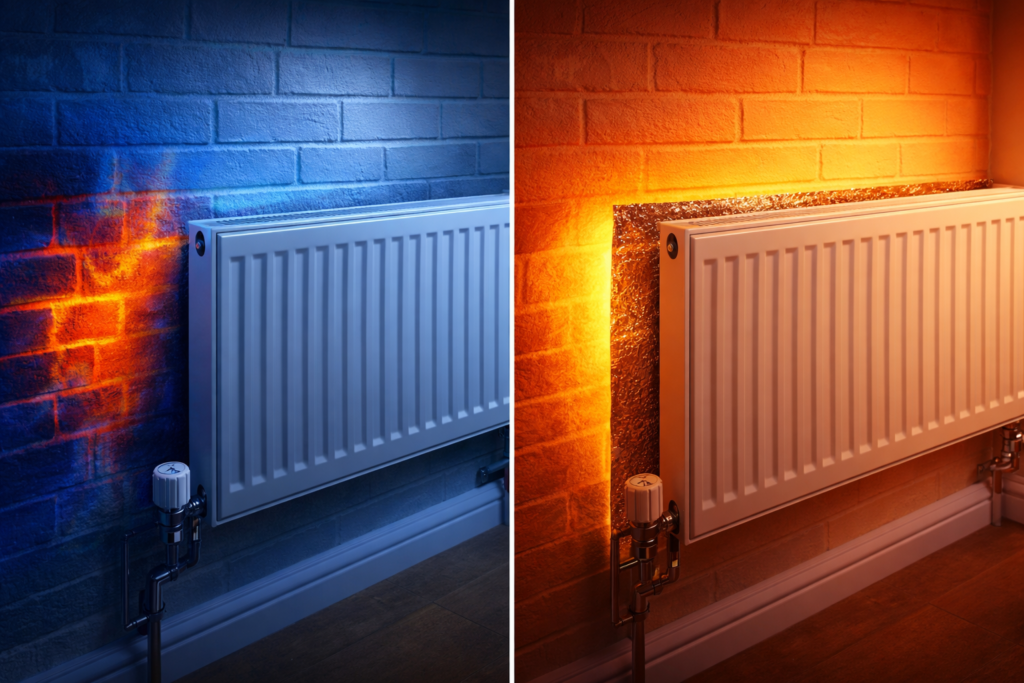
A radiator works by heating the air around it, which then circulates around the room. But the radiator also heats the wall directly behind it through a combination of conduction and radiation — and if that wall is an external wall with limited insulation, a meaningful proportion of that heat travels through the wall and is lost to the outside.
In older UK properties with solid brick walls — built before cavity construction became standard — this effect is particularly significant. The wall has no insulation barrier to slow the heat transfer, so a well-functioning radiator can still be quietly wasting 20–30% of its output into the brickwork.
Reflective foil works by placing a reflective barrier in the air gap between the radiator and the wall. Heat radiating from the back of the radiator hits the foil rather than the wall surface and is reflected back into the room. The foil itself doesn’t create heat — it simply redirects heat that would otherwise be lost.
The effect is most pronounced on external walls in solid-walled properties. For radiators on internal walls in well-insulated modern homes the benefit is more marginal, though still present. If you’re prioritising which radiators to do first, start with the coldest rooms and the radiators most exposed to outside-facing walls — that’s where the measurable difference will be largest.
Does Radiator Foil Actually Work?
The honest answer is yes — but with realistic expectations. Radiator reflector foil is not insulation. It doesn’t perform the same function as cavity wall insulation or loft insulation. What it does is reduce a specific and measurable heat loss pathway — the heat radiating from the back of a radiator into an external wall — and it does that effectively.
The savings available depend significantly on your home’s construction. In a solid-walled Victorian or Edwardian property where cavity insulation isn’t possible, reflective foil is one of the only practical options for reducing heat loss through external walls without major building work. BBA testing on Radflek shows wall heat transfer reduced by 45% in this scenario. For older UK homes where the walls themselves are the problem, insulating without major renovation covers the broader picture of what’s actually achievable without structural work.
In a modern cavity-walled property with good insulation already in the walls, the benefit is smaller because less heat is being lost through the wall in the first place. The foil still helps but the return is proportionally less dramatic.
For the investment involved — under £25 for most homes — the risk-reward calculation is strongly in favour of doing it. In a Scottish climate where the heating runs from October through to April and external walls face genuinely cold winters, the cumulative saving across a full heating season is considerably more meaningful than in milder parts of the UK. In our house — solid walls, older build, west-facing external walls that take the worst of the weather — radiator foil was one of the first things I’d recommend to anyone asking where to start on reducing heating costs. It doesn’t require a tradesperson, it doesn’t require planning, and it takes less time than most people expect.
At 24p per kWh, reducing heat loss by even 50 kWh per year from three radiators saves approximately £12 annually. Over five years that’s £60 from a £15 investment. Radflek’s laminated construction is tested to maintain reflectivity for 60 years — so the saving compounds year after year without replacement.
Two Things That Actually Matter When Choosing
Most buying guides walk through four or five technical criteria for radiator foil. In practice, two decisions determine which product you should buy.
The first is whether you want to stick the foil to the wall or hang it from the brackets. Radflek hangs from the wall brackets using clips — no adhesive, no wall contact, easy to remove completely. Everything else on this list uses adhesive pads to fix to the wall. For renters the choice is obvious. Radiator foil sits alongside a range of low-cost ways to stay warmer without touching the thermostat — the kind of changes that don’t require permission or professional installation. For homeowners it’s simply a matter of preference.
The second is whether adhesive pads are included. Finding out they’re not included after you’ve already cut everything to size is genuinely frustrating — and it happens more often than it should with cheaper products. Check before ordering.
Everything else — thickness, bubble vs flat foil, roll vs panel — matters less than these two decisions. All the products here use bubble construction, are the right thickness for behind-radiator use, and perform well in practice.
How to Install Radiator Foil
Most radiators can be done in ten minutes once you’ve measured up.
Switch the heating off and let the radiator cool down completely before starting — this sounds obvious but it’s easy to get impatient when you’re mid-project and the radiator is still warm. It’s worth waiting.
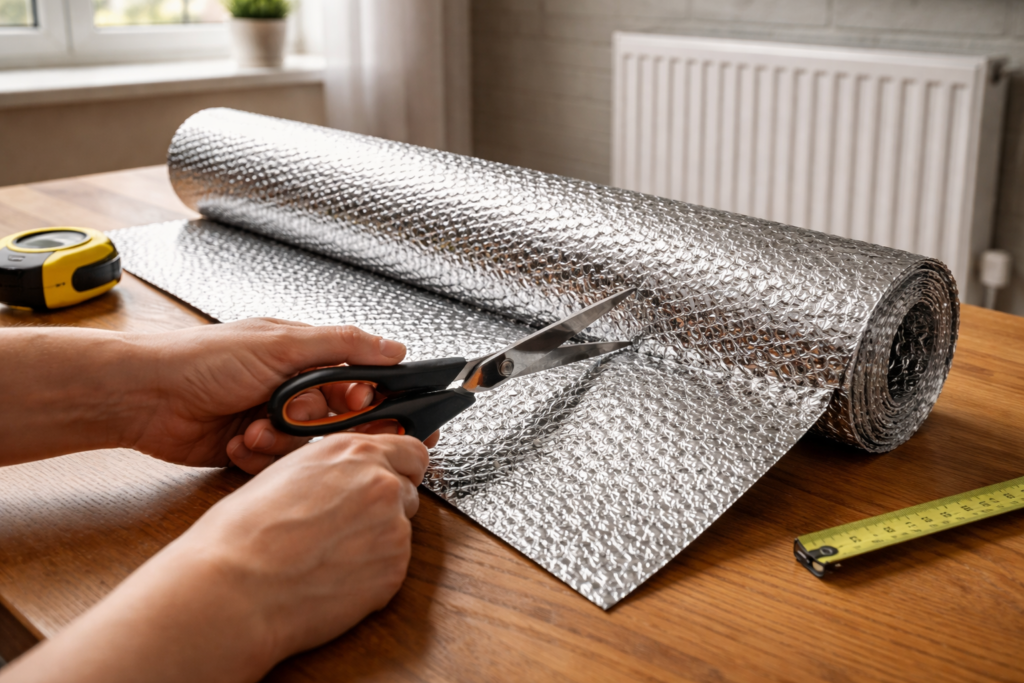
Measure the wall area directly behind the radiator — height between brackets and width. If you’re using roll foil, cut a piece slightly smaller than this area so it fits without bunching at the edges. For Radflek panels the sheets hang from the brackets so sizing is less critical.
For adhesive pad products, attach the pads to the corners and middle edges of the cut foil before inserting it. Get the foil into position first, check it’s flat and covering the right area, then press the pads firmly to the wall.
Slide the foil behind the radiator with the shiny reflective surface facing towards the room — not towards the wall. This is the one detail that catches people out. The reflective surface faces the radiator, not the wall. Getting it the wrong way round means the foil absorbs rather than reflects, and you’d wonder why it made no difference. It’s obvious once you think about it but easy to get backwards when you’re sliding something into a tight space.
For larger radiators it’s easier to work in two or three narrower strips than one large panel — simpler to slide in and still gives full coverage.
Once installed the foil should sit flat against the wall with a small air gap between the foil and the radiator itself. That gap is normal and part of how it works.
The Three Products Worth Buying
1. Radflek Radiator Reflector Panels — 3-Sheet Pack — around £12–16
Best for: homeowners and renters who want the most effective and independently verified product — and don’t want to stick anything to the wall.
Radflek is the standout product in this category and the performance gap between it and generic alternatives is meaningful rather than marginal. It’s the only radiator reflector tested and verified by the British Board of Agrément (BBA) and approved by Ofgem, with savings independently verified by the Building Research Establishment (BRE). The Energy Saving Trust recommends it. Those aren’t marketing claims — they’re third-party verifications that most competing products simply don’t have.
The laminated aluminium foil construction reflects 95% of the heat radiated from the back of the radiator. BBA testing shows it reduces heat transfer through external walls by 45%. BRE-verified data shows an 8-sheet pack saving up to 666 kWh and approximately £40 per year in an uninsulated solid wall home. The 3-sheet pack covering 3–6 radiators typically pays for itself within one heating season.
Installation is different from most alternatives — Radflek hangs from the wall brackets rather than sticking to the wall, meaning no adhesive, no permanent changes, and easy removal if you move or want to redecorate. The pack includes the sheets, fixing clips (Radklips), and adhesive strips (Radstik). The hanging method creates a small air gap either side of the sheet — the ideal setup for reflective insulation to work properly.
The 3-sheet pack covers 3–6 radiators. The 5-sheet and 8-sheet packs suit larger households. For most three-bedroom UK homes, the 5-sheet pack covering all external wall radiators is the most logical starting point.
2. Yuzet Radiator Heat Reflective Foil — Pack of 2 Rolls (0.6m x 5m each) — around £10–14
Best for: households who want a reliable budget option with enough coverage for a full house across two rolls.
Yuzet is a well-established UK insulation brand and their radiator foil is one of the most consistently reviewed products in this category. Two rolls of 0.6m x 5m each — 10 metres total — is enough to cover most rooms in a typical semi-detached or terraced property without running short.
The aluminium foil construction reflects heat effectively, has been tested to UK standards, and cuts cleanly with standard scissors making accurate sizing easier than it sounds. Installation is straightforward — cut to size, apply adhesive tape to corners, slide behind the radiator with the reflective surface facing out.
The change isn’t subtle when the room has been losing heat through an uninsulated external wall all winter. A day after fitting, the radiator was doing noticeably less work to maintain the same temperature — the room held its warmth between heating cycles in a way it hadn’t before.
One practical note: adhesive tape is not included. A pack of double-sided foam mounting pads works well and costs under £3 — worth adding to the same order.
3. SuperFOIL Radpack Radiator Insulation Foil — 1m x 0.6m — around £8–12 (Amazon UK)
Best for: households who want a first installation with everything included from a UK brand that meets building regulations.
SuperFOIL is a reputable UK insulation manufacturer whose products comply with UK building regulations and CE standards — meaningful confidence over generic marketplace alternatives at similar prices. The Radpack is made from up to 40% recycled material and designed to be cut and installed without tools, with adhesive pads included in the pack.
The 1m x 0.6m sheet covers approximately 3 average-sized radiators. Having the adhesive pads included matters — it’s the most common frustration with cheaper alternatives where you only discover they’re missing after everything is already cut to size.
On a clear afternoon you can do an entire house in under an hour — the kind of job that sounds like it might be complicated but turns out to be one of those genuinely satisfying quick wins. For households who’ve been putting this off because it sounds fiddly — the Radpack is proof it isn’t. Everything’s included, the process is straightforward, and an hour later your external wall radiators are working considerably harder for the same energy spend.
With over 8,000 reviews on Amazon UK, it’s one of the most purchased radiator foils available and customer feedback on ease of installation is consistently positive.
Frequently Asked Questions
Does radiator foil work on all radiator types? It works best on standard panel radiators mounted on walls — the most common type in UK homes. For floor-standing radiators the installation is different — Radflek provides specific floor mounting instructions. Column radiators with unusual profiles may require cutting foil to fit around brackets but the principle is the same. If your radiator is on an internal wall between two heated rooms, the heat loss through that wall is minimal and the benefit there is correspondingly small.
Can renters install radiator foil? Yes — particularly Radflek which hangs from the wall brackets without any adhesive or wall contact. It can be removed completely when you leave without leaving any mark or damage. For adhesive-backed options like the SuperFOIL Radpack, check your tenancy agreement first — most allow minor removable improvements but it’s worth confirming with your landlord.
Will I need to remove my radiator? No. All the products here are designed to slide behind the radiator while it’s mounted on the wall. In most cases you won’t need tools at all — just scissors for cutting to size. The process is significantly easier than it sounds and most people who’ve done it say the same thing: they wish they’d done it years earlier.
Is kitchen foil a cheaper alternative? Kitchen foil does reflect heat initially but degrades rapidly — it oxidises, tears easily, and loses its reflective properties within months. The gap between kitchen foil and a proper product widens quickly once you factor in replacement and degraded reflectivity. For a permanent solution a dedicated product is worth the small additional cost.
How much will I actually save? This depends on your home’s wall construction, how many radiators are on external walls, and how long your heating runs. For a solid-walled property with several external wall radiators running through a full UK winter, savings of £20–40 per year are realistic. For a well-insulated modern property the saving is more modest — perhaps £5–15 per year. Either way at the cost of these products the payback period is short.
Does it matter which side of the foil faces the room? Yes — the shiny reflective surface should face towards the radiator. The heat needs to hit the reflective surface and bounce back towards the room. Installing it the wrong way round significantly reduces the effectiveness. Most products are clearly marked but it’s worth double-checking before securing in position. A radiator reflector kit with adhesive pads with everything included removes the risk of missing components entirely.
Which Product Should You Buy?
For most homeowners who want the most effective option with genuine independent verification — Radflek. The BBA approval and BRE-verified savings data are real differentiators. It costs more than generic alternatives but the performance gap is documented rather than claimed and it’s designed to last decades.
For a budget-friendly option that covers a whole house across two rolls — Yuzet. A genuine UK brand, well reviewed, and enough foil to do every external wall radiator in a typical semi-detached. The only additional purchase needed is adhesive pads.
For a straightforward first installation with everything included — SuperFOIL Radpack. Adhesive pads included, UK building regulation compliant, over 8,000 Amazon reviews. The natural choice for households trying radiator foil for the first time.
Whichever you choose, start with the radiators in your coldest rooms on external walls — that’s where the heat loss is highest and the improvement most immediately noticeable. A radiator bleeding key is worth having to hand beforehand — bleeding any radiators that are cold at the top before fitting the foil means you’re not improving the efficiency of a radiator that isn’t working properly in the first place. Foil behind the radiator and draught stoppers on the doors in the same room is the combination that makes the biggest difference for the least spend — layering cheap fixes rather than relying on any single one.
Related Guides

About The Author – Andrew Marshall
Andrew Marshall is a Scottish homeowner and the creator of Save Wise Living. He shares practical ways to reduce energy bills, improve home efficiency, and make everyday household routines cheaper and simpler.
Pingback: Best Thermal Curtains UK 2025 | Keep Heat In & Cut Bills
Pingback: Best Door Draft Stoppers UK 2025 – Top 10 Under £20
Pingback: Best DIY Home Insulation Products UK 2025
Pingback: Best Oil-Filled Radiators Under £100 UK 2025 | Save Wise Living
Pingback: Smart Heating & Insulation Guide UK 2025 | Cut Bills Fast
Pingback: Do Smart Radiator Fans Work? UK Heating Guide 2025
Pingback: Radiator Shelves and Covers UK – Boost Heat & Style in 2025
Pingback: Radiator Foil vs Thermal Curtains – Best Way to Keep Heat In
Pingback: Why Radiators Stay Cold in UK Homes (Cheap Fixes That Work)
Pingback: Cheapest Way to Heat Your Home UK – Room-by-Room Guide
Pingback: How to Insulate an Old House UK Without Renovation