
Last Updated: June 2026
Two things changed how we approach power on camping trips and at home during outages. The first was a foldable solar panel that started as a camping purchase and ended up living in the car permanently — useful enough on family days out that it never went back in the shed. The second was a portable power station bought after a winter power cut left us without heating controls, phone charge, or any way to run the kids’ nebuliser for three hours on a dark January evening. Both felt like optional extras before we had them. Neither feels optional now.
Solar chargers and portable power stations solve different problems but they complement each other well — one harvests energy from sunlight, the other stores it for whenever you need it. For a UK household thinking about energy resilience, reducing reliance on the grid, or simply keeping devices charged on days out without hunting for a socket, both are worth understanding before buying either. The Lighting & Power Saving Tech Hub covers the full range of power-related upgrades worth making — this article focuses specifically on outdoor solar chargers and portable power stations available in the UK.
Solar Chargers and Power Stations — What’s the Difference
They sound similar and are often sold alongside each other, but they’re solving different problems and the distinction matters before spending anything.
A portable solar panel is a foldable or rigid panel that converts sunlight into electricity and uses that electricity to charge devices directly — typically via USB. Most are lightweight, packable, and designed for outdoor use. They work best in direct sunlight and output varies significantly with cloud cover. On a bright Scottish summer day a quality 20W panel charges a phone in two to three hours. On a grey October afternoon the same panel might charge the same phone in eight hours or not at all.
A portable power station is a large rechargeable battery with multiple output types — USB, USB-C, mains socket, 12V car socket — that stores electricity and delivers it on demand regardless of current weather or sunlight. It’s charged in advance from the mains, from a car, or from a solar panel connected to it. The power station doesn’t care whether the sun is out — it delivers what’s stored until the battery is empty.
Combined, they form a genuinely useful system: the solar panel tops up the power station during the day, the power station runs whatever you need whenever you need it. Used separately, each solves a narrower problem.
What to Look for in a Solar Charger
Output wattage is the primary specification. A 10W panel charges phones and small devices slowly but adequately. A 20W panel is the practical minimum for regular outdoor use — fast enough to be genuinely useful on a day out. A 40W or 60W panel suits serious camping or van life use where larger devices and power stations need topping up. For most UK family use, 20W is the right starting point.
Folded size and weight determines whether the panel actually comes with you. A solar charger that’s too bulky to fit in a day bag gets left behind. The best foldable solar charger for family use packs to roughly A4 size and weighs under 500g — light enough to go in a backpack without becoming the reason everyone complains about the bag being heavy.
USB and USB-C outputs — most modern panels include at least one USB-A and one USB-C port. A USB-C solar charger with Power Delivery is worth looking for if you’re charging modern phones or laptops — it delivers significantly faster charging than standard USB-A.
UK weather realism — solar chargers are rated under ideal conditions. A panel rated at 20W produces 20W in direct perpendicular sunlight. In the UK, factor on getting 50–70% of rated output on a clear day and significantly less on overcast days. This isn’t a reason not to buy — it’s a reason to buy a slightly higher wattage panel than you think you need. On a family camping trip to Argyll last summer we ran a 20W panel all day expecting to keep two phones and a tablet topped up. Two phones yes — the tablet was a stretch on anything less than a clear afternoon. We’ve since moved to a 28W panel and the difference on partially cloudy days is noticeable.
What to Look for in a Portable Power Station
Capacity in watt-hours (Wh) is the number that determines how much the station can power and for how long. A 200Wh station runs a phone from flat to full roughly 15–20 times, or powers a 20W camping light for ten hours. A 500Wh station runs a small electric cool box for eight to twelve hours, or keeps a CPAP machine running through a full night. A 1000Wh station can run a small electric heater for a couple of hours or power most household essentials during a short power cut.
Output types determine what you can plug in. USB and USB-C are standard. A mains AC socket — the standard three-pin UK socket — is the feature that makes a portable power station genuinely useful rather than just a large power bank. Without a mains socket you’re limited to USB devices. With one you can run a laptop, a small fan heater, a television, or a medical device.
Recharge time and input options — how long does it take to recharge from flat? Most mid-range power stations take four to eight hours from a mains socket. Solar input compatibility is worth checking if you plan to use it with a solar panel — not all power stations accept solar input and those that do vary in how efficiently they manage it. If motion sensors, smart locks, or security cameras are among the devices you’re planning to keep powered during outages, the smart motion sensors worth considering for UK hallways and stairs covers the power requirements of those devices — useful for working out how much capacity your power station actually needs.
Weight matters significantly for outdoor use. A 500Wh power station typically weighs 5–7kg — manageable for camping where it goes in the car boot but not practical for carrying any distance. A 200Wh station weighs 2–4kg and is genuinely portable.
Five Products Worth Buying
BigBlue 28W Foldable Solar Panel — Best Everyday Solar Charger
The BigBlue 28W is the solar charger that earns its place in the car rather than staying in the shed — compact enough when folded to fit in a day bag, output sufficient to charge a phone in two to three hours in reasonable UK sunlight, and robust enough to handle the outdoor use that camping and family days out involve.
Three USB-A ports allow simultaneous charging of multiple devices — useful when three children all want their tablets topped up on a long day out. The panel folds to roughly A4 size and weighs around 500g. The carabiner loops on the corners allow it to hang from a fence, a tent guy rope, or a car window to maximise sun exposure while setting up camp.
The honest caveat for UK use: on overcast days the output drops noticeably and on heavily overcast Scottish autumn days it may not deliver enough power to keep pace with a device’s active screen usage. A solar panel extension cable is worth buying alongside — it lets you position the panel in direct sunlight while keeping devices in the shade or inside a tent rather than having to drape everything together.
Hiluckey 25000mAh Solar Power Bank — Best Budget Solar Option
For households that want solar charging capability at the lowest possible entry cost, the Hiluckey solar power bank combines a large battery with a built-in solar panel in one compact unit. The 25000mAh capacity charges a standard smartphone eight to ten times from flat — enough for a week of camping without mains access if used carefully.
The built-in solar panel is small relative to dedicated foldable panels and charges the internal battery slowly — this is the honest caveat worth stating clearly. The Hiluckey is a capable power bank that happens to have solar as a supplementary top-up rather than a primary charging source. Think of it as a large USB-C power bank with solar as a useful bonus rather than the main event. The practical use case is a device that maintains charge on sunny days and is topped up from a socket between trips — not a panel that replaces mains charging independently.
For families who want a capable power bank with solar as a backup rather than the primary source, this covers the requirement at an accessible price. For anyone expecting the built-in panel to fully charge the bank without mains assistance, the expectation needs adjusting before buying.
Jackery Explorer 240 — Best Entry-Level Portable Power Station
The Jackery Explorer 240 is where portable power stations start to become genuinely useful for UK home and outdoor use rather than just an expensive power bank. At 240Wh capacity with a mains AC socket, two USB-A ports, and a USB-C port, it covers the essentials — phone charging, laptop power, a camping light, a small fan — in a unit that weighs 3.1kg and is genuinely portable.
The mains socket output is 200W continuous — sufficient for most small appliances including CPAP machines, small televisions, and laptop chargers. Not sufficient for kettles, toasters, or any heating element. The Explorer 240 is the right choice for the household that wants a capable backup power source for short outages and extended camping use rather than whole-home resilience.
After the January power cut mentioned at the start of this article, the Explorer 240 is the model I looked at first. It would have covered everything we needed that evening — phone charging, the nebuliser, a small lamp — for the duration of a typical UK power cut without running flat. Jackery is among the most established portable power station brands in the UK market and the Explorer range is consistently well reviewed — the build quality and battery management system are noticeably better than cheaper alternatives at a similar price point.
A power station carry bag is worth buying alongside if this is going camping regularly — the Explorer 240 has no dedicated carry case and a padded bag protects it in the boot alongside everything else.
EcoFlow RIVER 2 — Best Mid-Range Power Station for Families
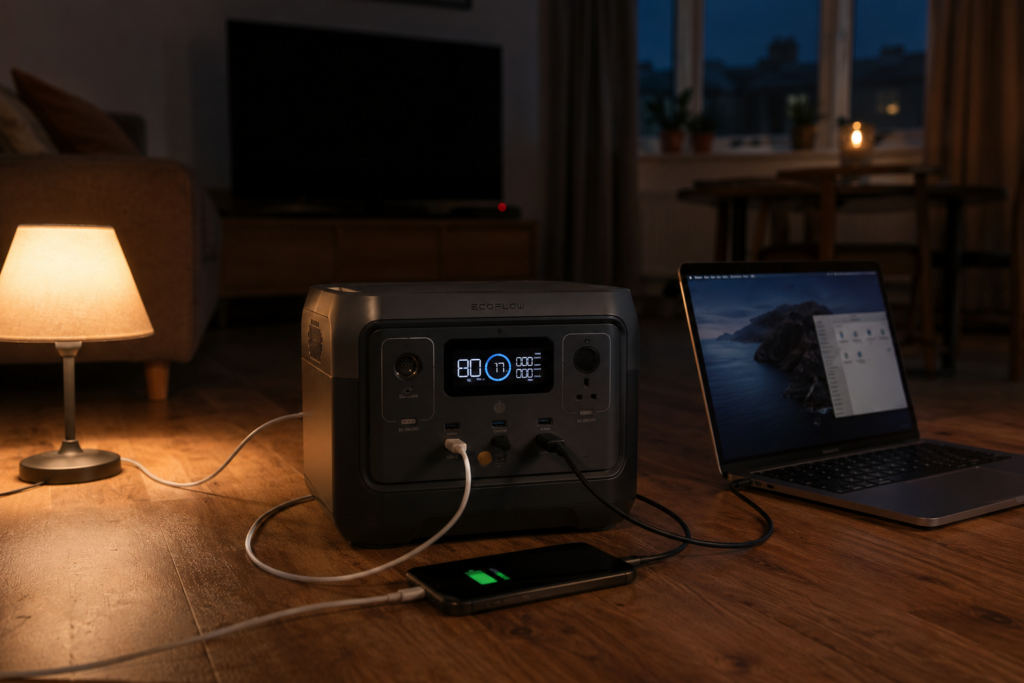
The EcoFlow RIVER 2 is the power station that suits a family household taking outdoor power seriously — 256Wh capacity, a 600W AC output that handles a wider range of appliances than the Jackery 240, and a recharge time from flat of under an hour from mains which is genuinely impressive at this price point.
The X-Boost technology allows it to run appliances rated up to 1200W by managing power delivery intelligently — which means a 800W electric blanket or a small hair dryer works where a standard 600W output would struggle. For camping use this significantly expands what’s practical to bring.
The app connectivity is worth using — EcoFlow’s app shows real-time consumption, remaining runtime at current draw, and allows scheduling of charging. I’ve used similar real-time monitoring on smart plugs and the habit of checking actual draw rather than estimating it changes how you manage power genuinely. Seeing that a laptop charger draws 45W rather than the 65W it’s rated at changes the runtime calculation meaningfully — the EcoFlow app brings the same visibility to the power station. For a household trying to charge on off-peak tariffs, the scheduling function is a genuine practical benefit.
At just over 3kg it’s comparable in weight to the Jackery 240 despite the higher capacity and output — the energy density is better at this price point than older power station designs.
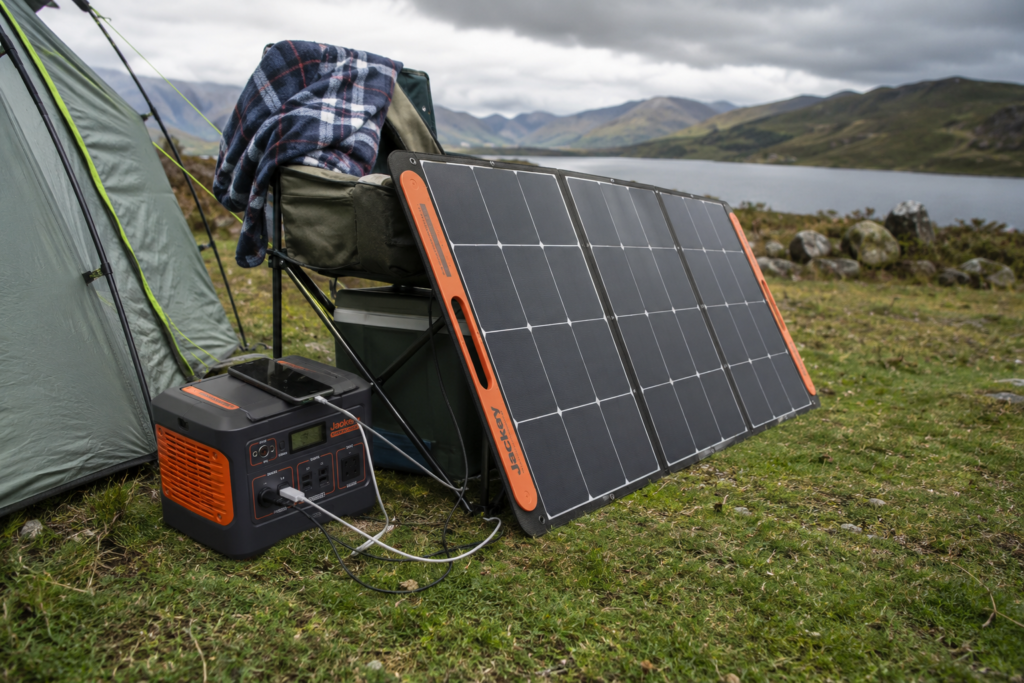
Jackery SolarSaga 100W + Explorer 1000 — Best Complete Solar and Storage System
For households that want a complete off-grid capable system rather than individual components, the Jackery SolarSaga 100W panel paired with the Explorer 1000 power station is the combination that makes a genuine difference — 1002Wh capacity, 1000W AC output, and a 100W solar panel that in good UK summer sunlight recharges the station in approximately ten hours.
The Explorer 1000 runs a small electric cool box, a laptop, phone charging, lighting, and a small fan simultaneously — the kind of setup that makes a week of camping feel genuinely comfortable rather than austere. For power cuts, 1002Wh covers most households for several hours of essential use including a small electric heater, which nothing at a lower capacity point can manage.
The weight — 10.5kg for the power station — means this isn’t a pack-and-carry product. It goes in the car boot and stays there. For car camping and home backup this isn’t a limitation. For anything involving carrying it any distance it matters considerably.
The SolarSaga 100W panel folds to a manageable size and connects directly to the Explorer 1000 via a dedicated input port. A solar panel storage bag is worth buying to protect the panel between trips — folded panels pick up scratches and connector damage in a boot alongside camping kit without one.
The UK Weather Reality
This needs saying clearly because most solar charger and power station reviews are written for sunnier climates than Scotland or the north of England.
Solar panels work in the UK. They work less efficiently than their rated output on most days and significantly less efficiently on heavily overcast days — which in Scotland from October through March describes the majority of days. A 100W panel in July on a clear Loch Lomond morning delivers close to its rated output. The same panel on a February afternoon in Glasgow delivers perhaps 15–20W. On a camping trip to the Argyll coast last September we ran a 100W panel for a full day and got roughly 60% of what the same panel had delivered in July — not a failure, but a useful recalibration of expectations before anyone relies on solar as a primary power source through autumn.
If lighting efficiency is part of the same winter energy review, how much switching from halogen to LED actually saves covers the calculation that most households haven’t done but probably should — useful context for anyone working through a complete home energy picture alongside the power station decision.
The practical approach for UK use is to treat solar input as supplementary rather than primary — charge the power station from mains when available, use solar to extend the charge between mains access points rather than to replace mains charging entirely. Positioning matters more in the UK than in sunnier climates — a panel angled toward the sun rather than lying flat produces noticeably better output on low winter sun angles. A solar panel mounting bracket or adjustable angle stands makes a meaningful difference to output on days where getting the angle right is the difference between useful and marginal charging.
Which Combination Is Right for Your Household
For everyday day-out use and basic camping — BigBlue 28W panel plus the Hiluckey power bank covers most family day-out requirements at the lowest combined cost. This is roughly the setup we started with — the power bank in the bag, the panel on the outside of the pack or hung from the tent.
For regular camping with a mix of device charging and small appliances — BigBlue 28W panel plus EcoFlow RIVER 2 is the most versatile combination at a mid-range price. The RIVER 2’s fast mains recharge means it tops up fully overnight between camping days and the BigBlue maintains it through the day.
For serious camping and home power cut resilience — Jackery SolarSaga 100W plus Explorer 1000 is the complete system that doesn’t compromise. This is what a family of five running a week of west coast camping with medical device requirements actually needs.
For households that want home backup power without the solar element initially — EcoFlow RIVER 2 alone charged from mains is the right starting point with a solar panel added later. For households already running rechargeable batteries across multiple devices and wanting to understand how a power station fits alongside that setup, the rechargeable battery packs worth knowing about for UK homes covers the full picture of rechargeable power at the smaller device level.
FAQ
Do solar chargers work in the UK in winter?
They produce power but significantly less than their rated output — expect 15–30% of rated wattage on a typical overcast UK winter day. They’re more useful as a supplementary top-up in winter than a primary charging source. In summer, particularly in July and August, output is much closer to the rated figure on clear days. If lighting efficiency is part of the same winter energy review, how much an LED bulb actually costs to run per hour puts the numbers in context for households working through the full picture of what their home’s power use costs.
How long does a portable power station last during a power cut?
It depends on what you’re running. A 256Wh station running phone charging, a laptop, and a lamp uses roughly 80–100W — giving two to three hours of combined runtime. The same station running only phone charging lasts significantly longer. Calculate your essential devices’ wattage and divide the station’s Wh capacity by that figure for an approximate runtime. A power consumption meter plugged into each device before a trip tells you the actual draw rather than the rated figure — which is often significantly lower and extends runtime meaningfully.
Can I charge a portable power station from my car?
Yes — most portable power stations include a 12V car socket input. Charging from a car is slower than mains charging but useful for topping up during a long drive between camping locations. Running the engine while charging rather than draining the car battery is the correct approach for anything beyond a brief top-up. A 12V car charging cable compatible with your specific power station model is worth carrying as standard kit.
Are portable power stations safe to use indoors?
Yes — lithium battery power stations produce no emissions and are safe for indoor use during power cuts. The only indoor caution applies to petrol generators which produce carbon monoxide — portable power stations have none of this risk.
What’s the difference between a power bank and a portable power station?
Capacity and output type primarily. A power bank typically offers USB outputs only and capacities in mAh — suitable for phones and small devices. A portable power station offers mains AC sockets alongside USB, capacities in Wh, and significantly higher power output suitable for laptops, medical devices, and small appliances. A high capacity power bank bridges the gap for households that need more than a standard power bank but don’t require mains output.
How do I know what size power station I need?
Add up the wattage of the devices you want to run simultaneously — this is printed on the device or on the charger. Multiply by the number of hours you want to run them. That gives you the minimum Wh capacity needed. Add 20–30% as a buffer for inefficiency. A family wanting to run a 60W laptop for four hours, two phone chargers at 20W each, and a 10W lamp needs roughly 440Wh — the EcoFlow RIVER 2 at 256Wh covers partial use, the Jackery Explorer 1000 covers it comfortably.
Related Guides

About The Author – Andrew Marshall
Andrew Marshall is a Scottish homeowner and the creator of Save Wise Living. He shares practical ways to reduce energy bills, improve home efficiency, and make everyday household routines cheaper and simpler.