
Last Updated: May 2026
Skin reactions to laundry detergent are more common than most people realise and more easily fixed than they expect. The itching that starts a few hours after getting dressed, the rash that appears where clothing sits closest to the skin, the eczema that flares without obvious cause — these are frequently detergent related, and switching to a fragrance-free or non-biological formula is often the thing that stops them.
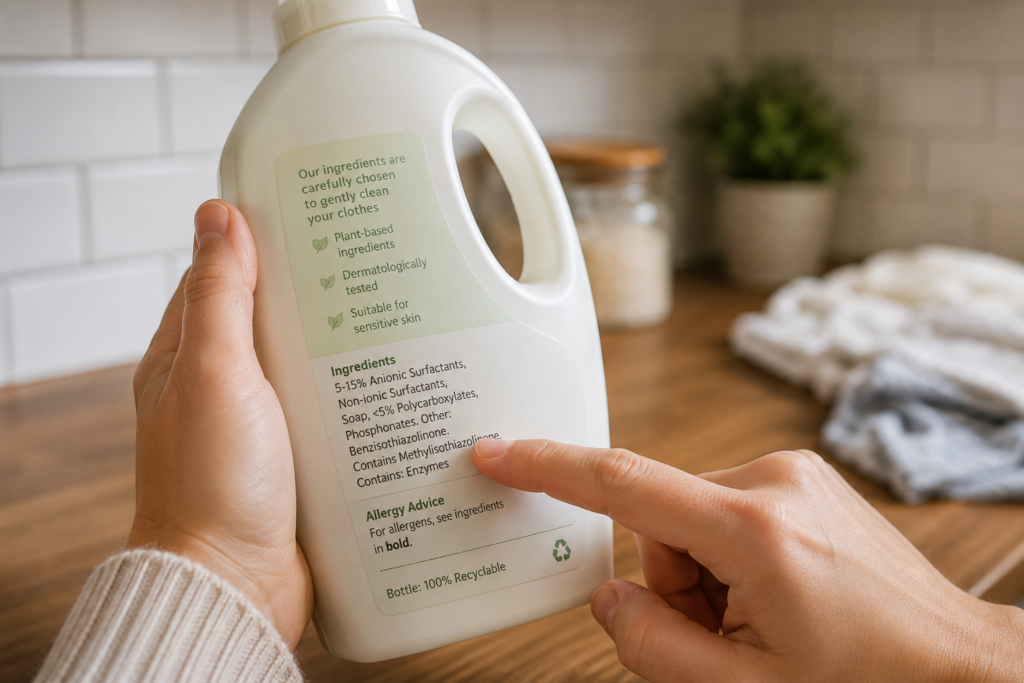
The confusion comes from the marketing. Products labelled sensitive, gentle, or dermatologically tested can still contain fragrance compounds, optical brighteners, and other ingredients that trigger reactions in people with skin sensitivities. Understanding the difference between what the label claims and what the ingredient list actually contains narrows the choice down quickly and removes months of switching between products that cause the same problem for different reasons.
More practical advice on low-energy laundry routines and running costs on the Laundry & Drying Efficiency hub — including how to get the most from a 30°C wash without losing cleaning performance.
What Actually Causes Skin Reactions to Laundry Detergent
The two most common causes of detergent-related skin reactions are fragrance and enzymes — and most standard laundry detergents contain both.
Fragrance is the leading culprit. Synthetic fragrance compounds are among the most common contact allergens in household products. The problem isn’t just the smell — fragrance chemicals bind to fabric fibres and stay in contact with skin for the entire time clothing is worn. A detergent that smells clean and fresh in the drum can be delivering a consistent low-level irritant against skin throughout the day. Products labelled fragrance-free rather than unscented are the ones to look for. Unscented can mean fragrance has been added to mask other smells, whereas fragrance-free means no fragrance compounds were used at all. That distinction matters considerably for anyone whose reactions are fragrance-driven.
Enzymes are the second common trigger. Biological detergents use enzymes — primarily protease, amylase, and lipase — to break down protein, starch, and fat-based stains. These enzymes are effective at cleaning, particularly at lower temperatures, but they can cause skin irritation in people whose skin is already compromised. Non-biological formulas don’t use enzymes, which is why non-bio is the standard recommendation for anyone with eczema, psoriasis, or persistent skin sensitivity. The cleaning performance of a good non-bio liquid at 30°C or 40°C is sufficient for everyday household laundry — the difference only becomes meaningful on heavy staining, where pre-treatment handles the gap.
Optical brighteners are worth understanding too. Many standard detergents include chemical brighteners that absorb UV light and re-emit it as visible blue-white light, making whites appear brighter. These compounds sit on fabric fibres after washing and can irritate sensitive skin — particularly for people who spend time in sunlight while wearing treated clothing, and for anyone with conditions such as polymorphic light eruption or solar urticaria where UV-activated residues on skin or clothing aggravate symptoms. Fragrance-free, enzyme-free formulas typically exclude optical brighteners too, but it’s worth checking the ingredient list specifically if photosensitive skin conditions are a factor.
A note on wash temperature and sensitive-skin detergents. Non-bio detergents without enzymes perform reliably at 30°C on everyday laundry — clothing, bedding, and towels — without difficulty. If you’re washing sensitive-skin laundry at 30°C to keep costs down, the actual cost difference between wash temperatures is worth knowing before deciding which cycle to default to.
The 5 Worth Buying
1. Ecover Zero Non-Bio Laundry Liquid — Best Overall for Sensitive Skin
Ecover Zero is the recommendation that comes up most consistently across UK dermatology communities, eczema forums, and allergy-focused buying guides. The formula is 0% fragrance and 0% enzyme, made with plant-based ingredients, and carries the British Allergy Foundation’s seal of approval — an independent assessment rather than a brand’s own claim, which gives it considerably more credibility than a standard dermatologically tested label.
We switched to it for school uniform washing after one of our children developed a reaction to a standard non-bio that had worked fine for years. The reaction stopped within two washes. The Ecover Zero laundry liquid cleans effectively at 30°C, handles children’s clothing and bedding without difficulty, and leaves no fragrance residue on fabric. UK reviewers with eczema and chemical sensitivities consistently note it as the product that stopped reactions that persisted through multiple other sensitive-skin alternatives. The 5L refill size is the best value option — significantly cheaper per wash than the smaller bottles and reducing plastic packaging.
The honest note: Ecover Zero doesn’t contain enzymes, which means heavy staining — grass knees, muddy sports kit, food stains on school shirts — benefits from a pre-treatment before washing. A small amount of washing-up liquid applied directly to the stain before it goes in the machine handles most everyday staining without compromising the fragrance-free wash. Pre-treating stains before a 30°C wash is one of several small habits that build a genuinely low-energy laundry routine without losing cleaning performance.
2. Surcare Concentrated Non-Bio Liquid — Best Completely Fragrance-Free Option
Surcare is the detergent that UK eczema communities and allergy specialists have recommended for decades. Where Ecover Zero is fragrance-free with a gentle plant-based formulation, Surcare is stripped back further — no fragrance, no dye, no optical brighteners, and no unnecessary additives of any kind. The formula contains the surfactants needed to clean and essentially nothing else. For people with severe chemical sensitivities or multiple confirmed contact allergens, that distinction matters considerably.
The Surcare non-bio laundry liquid is the product people reach for when everything else has failed — including other sensitive-skin alternatives that still contain one ingredient too many. A family member with both fragrance sensitivity and a reaction to certain plant-based surfactants in the Ecover range found Surcare was the only mainstream option that caused no reaction at all. That’s the specific gap it fills: not a general sensitive-skin option, but the option for skin that has responded badly to everything else.
The concentrated formula means the bottle lasts considerably longer than the size suggests. It performs reliably at 30°C and 40°C on everyday laundry without difficulty.
The honest note: Surcare can be harder to find in supermarkets than it used to be. Availability varies regionally and it occasionally goes out of stock locally. Amazon UK is the most reliable source for regular supply, and buying in multiples when it’s available is worth doing.
3. Persil Non-Bio Liquid — Best for Families Needing Sensitive and Effective
Persil Non-Bio is the sensitive-skin option for households where stain removal performance still needs to hold up across school uniform, sports kit, and general family washing. It’s recognised by the British Skin Foundation and dermatologically tested — credentials that carry more weight than in-house labelling — and it performs noticeably better than the enzyme-free alternatives on everyday staining at 30°C without pre-treatment.
The Persil Non-Bio laundry liquid does contain a mild fragrance — it’s non-biological and considerably gentler than standard bio detergents, but it isn’t fragrance-free in the way Ecover Zero and Surcare are. For most people with moderately sensitive skin or general skin sensitivity rather than confirmed fragrance allergy, this is the right balance — better cleaning performance than the completely fragrance-free options, gentle enough to stop the reactions that bio detergents cause.
For families doing daily family washing who want to stop the cycle of bio detergent skin reactions without moving to a specialist product that requires pre-treatment for every stained item, Persil Non-Bio is the practical answer that handles most of what a busy household produces.
4. Fairy Non-Bio Liquid — Best Budget-Accessible First Switch
Fairy Non-Bio has been the standard UK first recommendation for babies and children with sensitive skin for years — widely available in every supermarket, accessibly priced, and consistently gentle enough for most people with non-severe skin sensitivity without requiring a specialist purchase. The formula is non-biological with a mild fragrance significantly less intense than standard detergents, and it’s widely recommended by UK health visitors and dermatologists as the first switch for babies and children showing eczema symptoms.
When our youngest was a baby we used Fairy Non-Bio for the first year without any issues — it was the obvious starting point before we understood the difference between non-bio and completely fragrance-free. For a family making the first change away from a standard bio detergent after noticing skin reactions, it’s often the most practical starting point. Available immediately at any supermarket, no specialist search required, and effective for everyday family washing at 30°C and 40°C. The Fairy Non-Bio laundry liquid resolves enzyme-triggered reactions immediately and reduces fragrance-triggered reactions for most people with moderate sensitivities.
The honest note: Fairy Non-Bio does contain fragrance. For anyone who has specifically identified fragrance as their trigger, or whose reactions persist after switching from bio to non-bio, moving to Ecover Zero or Surcare is the next step.
5. Ecover Zero Non-Bio Powder — Best Value per Wash for Larger Households
The powder version of Ecover Zero carries the same fragrance-free, enzyme-free, BAF-approved formula as the liquid — at a significantly lower cost per wash at the 4kg box size. For a household doing five or more washes per week on a sensitive-skin formula, the powder works out meaningfully cheaper than the liquid over a month of regular use without any compromise on the skin-safety credentials.
The 4kg box provides 80 washes at standard dosing — enough for a family of four’s regular laundry for several weeks. The Ecover Zero laundry powder dissolves reliably at 30°C and 40°C for most loads, though at very cold temperatures or in shorter cycles some powder may not dissolve fully. Placing the powder directly in the drum rather than the drawer improves dissolution at lower temperatures — worth doing as a habit for cooler washes.
The honest note: powder format is less convenient than liquid for pre-treating stains. For households doing heavy volume weekly washing where the cost saving is the priority, the powder is the right choice. For households doing smaller loads with more variable staining, the liquid is more versatile.
What Else to Check When Skin Reactions Persist
Switching to a fragrance-free non-bio detergent resolves most detergent-related skin reactions. When reactions continue despite switching, these steps are worth trying before assuming the new detergent is still the problem.
Rinse cycle and detergent residue. Detergent residue left on fabric after washing is the most common cause of ongoing skin irritation even after switching to a gentler formula. Running an extra rinse cycle, or ensuring the machine’s rinse temperature is correct, removes residue that a single rinse leaves behind. Hard water areas — much of England south and east of the Pennines — make residue harder to rinse out. Using slightly less detergent than the recommended dose and running an additional rinse addresses this for most people. Detergent residue left in fabric after washing doesn’t just cause skin reactions — it’s also one of the main reasons clothes smell damp even after drying properly.
The fabric softener trap. This is the mistake most people make when switching to a sensitive-skin detergent and the one that causes the most confusion. A fragrance-free detergent paired with a standard fabric softener reintroduces exactly the fragrance compounds the detergent switch was supposed to remove. The fabric softener coats every fibre of every garment — often more thoroughly than the detergent itself — and stays there throughout the day in contact with skin. Switching detergent while keeping a standard softener produces no improvement for fragrance-sensitive skin and is frequently the reason people conclude that sensitive-skin detergents don’t work.
Ecover Zero and Surcare both produce matching fragrance-free fabric conditioners that pair correctly with their detergents. For skin that’s reacting to fragrance, replacing the softener at the same time as the detergent is necessary rather than optional. For people with the most severe sensitivities, skipping fabric softener entirely — or using a small amount of white vinegar in the softener drawer, which softens fabric without fragrance — is worth trying before concluding the new detergent isn’t working.
A clean machine also makes a meaningful difference to how well eco and low-temperature detergents perform — residue from previous bio washes can interfere with gentler formulas in ways that are easy to mistake for the new detergent not working.
Washing machine drawer and drum. A machine that hasn’t been cleaned recently holds residue from previous detergent loads — including bio enzyme residue — that contaminates sensitive-skin washes. Running a 60°C maintenance wash with a machine cleaner before switching to a new sensitive-skin formula removes residue that would otherwise undermine the switch for the first several washes.
A note on pods and capsules. Fragrance-free pod options are more limited than liquid or powder alternatives and pods can’t be dose-adjusted for smaller loads — you get the full dose regardless of how little washing is in the machine. For sensitive skin where getting the detergent concentration right matters, liquid or powder gives considerably more control. If pods are the preferred format for convenience, check the ingredient list carefully — most mainstream pod options contain fragrance even in non-bio varieties.
Which Detergent for Your Household
For the most sensitive skin, confirmed fragrance allergies, or eczema that has persisted through other sensitive-skin alternatives: Ecover Zero Liquid or Surcare. Both are genuinely fragrance-free with independent allergy certification. Surcare is the option when even plant-based surfactants in Ecover have caused reactions.
For families with moderately sensitive skin who still need strong stain performance without pre-treating everything: Persil Non-Bio. Better cleaning at low temperatures than the enzyme-free alternatives, mild fragrance, British Skin Foundation recognised.
For a budget-accessible first switch away from bio detergent: Fairy Non-Bio. Available immediately, gentle enough for most non-severe sensitivities, the natural starting point before moving to a fully fragrance-free formula if reactions persist.
For larger households doing high-volume washing on a sensitive-skin formula: Ecover Zero Powder at the 4kg size. The same formula as the liquid at a lower cost per wash — the one that makes daily sensitive-skin laundry genuinely affordable over a full season of regular use.
Related Guides

About The Author – Andrew Marshall
Andrew Marshall is a Scottish homeowner and the creator of Save Wise Living. He shares practical ways to reduce energy bills, improve home efficiency, and make everyday household routines cheaper and simpler.