
Last Updated: 11th March 2026
If you’ve bought a kitchen appliance recently, you’ll have seen the A–G energy label on the front. Most people glance at it, notice the letter, and move on. But the label contains a lot more useful information than most buyers realise — and understanding it properly can make a real difference to both what you spend upfront and what you pay to run it.
When we replaced our fridge freezer a couple of years ago, spending an extra twenty minutes understanding what the label actually meant changed which model we bought. The running cost difference over five years was more significant than the price difference between the two models.
This guide explains the UK energy label system properly — what changed in 2021, what each part of the label means, and how to use it to make smarter decisions when buying kitchen appliances.
What Changed: From A+++ to A–G
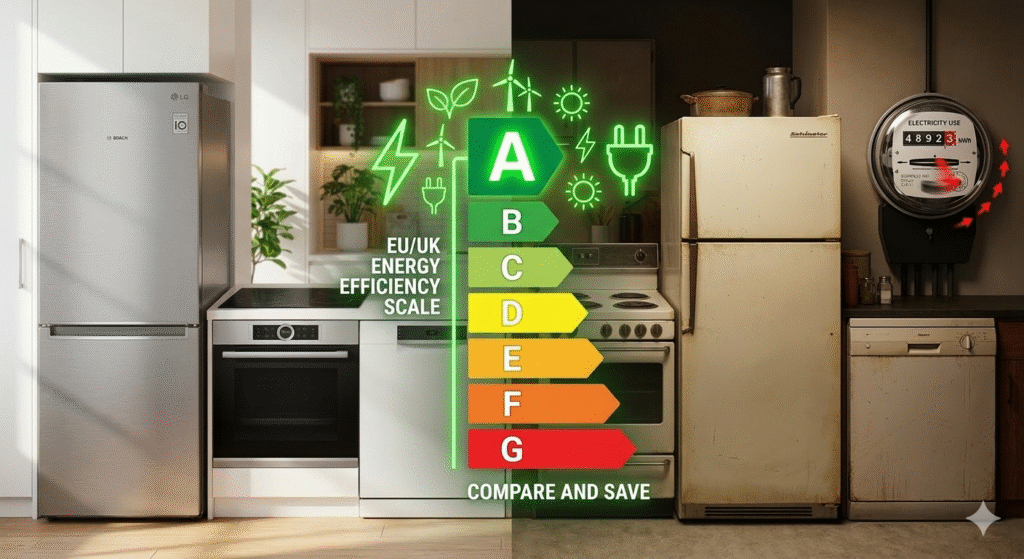
Before 2021, energy labels were cluttered with A+, A++, and A+++ ratings — making it hard to tell which appliances were truly efficient. The updated energy ratings for kitchen appliances now follow a stricter A–G scale, where:
- A = best-in-class efficiency
- G = least efficient
Under the old system, almost everything was A+, A++, or A+++ — which sounds impressive but made genuine comparison almost impossible. A washing machine rated A+++ in 2018 might only scrape a C or D on today’s scale.
Under the new rules, A-rated appliances are genuinely rare. Most good modern appliances sit between B and D — which surprises a lot of buyers who assume anything new should be near the top of the scale. It doesn’t mean they’re inefficient — it means the scale is now honest.
The practical takeaway: don’t be put off by a B or C rating on a new appliance. Compare the actual kWh figure on the label rather than just the letter.
When we bought our washing machine last year I nearly dismissed a perfectly good B-rated model assuming it wasn’t efficient enough — that assumption would have cost us more upfront for no meaningful running cost difference.
How to Read Energy Ratings for Kitchen Appliances
Each energy label includes more than just a letter. Here’s what to look for:
- Annual energy consumption (kWh/year)
- Noise level (especially for dishwashers and fridge freezers)
- Water usage (for dishwashers and washing machines)
- Capacity (litres or kg)
- QR code linking to EU/UK product database
The most important number is the annual kWh figure — not the letter. Two appliances can both be rated B but have meaningfully different kWh figures depending on size and design. A smaller B-rated fridge freezer using 180 kWh per year will cost less to run than a larger B-rated model using 230 kWh — even though both carry the same letter.
At current UK electricity rates of around 28p per kWh, the difference between a 150 kWh and a 300 kWh appliance is roughly £42 per year. Over ten years — which is a reasonable lifespan for a fridge freezer or washing machine — that’s over £400.
The QR code on the label links to the EPREL product database where you can see full test results for any registered appliance. It takes thirty seconds to scan and gives you far more detail than the label itself.
These details help you compare appliances within the same category — and spot hidden costs. For a full breakdown, check the UK Government’s energy label guide.
What an ‘A’ Rated Appliance Actually Looks Like
A-rated appliances are worth considering if you’re replacing something that’s five or more years old and runs daily — the running cost saving compounds significantly over time.
Bosch Series 4 Slimline Dishwasher SPS4HMW49G — A-rated for both energy and water use, and genuinely quiet at under 46 dB. The slimline format suits smaller UK kitchens without sacrificing a full place setting capacity.
Bosch Series 2 Washing Machine WGE03408GB — 8kg capacity, 1400rpm, A-rated with EcoSilence Drive. The SpeedPerfect function reduces cycle time without increasing energy use — useful for busy households.
Samsung SpaceMax Fridge Freezer — A-rated with AI Energy Mode that adjusts cooling based on usage patterns. Frost-free and quieter than most fridge freezers at this price point.
How to Compare Appliances Within the Same Category
Energy ratings only make sense when comparing like for like:
- Compare fridge vs fridge, not fridge vs oven
- When comparing energy ratings for kitchen appliances, always look at kWh/year
- Consider size and usage — a smaller B-rated fridge may use less energy than a large A-rated one
Always check the label’s full breakdown before buying. The letter is a quick filter — it tells you roughly where an appliance sits. But two C-rated fridge freezers can have annual consumption figures that differ by 80–100 kWh, which at current UK rates is around £25 per year. Over ten years that’s £250 from two appliances with identical ratings. The kWh figure is where the real comparison happens.
Energy Ratings vs Real-World Use
Energy labels are based on standardised testing — but your habits matter:
- A B-rated dishwasher used once daily may cost less than an A-rated one used twice
- Overfilling your fridge or washing machine can reduce efficiency
- Pairing appliances with smart plugs or energy monitors lets you track actual consumption — our Smart Kitchen Gadgets that save electricity guide covers the best options currently available in the UK.
Temperature settings matter more than most people realise. A fridge set to 3°C rather than 1°C uses noticeably less energy — the EU recommended range is 3–5°C for the fridge compartment and -18°C for the freezer. Running either colder than necessary wastes electricity every hour of every day.
Placement affects efficiency too. A fridge freezer next to an oven or in direct sunlight works harder to maintain temperature. Leaving a gap at the back and top for ventilation — usually specified in the manual — makes a measurable difference to how hard the compressor works.
For washing machines and dishwashers, the eco or energy-saving programme almost always uses less electricity than the standard programme, even if the cycle takes longer. The energy label rating is tested using these programmes — so if you never use them, the real-world cost will be higher than the label suggests.
Use ratings as a starting point, not the final word.
Frequently Asked Questions
Is a B energy rating good for a fridge freezer?
Yes — under the current A–G scale introduced in 2021, a B-rated fridge freezer is genuinely efficient. Most new appliances sit between B and D. A-rated models exist but are rare and command a premium price. B is a strong real-world choice.
What does the kWh figure on the label mean?
It’s the estimated annual electricity consumption based on standardised testing. Multiply it by your unit rate — currently around 28p per kWh in the UK — to get an approximate annual running cost. A 200 kWh appliance costs roughly £56 per year to run.
Are old A+++ appliances still efficient?
By old standards, yes. By new standards, an A+++ appliance from before 2021 would typically rate around C or D on the current scale. It’s not inefficient, but it’s not top-tier under modern testing either.
Does the energy rating change how I should use the appliance?
Not directly — but the label is tested using specific programmes and settings. Using a dishwasher on quick wash rather than eco mode, or a washing machine on 60°C rather than 40°C, will cost more to run than the label suggests regardless of the rating.
Where can I find more detail than the label shows?
Scan the QR code on the label — it links to the EPREL database where full test data is available for every registered appliance sold in the UK and EU.
Use Ratings as a Guide, Not Gospel
The energy label is the most useful tool you have when buying a kitchen appliance — but it’s a starting point, not the final answer. The letter matters less than the kWh figure. The kWh figure matters less than whether the appliance suits how your household actually uses it.
A well-chosen B-rated appliance used efficiently will often cost less to run than a poorly chosen A-rated one that’s too large, badly positioned, or set to the wrong temperature.
Read the label properly, check the kWh figure, and factor in how you actually cook, wash, and store food. That combination beats chasing the highest letter every time.
More appliance guides and energy-saving advice in our Smart Kitchen & Appliances Hub.
Related Guides Worth Reading

About The Author – Andrew Marshall
Andrew Marshall is a Scottish homeowner and the creator of Save Wise Living. He shares practical ways to reduce energy bills, improve home efficiency, and make everyday household routines cheaper and simpler.