
Last Updated: April 2026
The kitchen is one of the most power-hungry rooms in the house. Between the fridge running continuously, the kettle boiling multiple times a day, the oven preheating for twenty minutes before anything goes in, and the various smaller appliances sitting on standby, it’s easy to burn through several kilowatt-hours a day without noticing. At 24p per kWh, that adds up faster than most people realise — and most of the waste doesn’t require spending money to fix.
A lot of it is habit. How you use what you already have, in what order, and whether you’re heating more than you actually need. This covers the changes that genuinely move the needle on a UK electricity bill, with real numbers at current rates so you can judge which ones are worth prioritising first.
The Smart Kitchen and Appliances hub covers the appliances and gadgets that fit into a lower-energy kitchen setup — worth a look if you’re thinking about upgrades alongside habits.
Start With What’s Actually Costing You
Before changing anything, it helps to know where the kitchen electricity is actually going. The fridge freezer accounts for around 12% of a typical UK home’s total electricity bill — it runs every hour of every day without being asked. Wet appliances like the dishwasher and washing machine account for another 14–16%. Cooking appliances — oven, hob, kettle, microwave — sit at around 4% of total home energy use, which sounds low but translates to a meaningful daily cost at current rates.
Standby power is the less visible drain. Citizens Advice estimate the average UK household spends around £45 a year powering devices that aren’t actively being used — things sitting on standby, chargers left plugged in with nothing attached, appliances with clocks or displays that never fully switch off. In the kitchen specifically this includes the microwave clock, the coffee machine warming light, and anything with a power indicator that glows overnight.
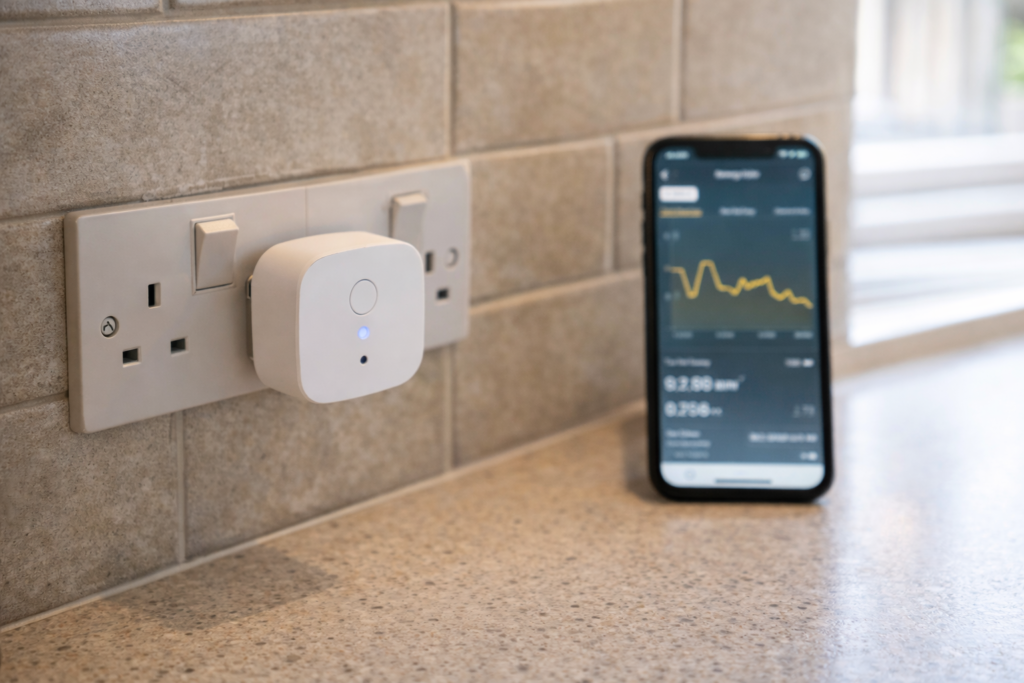
The most useful thing you can do before applying any of the habits below is to find out which appliances are actually costing the most. A smart plug with energy monitoring plugged into each appliance in turn for a week gives real data rather than assumptions. Without it you’re guessing. With it you know exactly where the money is going and which habits will actually make a difference. What it actually costs to boil water using different methods surprises most people who’ve never looked at the numbers — the cost comparison across kettle, hob and microwave is a good place to start.
Smart Plugs — The Most Useful Kitchen Upgrade Under £15
A smart plug with energy monitoring does two things: it tells you precisely how much electricity an appliance is using, and it lets you schedule or remotely control when that appliance draws power. For a kitchen that runs on routines, both of these are genuinely useful.
The Tapo P110M is the one worth recommending without qualification. It’s Matter-certified — which means it works across Apple HomeKit, Alexa, and Google Home without being locked to one ecosystem — the energy monitoring is detailed and presented clearly in the app, and the compact design means it doesn’t block the adjacent socket on a standard UK double outlet. Setup takes around three minutes. I have several in the kitchen now and the coffee machine was the first thing I plugged in.
A typical coffee machine left on standby draws 1–5W continuously. Small per hour, but left on all day every day it adds £3–8 a year without making a single coffee. The more useful discovery comes when you find the warming plate consumption — a coffee machine keeping coffee warm draws 40–60W, costing around 1p per hour. That sounds trivial until you realise it’s been doing it for four hours every morning while nobody is drinking from it. A schedule in the Tapo app cuts power after thirty minutes from the last brew of the morning and handles it automatically.
A second plug on the microwave eliminates its standby drain — most UK microwaves draw 2–3W continuously just to power the clock display, costing around £5 per year for a clock most people check on their phone instead. An overnight power cut schedule via the app removes it entirely.
A Tapo P110M smart plug costs around £12 on Amazon UK. The data it provides changes how you make decisions about what to leave on, what to schedule, and what to replace — which is worth considerably more than the cost of the plug itself.
The Kettle — Where Most UK Households Waste More Than They Think
Over 90% of UK households use the kettle every day. Around 40% use it five or more times a day. It’s the most frequently used kitchen appliance in the country, which means habits around it compound significantly across a year.
Boiling 1 litre of water in a standard 3kW kettle uses approximately 0.11kWh, costing around 2.6p per full boil. That sounds cheap. But most UK households are boiling far more water than they’re actually using. A kettle filled to the 1.5 litre mark for two cups of tea wastes roughly half its energy on every boil. The Energy Saving Trust estimates that not overfilling the kettle saves around £12 a year — which is meaningful for a habit that costs nothing to change.
Fill the kettle with what you actually need, not to a comfortable waterline. If you’re making two mugs, fill to the two-mug mark. If you’re making one, fill to one. This single change across a household doing four or five boils a day saves around 10p per day — roughly £35 a year. No product required.
If you’re replacing a kettle, the features worth paying for are a low minimum fill — 250ml or less, so a single cup doesn’t require boiling half a litre — and a fast boil, because a kettle that heats a cup in 45 seconds uses the element for less total time than one that takes two minutes. The low-energy kettles worth buying under £50 covers the specific models with single-cup markings and fast boil that remove the overfilling temptation by making the right amount the default. A fast boil energy efficient kettle costs the same as a standard one and earns back the difference in the first month.
In a hard water area — which covers most of England south of the Midlands and patches of Scotland including parts of the central belt — limescale builds on the heating element and makes it work harder to produce the same result. A kettle with visible limescale uses measurably more electricity than a descaled one. Descaling every four to six weeks in a hard water area keeps the element running at its rated efficiency. White vinegar solution or a proprietary descaler both work — run a full boil of the solution, discard, rinse twice, done.
The Fridge and Freezer — The Appliances You Can’t Switch Off
The fridge freezer is unique because it runs every hour of every year. A modern A-rated fridge freezer uses approximately 200kWh annually, costing around £48 at current rates. An older model from ten or more years ago can use 400kWh — around £96 per year. The difference between keeping an old fridge freezer and replacing it with an efficient modern one is around £48 per year in running costs, compounding every year it runs.
That replacement decision is a long-term one. The habits that apply to any fridge freezer are cheaper and faster to implement.
Temperature is the first thing to check. A fridge set colder than necessary runs the compressor harder and uses more electricity. The correct range for a UK kitchen is 3–5°C for the fridge and -18°C for the freezer. Most households have theirs set colder than needed because the dial positions aren’t intuitive. A fridge thermometer UK costs around £5 and removes the guesswork entirely — the most impactful £5 you can spend on reducing fridge running costs.
The condenser coils at the back or underneath the fridge need to dissipate heat into the room to work efficiently. A fridge pushed hard against the wall with no airflow runs the compressor longer for the same cooling effect. Pulling it out 5cm and cleaning the coils once or twice a year keeps it running at its rated efficiency. Don’t put hot food directly into the fridge either — letting it cool to room temperature first means the compressor doesn’t have to work harder to bring the internal temperature back down after every meal.
Check the door seals. A seal that isn’t closing properly lets cold air escape continuously, running the compressor harder than necessary. Close the door on a piece of paper — if it slides out easily, the seal needs replacing. Replacement door seals are inexpensive and widely available for most UK fridge models.
If your fridge freezer is more than ten years old, the A to C rated models worth replacing it with pay for themselves in reduced running costs faster than most people expect — particularly if you’re currently running a fridge that predates the current energy label system entirely.
The Oven — Where Batch Cooking Changes Everything
A standard 2kW electric oven costs around 48p per hour to run at 24p per kWh. Most UK households preheat it, cook one meal, switch it off, and discard all that stored heat — paying to warm a large insulated box for thirty to forty minutes before anything goes in, then paying again for the cooking itself.
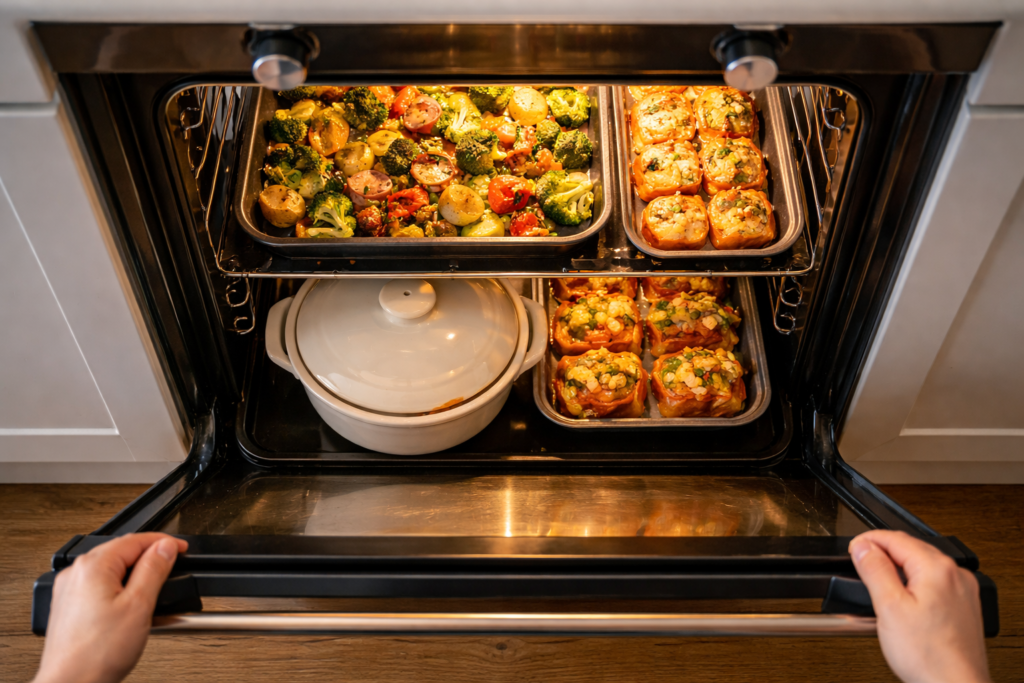
Batch cooking is the single highest-impact habit for reducing oven running costs. Cooking two or three meals at once uses the same electricity as cooking one — the oven is already at temperature, already maintaining that temperature. A household that batch cooks twice a week and refrigerates or freezes the extra portions halves its oven electricity use for those meals without eating differently or cooking more often.
Don’t preheat for longer than necessary. Most ovens reach temperature in ten to fifteen minutes. Switching the oven on when you start preparing the meal rather than when you begin preparation means paying for fifteen to twenty minutes of empty oven running. Switch it on later than feels natural.
Use the residual heat. An electric oven retains significant heat for ten to fifteen minutes after switching off. For dishes that need gentle finishing — casseroles, bakes, anything that doesn’t require precise high temperature at the end — switching the oven off five to ten minutes early completes the cooking with no electricity use at all. Keep the door closed throughout. Every time you open it during cooking the internal temperature drops 15–20°C instantly, forcing the element to fire again to recover.
For smaller meals — a portion of fish, reheating leftovers, cooking for one — an air fryer or microwave uses a fraction of the electricity an oven does for the same result. The oven is most economical when cooking for multiple people or multiple portions simultaneously. For solo or couple cooking the economics shift significantly toward smaller appliances, and the actual cost per meal between cooking methods varies more than most people realise when they’ve never run the numbers.
The Hob — Small Habits With Compounding Returns
Use the right pan size for the ring you’re using. A small pan on a large ring wastes a significant proportion of the generated heat into the air rather than into the food. Match pan size to ring size — it makes a noticeable difference to how quickly the contents heat and to how long the ring needs to run.
Use lids. A pan with a lid reaches boiling temperature significantly faster than one without — the lid traps heat that would otherwise escape into the kitchen. For pasta, rice, vegetables, anything that needs boiling water, the lid makes the pan more efficient and reduces cooking time. Less time on the hob means less electricity used.
For anything requiring boiling water, boil it in the kettle first and pour it into the pan. A kettle brings water to 100°C in under two minutes. An electric hob starting from cold takes considerably longer and the efficiency of the transfer is lower. This one habit saves several pounds a year for any household cooking pasta or similar dishes regularly.
Turn the hob off slightly early. Most hobs retain enough heat in the pan and food to finish cooking for two to four minutes after the element cuts out. For scrambled eggs, pasta, rice — anything needing gentle finishing — the stored heat completes the cooking at no cost.
The Dishwasher — The Setting Most People Never Use
Modern dishwashers have an eco mode that runs at lower water temperature for longer to clean dishes using significantly less electricity than a standard cycle. Eco mode typically uses 0.6–0.8kWh per cycle compared to 1.0–1.5kWh for a standard hot wash. At 24p per kWh that’s a saving of 10–17p per cycle — roughly £35–60 per year for a household running the dishwasher daily, from one setting change.
For normally soiled dishes — the everyday plates, glasses, and cutlery that make up most household loads — eco mode cleans perfectly. For heavily soiled pots or baked-on food, a hotter cycle makes sense. Use eco mode as the default and switch up only when actually needed.
Skip the heated drying cycle. Open the dishwasher door at the end of the wash and let the residual heat evaporate the moisture naturally — it takes twenty to thirty minutes and uses no electricity at all. The heated dry cycle exists because manufacturers assume people won’t do this, but it’s the easiest electricity saving in the entire kitchen. Just open the door.
Standby Power — The Slow Drain That Adds Up
Every appliance in the kitchen with a display, clock, or power light is drawing electricity continuously. The individual amounts are small — 1W here, 3W there — but across a kitchen of appliances running twenty-four hours a day the total reaches £40–50 a year. The high-priority items to switch off at the wall are the microwave overnight, the coffee machine, under-cabinet lighting on a transformer when not in use, and any device with a display that serves no purpose after the kitchen closes for the evening.
A smart extension lead with individual socket control for the counter area solves this without having to unplug anything manually. Schedule the whole strip to cut power after a set time and the standby drain from multiple appliances disappears simultaneously.
LED Kitchen Lighting — The Highest-Return Change in the Room
Kitchen lighting is often the last thing people change when reducing electricity costs, partly because it doesn’t feel like a large cost. In a kitchen with six GU10 halogen spotlights running for four hours every evening, the maths is revealing. Each halogen uses 50W. An LED replacement uses 5–7W for the same light output. Six halogens running four hours per evening cost around 29p. Six LEDs running the same time cost around 3p. Across a year that difference is roughly £95 — and most UK kitchens have more than six spots.
GU10 LED bulbs compatible with standard halogen fittings cost £2–4 each and last ten times longer. No rewiring, no installation, just swap them over. It’s the single highest-return change you can make to a UK kitchen electricity bill and it takes fifteen minutes.
The Microwave — The Most Underused Cooking Tool in the Kitchen
A standard 1kW microwave costs around 2.4p for ten minutes of use. An electric oven costs around 8p for ten minutes, plus the preheat cost on top. For reheating portions, cooking vegetables, defrosting, and preparing small meals, the microwave costs a fraction of what the oven does for an equivalent result.
Reheating last night’s pasta in the microwave for three minutes uses around 1.2p of electricity. Putting the same portion in the oven to reheat uses the oven for twenty minutes plus preheat time — around 20p or more depending on how long preheat runs. For a household that regularly reheats food, treating the microwave as the default for small tasks and reserving the oven for batch cooking compounds into a meaningful annual saving.
Where to Start
If you’re making one change this week, put a smart plug with energy monitoring on the appliance you’re most unsure about. The data it gives you is worth more than any assumption about what’s expensive. From there, the habits with the highest return for most UK households are stopping the overfilling of the kettle, switching to eco mode on the dishwasher as the default, batch cooking to reduce oven cycles, and swapping kitchen spotlights to LED if you haven’t already done it.
The total investment for a smart plug and a set of LED bulbs is under £30. The total annual saving from all of the habits above applied consistently in a typical UK kitchen runs to £80–150 per year at current electricity rates — with no change to what you eat, how you cook, or how clean your dishes need to be.
Related Guides

About The Author – Andrew Marshall
Andrew Marshall is a Scottish homeowner and the creator of Save Wise Living. He shares practical ways to reduce energy bills, improve home efficiency, and make everyday household routines cheaper and simpler.