
Last Updated: 31st March 2026
Induction hobs are the most energy-efficient way to cook in a UK home right now. Faster than gas, cheaper to run than a conventional electric ring, and considerably safer with young children in the kitchen. The surface stays cool while the pan heats directly — no burned hands on the hob itself, and no wasted heat escaping into the kitchen.
The problem is that most people use them the same way they used their old gas or electric hob and wonder why the results aren’t quite right. Induction cooking behaves differently — the heat is more immediate, more precise, and more sensitive to pan choice than anything most UK households have cooked on before. Get those habits right and an induction hob is a genuinely impressive kitchen tool. Get them wrong and you’ll be burning things on high settings that should have been on medium, wondering why certain pans won’t heat at all, and watching the glass surface slowly accumulate stains that shouldn’t be there.
We made most of these mistakes ourselves in the first month of switching. This covers the five that matter most — with honest fixes for each one.
More energy-efficient kitchen upgrades for UK homes are in our Smart Kitchen & Appliances Hub.
How Induction Actually Works — Worth Understanding Before You Cook
Induction hobs use electromagnetic coils beneath the glass surface to create a magnetic field. When you place a compatible pan on the zone, the field creates electrical currents within the pan’s base which generate heat — directly in the cookware, not in the hob surface itself.
This is why induction is so efficient — almost all the energy goes into heating the pan rather than the surrounding air. It’s also why the glass stays relatively cool and why pan compatibility matters more than on any other hob type. The field needs a ferromagnetic base to work. If the pan can’t interact with the magnetic field, nothing happens.
At 24p per kWh, a 2,000W induction hob running at full power costs 48p per hour. In practice most cooking happens at 60–80% power, which brings the typical hourly cooking cost to around 29–38p. That’s meaningfully cheaper per hour than a gas hob factoring in current gas unit rates, and considerably faster — which means the overall energy spent per meal is lower than the wattage alone suggests. For a direct comparison of what different cooking methods actually cost per hour at current UK rates, gas hob vs electric hob running costs breaks down the numbers honestly.
Mistake 1: Using Pans That Aren’t Compatible
This is the first thing every new induction hob owner discovers, usually by placing a favourite pan on the hob and watching nothing happen.
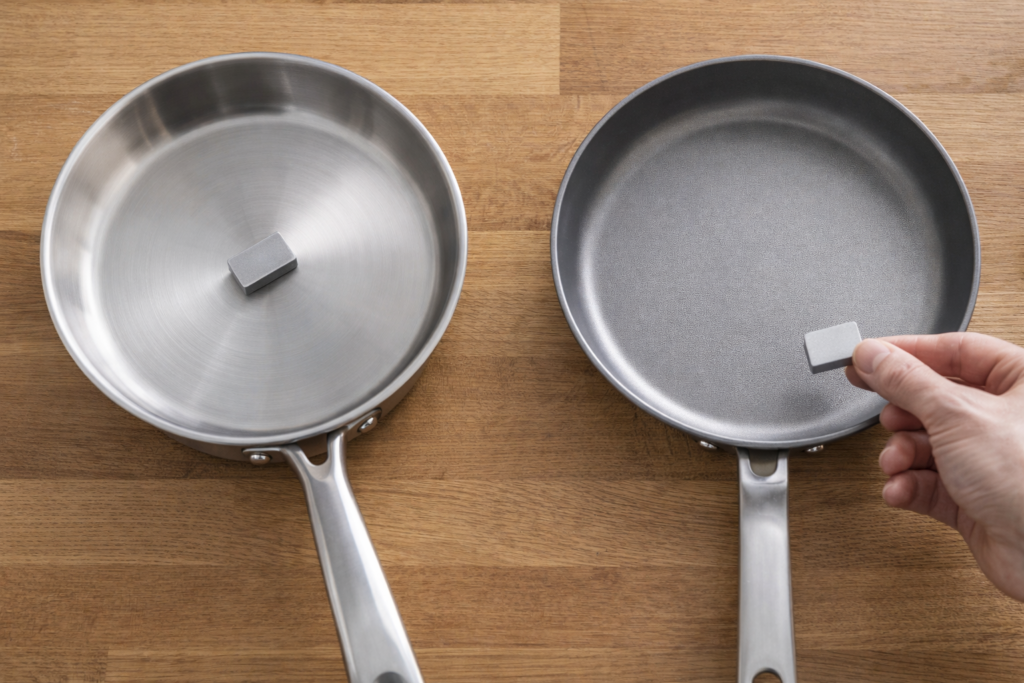
Induction hobs only work with pans that have a magnetic base — typically stainless steel with a magnetic layer, cast iron, or enamel-coated iron. Aluminium, copper, glass, and ceramic pans without a magnetic layer won’t work at all. The hob will beep and display an error code rather than heating.
The quickest check is a fridge magnet. Hold it against the base of the pan — if it sticks firmly, the pan is compatible. If it slides off or doesn’t attract at all, it won’t work on induction. This takes ten seconds and saves the frustration of discovering it mid-cook.
We had three pans that turned out to be incompatible when we first switched — a lightweight aluminium frying pan and two ceramic-coated pans that looked the part but had no magnetic base. Replacing them one by one with proper induction-compatible alternatives made more difference to the cooking experience than anything else in that first month.
A stainless steel induction cookware set is the most cost-effective way to replace incompatible pans in one go — sets covering the main pan sizes typically start around £35–60 and cover everything needed for everyday cooking.
If you have a pan you love that isn’t induction-compatible — a moka pot, a milk pan, or a smaller saucepan — an induction adapter plate sits between the hob and the pan and acts as a magnetic bridge. It’s not as efficient as using a proper induction pan directly but it works and costs under £15.
Mistake 2: Treating the Heat Settings Like a Gas Hob
On a gas hob, high means high but the response is gradual. On an induction hob, high means genuinely high and it gets there in seconds rather than minutes. Most new users set the hob too high for the first few weeks and burn things they’d never have burned before — garlic that should have softened gently, oil that should have been warm not smoking, sauces that should have simmered not boiled.
The adjustment is straightforward once you understand it but it takes a conscious change of habit. For most everyday cooking — frying, sautéing, making sauces — medium heat on an induction hob is equivalent to what high would have been on a gas ring. The boost or max function is genuinely useful for boiling a full pan of water quickly but it’s not for cooking most food.
Most induction hobs have 9 or 10 power settings. Settings 1–3 cover keeping warm and gentle simmering. Settings 4–6 cover most frying and sauce work. Settings 7–9 or max cover rapid boiling and searing. Starting lower than you think you need and adjusting up is a better default than starting high and compensating.
The precision available at low settings is one of induction’s genuine advantages over gas — holding a sauce at a slow simmer without it catching is considerably easier than managing a gas flame at the lowest setting. If you’re also looking at whether an air fryer could handle some of what you currently use the hob for, air fryer vs oven running costs covers where each appliance actually saves money in a UK kitchen.
Mistake 3: Getting Pan Size and Zone Placement Wrong
This one took us a while to diagnose. The scrambled eggs were cooking unevenly — one side firmer than the other — and the pan seemed fine. The problem turned out to be placement. The pan was sitting a centimetre off-centre and one side of the base wasn’t fully in the active field. Moved it to the middle and the problem disappeared immediately.
Each zone on an induction hob has a minimum and maximum pan diameter it can reliably detect and heat. Too small and the hob may not register the pan at all, or heat only the centre. Too large and the outer edges of the base sit beyond the coil and heat unevenly. The general rule is to match pan size to zone size as closely as possible. Most hobs have zones designed for 16–24cm pans — the sizes that cover the majority of everyday cooking.
Very small pans like milk pans and moka pots often cause detection issues, which is where the adapter plate mentioned in Mistake 1 becomes useful. Centre the pan on the zone every time — on a gas hob a slightly off-centre position matters less because the flame spreads. On induction the heat is generated directly in the base and placement makes a visible difference.
A cast iron skillet for induction hobs is the most reliable pan for even heat distribution on any zone size — the weight and solid magnetic base make it one of the most forgiving pans available for induction cooking.
For hobs with flexizone or bridge functions — where two zones combine for a single large pan or griddle — check the manual for minimum pan dimensions before use. A small pan on a bridge zone is one of the more common causes of the hob not responding as expected.
Mistake 4: Not Cleaning the Surface After Every Use
The worst induction hob mistake we made wasn’t a cooking error — it was leaving a pot of jam to cool overnight without wiping the hob down. The sugar had bonded to the glass by morning and took twenty minutes of careful work with the HG cleaner to remove. Wipe it warm and it takes ten seconds. Leave it until the next day and you’ll understand why this habit matters.
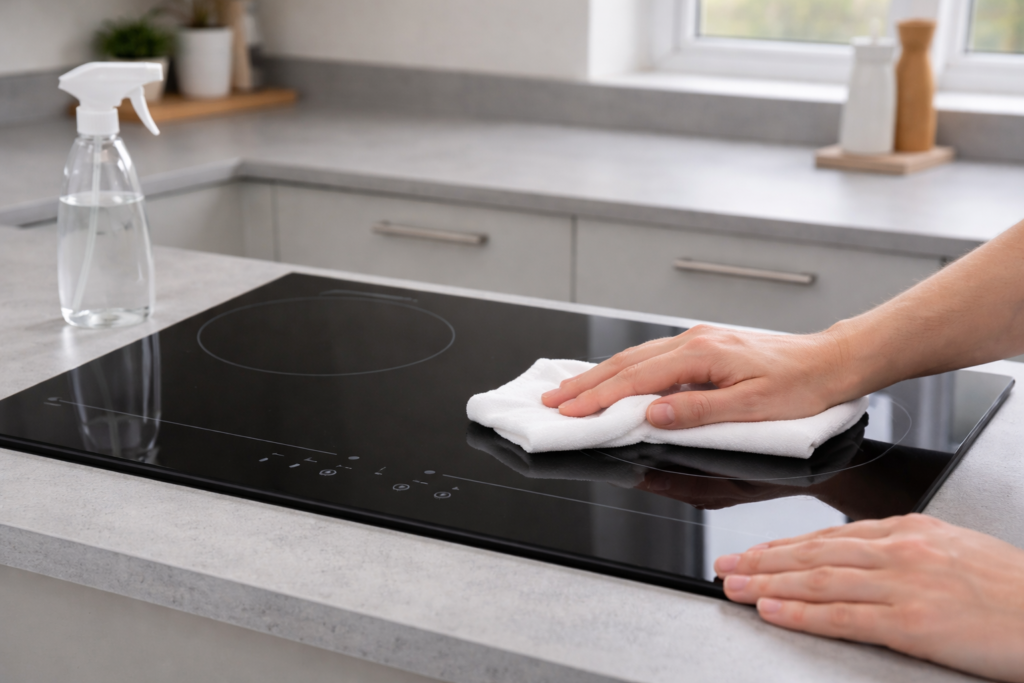
The cleaning routine that works is simple: wipe down after every use with a damp cloth while the surface is still slightly warm but not hot. Fresh spills come off immediately. Left until the next morning, the same spill requires considerably more effort.
For weekly maintenance, HG Hob Cleaner Spray is the most consistently recommended product in this category on Amazon UK — it removes grease and light scale without scratching the glass and leaves a protective shine. A 500ml bottle lasts months used weekly. If you’re building a more energy-efficient kitchen setup around your induction hob, smart kitchen gadgets that cut electricity bills covers the appliances and tools worth adding alongside it.
Avoid anything abrasive — scouring pads and harsh household cleaners will dull the surface permanently. Lift pans rather than sliding them across the glass. Sliding doesn’t immediately damage the surface but over time the micro-scratches accumulate and the glass loses its appearance. It’s a habit worth forming from day one.
Mistake 5: Running Multiple Zones at Full Power Simultaneously
Most induction hobs have a total power limit shared across all zones. Running every zone at maximum simultaneously often triggers automatic power reduction — the hob manages the load by cycling power across zones, which can cause uneven cooking if you’re not expecting it.
The better approach for busy cooking sessions is to stagger. Bring the water to boil on max, then reduce it to simmer before starting the frying pan. Sequence the zones rather than running all of them at full power at the same time. This produces better cooking results as well as staying within the hob’s power management limits.
Oversized pans that span across two zones cause similar issues — the hob detects an unusual load and may reduce power or trigger errors. Use pans that fit within a single zone unless your hob specifically supports bridge or flexizone cooking with larger cookware.
What About a Portable Induction Hob?
If you’re renting and can’t install a built-in hob, cooking in a caravan, or want an extra zone for busy meal prep, a portable induction hob is a practical and affordable option.
The AMZCHEF Single Portable Induction Hob (around £35–45, Amazon UK) is one of the most consistently reviewed options at this price point. 2000W with 10 temperature settings and 20 power levels covering 60°C to 240°C, a 3-hour timer, safety lock, and touch control panel. It runs on a standard UK plug and stores in a kitchen drawer when not in use.
It’s the kind of appliance that seems like a compromise until you actually use it — at which point the question becomes why you didn’t buy one sooner. For anyone cooking in a rented flat without a proper hob, or needing an extra ring at Christmas, it covers everything a built-in hob does for under £40. For households still deciding whether a portable hob or a full built-in model suits their setup, the best induction hobs for energy savings covers the built-in options worth considering at different price points.
All the same principles above apply — compatible pans, matched sizing, cleaning after use, and sensible power management.
Frequently Asked Questions
Can I use any pan on an induction hob? Only pans with a magnetic base — stainless steel, cast iron, or enamel-coated iron. A fridge magnet on the base is the quickest check. If it sticks firmly the pan will work. If it doesn’t attract, the hob won’t detect it.
Why does my induction hob keep switching off? The most common cause is an incompatible or incorrectly positioned pan. The hob’s detection system requires the pan to be centred on the zone with a magnetic base in full contact with the glass. The hob will also switch off automatically if no pan is detected for a set period — typically 30–60 seconds — which is a safety feature rather than a fault. Recentre the pan and the issue usually resolves immediately.
Is induction cheaper than gas to run? At current UK rates, induction is typically cheaper per meal than gas because around 90% of energy goes directly into the pan compared to 40–50% for gas. Induction’s speed advantage also means less total cooking time for the same result — which compounds the saving. The comparison shifts with unit price changes but induction’s efficiency advantage is consistent.
What’s the best way to clean burnt-on food? Soak a cloth in warm soapy water and lay it flat on the affected area for 10–15 minutes before attempting to remove it. For stubborn residue the HG Hob Cleaner Extra Strong version handles cooked-on food without the abrasion risk of a scouring pad. Never use a metal scraper or scouring pad on induction glass — the surface damage is permanent.
Do induction hobs work during a power cut? No — induction hobs require mains electricity to operate. During a power cut a portable gas camping stove is the practical backup option. A portable camping gas stove costs under £20 for a basic model and is worth keeping in the kitchen cupboard — it also earns its place for outdoor cooking and camping.
What We’d Actually Buy
For anyone setting up an induction kitchen from scratch — a proper induction-compatible stainless steel pan set is the first priority. Everything else is secondary to having the right cookware.
For cleaning — the HG Hob Cleaner Spray. Under £5, lasts months, and the difference between a hob that looks new after two years and one that looks scratched and dull usually comes down to whether this or a scouring pad was used for the weekly clean.
For portable cooking — the AMZCHEF single hob. Reliable, affordable, covers the main use cases, and stores easily when not needed.
The five mistakes above are all straightforward to avoid once you know about them. Induction cooking genuinely is faster, cheaper, and safer than gas or conventional electric — but only if the habits match the technology.
Related Guides

About The Author – Andrew Marshall
Andrew Marshall is a Scottish homeowner and the creator of Save Wise Living. He shares practical ways to reduce energy bills, improve home efficiency, and make everyday household routines cheaper and simpler.