
Last Updated: 5th March 2026
Quick answer: A heated airer costs around £35–£45 per year to run. A tumble dryer costs £90–£170. That gap is real — but whether switching makes sense for your household depends on things most comparison articles don’t bother to address. Here’s the full picture.
What Each One Actually Costs to Run
Most people don’t realise how much their tumble dryer costs until they actually sit down and do the maths. When I did, the number was higher than I expected — and it’s one of those costs that quietly adds up every single week without ever appearing as a single obvious charge on your bill.
A standard tumble dryer uses between 2.5 and 4.5 kWh per cycle. At the current Ofgem price cap rate of around 24–25p per kWh (October 2025), that’s roughly 60p to £1.10 per load. Run it three times a week across a full year and you’re spending between £90 and £170 just on drying. That’s a modern, reasonably efficient model — older dryers cost more and plenty of UK households still have them.
A heated airer sits in a completely different bracket. Most models run between 200W and 300W, drawing around 0.2 to 0.3 kWh per hour. A four-hour drying session costs somewhere between 20p and 30p. Three loads a week over a full year comes to roughly £35–£45.
The difference is £100 to £130 per year for most households. That’s not a rounding error — it’s a genuine saving that shows up on your bill.
One thing worth knowing if you’re on a smart tariff or Economy 7 — the cost gap narrows if you time your drying around off-peak electricity hours. At 10–12p per kWh overnight rather than 24p, a tumble dryer becomes considerably cheaper than at standard rates. Worth checking your tariff before assuming the numbers above apply directly to you.
| Heated Airer | Tumble Dryer | |
|---|---|---|
| Power | 200–300W | 2,500–4,500W |
| Cost per load | 20p–30p | 60p–£1.10 |
| Drying time | 3–5 hours | 60–90 minutes |
| Yearly cost (3x/week) | ~£35–£45 | ~£90–£170 |
| Damp risk | Yes, without ventilation | No |
| Gentle on fabrics | Yes | No |
| Best for | Saving money | Speed and dry results |
The cost difference is clear. But before you decide, there are a few things that don’t show up in a table — and they matter more than the numbers for some households. The next section is where most people get caught out.
Why Not Just Use the Radiators?
This is the question that doesn’t get asked enough, because most households without a tumble dryer are already doing exactly this without thinking about whether it’s actually a good idea.
I do it myself — or did, before looking into this properly. A finished load goes over whatever radiators are on and eventually dries. It works, technically. But there are two problems that quietly make it worse than it seems.
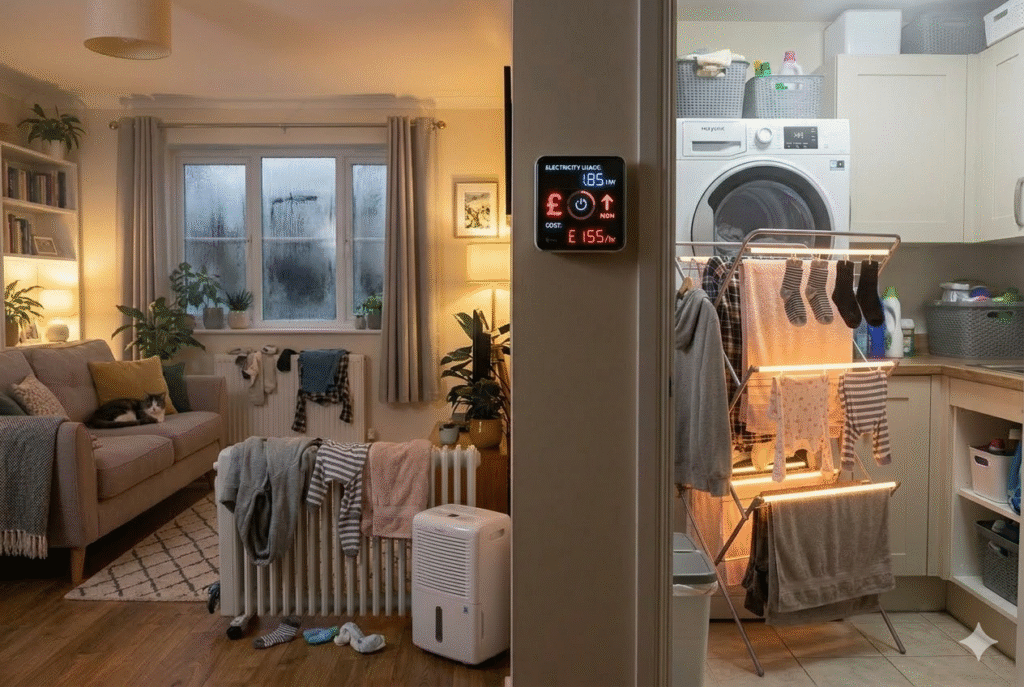
Clothes draped over radiators block heat from circulating properly into the room. You’re paying to heat your home but getting significantly less warmth from it because the surface is covered. In a Scottish winter when heating costs are already painful, that’s a real inefficiency. Space runs out fast too — a decent family wash spread across every radiator in the house looks like a jumble sale and still takes hours. And just like any indoor drying, it releases moisture into the air and feeds the condensation problem that most older UK homes already have enough of.
A heated airer keeps your radiators free to do their actual job, uses a fraction of the energy a tumble dryer uses, and puts everything in one manageable spot. It’s a better default than radiators for most households — but it comes with its own problem that nobody warns you about before you buy.
The Condensation Problem — What Nobody Mentions Before You Buy
This is the part that catches people out, and it’s worth being direct about it.
In a cold Scottish home in January with the windows shut — which is most of us, most of the time — running a heated airer for four hours releases a real amount of moisture into the air. You’ll notice it. That slightly heavy, damp atmosphere that settles into a room by the time the clothes are dry. Left unchecked it ends up on your windows, on cold external walls, and over time it contributes to the kind of mould and damp issues that are already a serious problem in older UK housing stock.
Every Scottish homeowner knows the January dilemma — crack the window and freeze the place out, or keep it shut and deal with condensation by morning. Drying clothes indoors without managing the moisture just makes that worse.
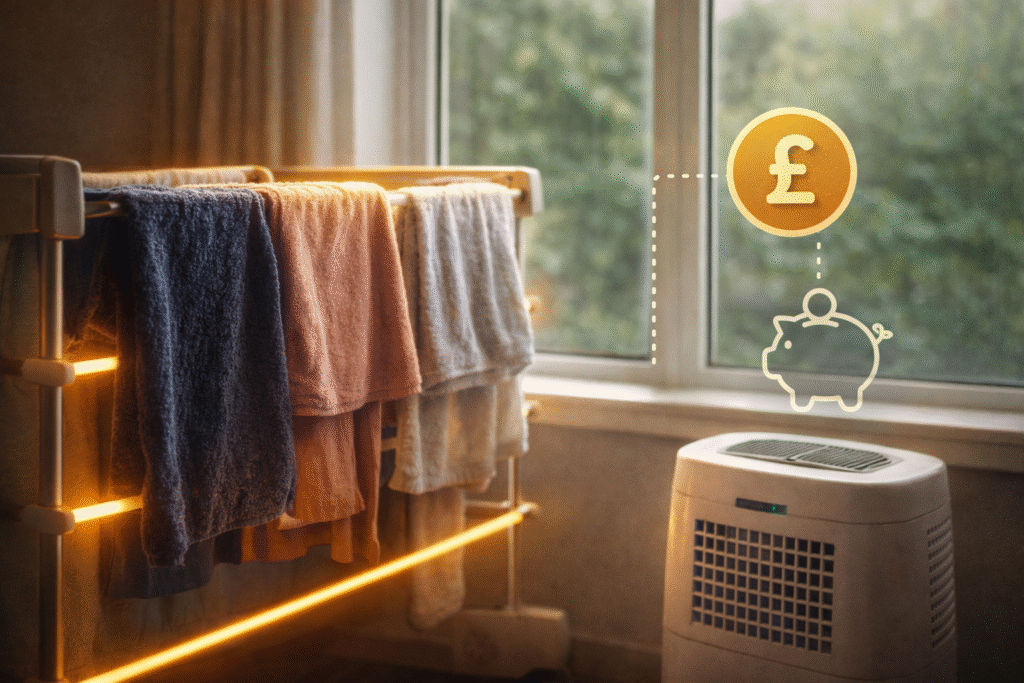
A small dehumidifier running alongside the airer changes things completely. It pulls moisture out of the air as the clothes dry, which does two things at once — clothes dry faster, often cutting the session from four or five hours down to two or three, and the room doesn’t feel damp afterwards. Getting the combination of airer and dehumidifier working properly makes more difference than most people expect.
The combined running cost of a 300W airer and a 150W dehumidifier is still considerably less than a tumble dryer cycle, so the savings hold up. But more than the cost — it solves the condensation problem that puts people off heated airers in the first place. In an older or colder home, that matters more than the numbers alone.
How Long Does Drying Actually Take?
A tumble dryer handles a full load in 60 to 90 minutes. A heated airer takes three to five hours for the same wash — sometimes longer in winter if the room is cold and the air is already damp. With a dehumidifier running you can bring that down to two to three hours, but you’re not getting anywhere near tumble dryer speed.
That time difference is worth being honest about. If you’ve got school uniforms that need to be dry by 7am or work clothes ready in an hour, a heated airer creates a real practical problem. You have to plan laundry differently — think about it the evening before rather than throwing a load on and expecting it done quickly.
For households that can build that habit, it stops being an issue within a week or two. For households under constant time pressure — lots of people, lots of washing, no margin — it remains a genuine limitation.
One thing the table above doesn’t show: a tumble dryer is harder on certain fabrics. Delicates, wool, and anything with a care label that says “do not tumble dry” can’t go in the dryer without risk. A heated airer handles all of it without issue. If you regularly wash delicates or have fabrics you’re careful with, that’s a practical advantage that goes beyond the running cost comparison.
Flat vs House — It’s Not the Same Calculation
This doesn’t get mentioned in most comparisons and it should.
If you’re in a one-bedroom Glasgow flat with limited floor space, a full-size three-tier heated airer takes up a meaningful chunk of your living area for three to five hours at a time. That’s worth thinking about practically — one of the heated airers built specifically for smaller spaces might suit better, or keeping it in the hallway or bedroom rather than the main living space.
In a house with a utility room or a spare bedroom, the airer just lives there when it’s on and it’s never in the way. The calculation is different and the practicality is much easier.
Neither situation makes the airer the wrong choice — but knowing which situation you’re in helps you set it up in a way that actually works day to day rather than becoming an inconvenience you stop using after a fortnight.
What to Do By Season
This changes more than people expect.
In winter — use the heated airer with a dehumidifier running in the same room. Keep a window slightly open if the room allows it. Plan laundry the evening before. Accept that speed isn’t the goal and the cost saving is.
In summer — if you have outdoor space and a decent day, the washing line beats everything on this list. Free, done in a few hours, and clothes come in smelling genuinely fresh in a way no appliance comes close to. It’s worth planning laundry around the weather when you actually get the chance — and when a good Scottish summer day arrives, nothing touches it.
In the shoulder seasons — spring and autumn — it depends on the day. A breezy dry day outside is still better than indoors. A wet week in October, the airer and dehumidifier is your best option.
If You Already Own Both
A lot of people reading this aren’t deciding whether to buy — they’re deciding how to use what they already have. If that’s you, the most practical approach is straightforward.
Use the heated airer as your default for most loads — anything where there’s no time pressure. Evening loads, weekend washing, anything that can run overnight or through the day. Use the tumble dryer for urgent items only — the school uniform needed by morning, the towels that need to be properly dry quickly.
Most households that do this find their tumble dryer use drops by half or more without any real change to how laundry actually gets done. The saving over a year is meaningful and it requires almost no adjustment once the habit is in place.
The One to Buy
If you’re making the switch, the Lakeland Dry:Soon 3-Tier is the one worth starting with. It typically costs £55–£70 and runs at 300W, giving you 21 metres of drying space — which handles a proper family wash rather than just a few items. The build quality holds up to daily use in a way that cheaper alternatives often don’t, and it folds flat when not in use which matters if space is tight.
The optional cover is worth getting at the same time rather than adding later. It fits over the whole airer, traps warmth around the clothes, and cuts drying time noticeably. It’s available directly from Lakeland as well as Amazon — buying direct sometimes works out the same price and their customer service is worth having if anything goes wrong.
FAQs
Is it safe to leave a heated airer on overnight? Most modern models include an automatic thermal cut-off which makes overnight use safe in practice. Always check the specific guidance for your model before doing it — the Lakeland Dry:Soon has this built in, which is one reason it’s worth paying slightly more for a reputable brand over the cheapest option on Amazon.
Will it cause damp in my home? It will add moisture to the air — that’s unavoidable with any indoor drying. In a well-ventilated room it disperses without issue. In a smaller, colder, or poorly ventilated space — which covers a lot of Scottish and northern UK homes in winter — you’ll get condensation on windows and walls unless you’re running a dehumidifier alongside it or keeping a window slightly open. Don’t skip the dehumidifier step and then blame the airer.
What’s the drying time compared to a tumble dryer? A tumble dryer does a full load in 60 to 90 minutes. A heated airer takes three to five hours without a dehumidifier, two to three hours with one running in the same room. If speed is the priority, a tumble dryer wins — that’s the honest answer.
Is it worth buying if I already own a tumble dryer? Yes, for most households. Use the airer as your default and the dryer for urgent items only. Most people find their dryer use drops significantly once the habit is in place, and the annual saving across a year is noticeable.
What about delicates and wool? A heated airer is gentle enough for most fabrics including delicates, wool, and anything marked “do not tumble dry.” That’s a practical advantage over a tumble dryer that goes beyond the running cost comparison.
The Honest Call
If cost is the main concern — heated airer, paired with a dehumidifier from the start. The savings are real, the setup works well even through a cold northern winter, and planning laundry a few hours ahead becomes habit quickly.
If time and properly dry results are what your household needs — towels that feel genuinely dry, a full load finished before school pickup — a tumble dryer is still the right answer. It costs more to run but it earns that cost through the time it saves.
If you already own both — use the airer as your default and the dryer for urgent loads only. It’s the most practical middle ground and the one most households settle on once they try it.
And when a good day arrives and the washing line’s an option — use it. Free, fast in a good breeze, and that fresh air smell is something no appliance has ever come close to replicating. Worth planning around when Scotland actually gives you the weather for it.
Related Guides

About The Author – Andrew Marshall
Andrew Marshall is a Scottish homeowner and the creator of Save Wise Living. He shares practical ways to reduce energy bills, improve home efficiency, and make everyday household routines cheaper and simpler.
Pingback: Best dehumidifiers for laundry drying uk 2025
Pingback: Best Heated Airers UK 2025 | Save Wise Living
Pingback: Laundry Efficiency Hub UK 2025 | Dry Clothes for Less
Pingback: Do Dryer Balls Save Electricity UK 2025 Homes? Myth-Busting
Pingback: Condenser vs Vented vs Heat-pump Tumble Dryers Which Is Best