
Last Updated: 21st March 2026
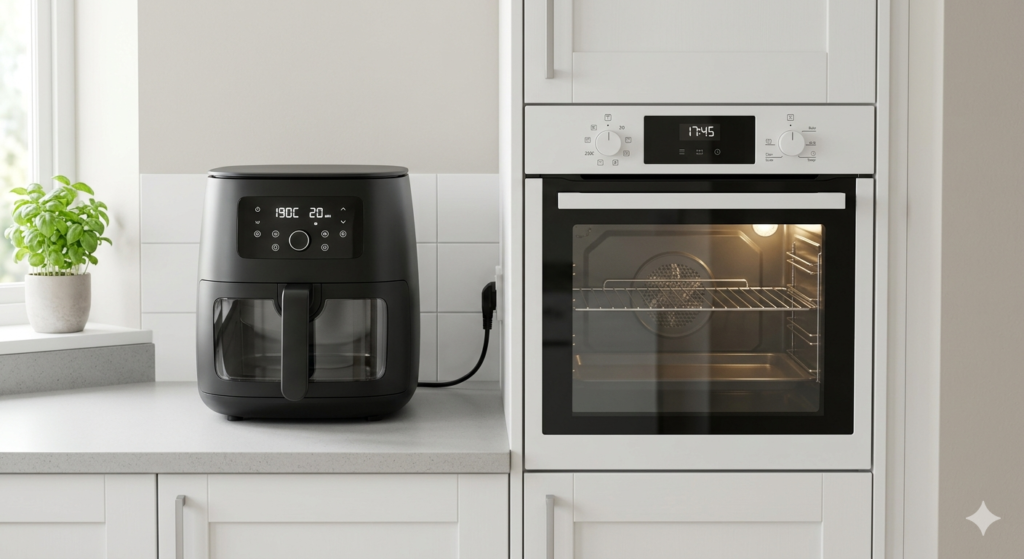
Your oven is probably the most expensive appliance in your kitchen to run. Not because it’s faulty — but because it takes 10–15 minutes to preheat before it does anything useful, draws 2,000 watts or more while it’s working, and stays on for 45–60 minutes for a meal that an air fryer could handle in 20.
The question isn’t really whether air fryers use less energy than ovens — they do, consistently and significantly. The real question is how much you’d actually save with your specific cooking habits, whether the results are good enough to make the switch worth it, and which model is worth buying. That’s what this comparison covers — with real numbers, honest caveats, and no overselling.
Scottish electricity bills run at the same unit rate as the rest of the UK — approximately 24p per kWh on a standard tariff — so every figure here applies directly regardless of where you are. Everything else we’ve done to cut our kitchen energy costs is in our Smart Kitchen & Appliances Hub.
Why Air Fryers Use Less Energy — The Actual Reason
It’s not just wattage. Three things work together to make an air fryer cheaper to run than an oven:
Lower wattage — a typical air fryer draws 1,200–1,700 watts versus 1,800–2,500 watts for a full-size oven. That difference matters but it’s not the whole story.
No preheating — most air fryers start cooking immediately. An oven needs 10–15 minutes of preheating before food goes in. That’s 300–400 watt-hours of electricity used before a single chip has been cooked.
Faster cooking — the heating element in an air fryer is directly above the food and the hot air circulates intensely around a compact space. Most foods cook in 20–25 minutes versus 40–60 minutes in an oven. Less time running means less energy used regardless of wattage.
All three advantages compound. A lower-wattage appliance that also cooks faster and needs no preheating uses dramatically less electricity than the headline wattage comparison suggests.
The Real Numbers at Current UK Rates
At the current UK electricity rate of approximately 24p per kWh:
Full-size fan oven at 2,000W for 50 minutes including preheat: approximately 0.4 kWh — around 10p per session. One session per day across a year: approximately £36.
Air fryer at 1,500W for 25 minutes with no preheat: approximately 0.19 kWh — around 4.5p per session. One session per day across a year: approximately £16.
That’s approximately £20 per year saved from one daily cooking session switched from oven to air fryer. For families cooking two sessions per day the saving approaches £40 annually.
To put the payback case clearly: a Ninja AF100UK at around £85 pays for itself in two to four years at one session per day — and saves money indefinitely from that point. A dual-basket model at £50–90 pays back faster for families replacing full oven meals. If you want to understand exactly what your oven costs per hour before making any decisions, the per-hour breakdown for electric ovens does that calculation for you.
We made the switch to using our air fryer for most weeknight meals about two years ago — anything that would have gone in the oven now goes in the air fryer first. The difference showed up on our energy bills within the first month and has been consistent every month since.
What Actually Cooks Better in an Air Fryer
This is where most comparison articles hedge. Here’s the honest version.
Air fryers produce better results than ovens for anything that benefits from a crispy exterior: chips, roasted vegetables, chicken pieces, fish fillets, sausages, bacon, breaded items, and most things you’d put on a baking tray. The intense circulating heat creates a crispier exterior faster than a conventional oven manages, with less oil and in less time.
We tested this side by side on a wet Tuesday evening — same supermarket oven chips, same portion, one tray in the oven and one basket in the air fryer. The air fryer chips were done in 18 minutes. The oven chips needed 28 minutes plus 12 minutes of preheating. The texture wasn’t close — the air fryer chips were noticeably crispier without any extra oil.
If you want to take this further and cook complete meals without the oven at all, cooking entire meals in an air fryer is more achievable than most people expect — and the energy saving compounds further when the oven doesn’t come on at all.
For reheating leftovers, the air fryer is also meaningfully better than an oven — it restores crispiness that a microwave destroys and does it in five to eight minutes. Using air fryer liners for these sessions keeps the basket clean and makes the daily habit easier to sustain. A set of silicone air fryer accessories — small racks, skewers, and dividers — also extends what you can cook without extra pans.
What Still Needs the Oven
This is the part most air fryer articles gloss over. Being honest about it matters.
Large roasts — a whole chicken, a leg of lamb, or a large joint needs the space and sustained even heat of an oven. An air fryer handles smaller cuts well but a traditional Sunday roast is still oven territory. In our house it always will be — and that’s fine.
Batch baking — multiple trays of biscuits, a large cake, or any baking that needs consistent temperature across a wide surface works better in an oven. Air fryers produce good results for individual portions but can’t replicate the capacity for batch work.
Full-size pizzas — a standard supermarket pizza doesn’t fit in most air fryer baskets. Personal-size pizzas work well. A 12-inch pizza needs an oven.
Bread — most bread benefits from steam and sustained heat that an oven provides. Air fryer bread is possible but the results are different and not preferred by most people who bake regularly.
The practical approach for most households: use the air fryer as the default for everyday cooking and reserve the oven for the specific tasks where it genuinely performs better. Most families find the oven goes from daily use to three or four times a week — which is exactly where the meaningful annual saving comes from.
Best Air Fryers for Replacing Oven Cooking
Ninja AF100UK — 3.8L, 1550W — around £79–95 (Amazon UK)
Best for: one to two people or smaller family portions — the most consistently reliable entry-level air fryer on Amazon UK.
The Ninja AF100UK earns its position as the most recommended first air fryer in the UK through reliability rather than a long feature list. Four functions — air fry, roast, reheat, dehydrate — cover everything most households need, and the 3.8L capacity handles a full meal for two or a family-sized portion of chips without issue.
The 1550W element heats quickly and the non-stick basket and crisper plate are both dishwasher safe — which matters for a daily-use appliance. Setup takes five minutes and the appliance requires no learning curve whatsoever.
The energy saving over an equivalent oven session runs consistently at 60–70% for typical portions. For a household replacing the oven for everyday meals, the Ninja is the most sensible starting point — and the one most likely to still be running reliably three years from now. A non-stick cooking spray used lightly on the basket extends its life and prevents sticking on delicate foods.
Keplin 9L Dual Zone Air Fryer — 2700W — around £60–70
Best for: budget-conscious families who want dual-basket cooking without spending over £70.
The Keplin 9L Dual Zone is the best-value dual-basket air fryer currently available on Amazon UK and at this price point it represents exceptional value for families. Two independent baskets allow two completely different foods to be cooked simultaneously at different temperatures — which is the feature that genuinely enables families to cook full meals without turning the oven on at all.
Featured in Good Housekeeping’s best dual air fryers recommendations, the Even Heating Technology cooks up to 50% faster than conventional ovens and the digital touchscreen is clear and intuitive from the first use. Seven presets cover the most common cooking tasks and both baskets are dishwasher safe.
At 2700W it draws more power per minute than single-basket alternatives — worth knowing upfront. The saving comes from replacing an entire oven session with one dual-basket air fryer session rather than comparing individual portions. For a family cooking protein and vegetables simultaneously, the total energy saving versus a full oven session is still significant.
Tower T17099 Vortx Eco Dual Basket Air Fryer — 5.2L + 3.3L, 1700W — around £120
Best for: families who cook full meals regularly and want better build quality than budget alternatives with a smart finish function worth paying for.
The Tower T17099 sits between the budget Keplin and premium Ninja dual-basket models in both price and capability. The Smart Finish function is the standout feature — it adjusts cook times automatically so both baskets finish simultaneously without manual coordination. Tower claims up to 70% energy saving compared to a conventional oven at equivalent meal sizes.
Where the Tower earns its place over the budget Keplin is specifically that Smart Finish function. Having both baskets finish simultaneously without manual adjustment removes the one genuinely frustrating coordination element of dual-basket cooking. For families who regularly cook different foods at different temperatures, that’s a feature worth the additional spend over the Keplin.
Eight one-touch presets, Vortx hot air circulation for consistent results, and Tower’s established UK track record make this the most complete family air fryer on this list. The 5.2L plus 3.3L basket combination suits families of three to five without requiring batch cooking. A set of air fryer parchment liners keeps both baskets cleaner between sessions and reduces washing up significantly.
Is Making the Switch Worth It?
For most UK households who currently use their oven daily — yes. The saving is real, the results for everyday cooking are comparable or better, and the behaviour change is small once the air fryer becomes the default appliance.
The honest caveat is that an air fryer supplements rather than replaces an oven entirely. It handles 70–80% of everyday cooking more efficiently, leaving the oven for the 20–30% of tasks where it genuinely performs better. That’s the realistic outcome — not an oven gathering dust in the corner, but an oven that gets used deliberately rather than by default.
At current UK electricity rates, a household switching from oven-only to air fryer-primary cooking for everyday meals can realistically expect to save £20–40 per year depending on household size and cooking frequency. For families specifically wondering whether the switch makes financial sense for bigger meals, the family meal cost comparison breaks it down by meal type and portion size.
That saving requires no ongoing effort — buy the right model, use it as the default, and it compounds across every year of ownership without you thinking about it again.
The most useful way to think about it: buy an air fryer, use it as your default for everyday cooking, keep the oven for the meals that genuinely need it. Most households find within a month that the oven gets used two or three times a week rather than daily — and the saving takes care of itself.
Frequently Asked Questions
Can an air fryer completely replace an oven? For most everyday cooking — yes. For large roasts, batch baking, and full-size pizzas — no. Most households find the air fryer handles 70–80% of their cooking more efficiently, with the oven retained for specific tasks. Replacing the oven entirely is possible but requires adjusting how you approach certain meals.
Is an air fryer cheaper to run than an oven for every meal? For portions under about 800g — yes. For very large portions where the air fryer would need two separate cooking cycles, the saving narrows. The most significant saving comes from meals that previously needed 45–60 minutes in a preheated oven and now take 20–25 minutes with no preheat.
Does preheating an air fryer waste energy? Most air fryers don’t require preheating. A brief one to two minute preheat for foods that benefit from immediate high heat — chips, breaded items — uses minimal electricity. For most foods, starting cold is fine and saves the small amount of energy a preheat cycle uses.
How long does an air fryer take to pay for itself? At a saving of approximately £20–40 per year from switching everyday cooking from oven to air fryer, a mid-range air fryer at £50–90 pays for itself in two to four years. A budget model at £40–55 pays back in one to two years. From that point it saves money indefinitely — and unlike most energy-saving purchases, it also improves the quality of certain foods rather than compromising on convenience.
How do I know exactly how much my oven costs to run? A plug-in energy monitor on your oven gives you precise real-world figures. Most ovens plug into a standard 13-amp socket and are compatible with a standard energy monitoring plug — it shows consumption in kWh per session which you multiply by 24p to get cost per cook.
Does an air fryer produce the same results as an oven? For most foods — comparable or better. Chips, roasted vegetables, chicken, fish, and reheated food all come out crispier from an air fryer. Baked goods, bread, and large roasts suit the oven better. The texture difference on crispy foods is usually the first thing people notice and the reason most households don’t go back to oven-only cooking once they’ve made the switch. For reheating specifically, the running cost comparison between air fryer and microwave is worth knowing — they serve different purposes but the cost difference per session is smaller than most people expect.
Related Guides

About The Author – Andrew Marshall
Andrew Marshall is a Scottish homeowner and the creator of Save Wise Living. He shares practical ways to reduce energy bills, improve home efficiency, and make everyday household routines cheaper and simpler.
Pingback: Smart Kitchen Savings Guide UK 2025 | Cook Smarter
Pingback: Best Toaster Ovens & Multi-Cookers UK 2025