

Written by Andrew Marshall
Scottish homeowner sharing practical ways to reduce energy bills and improve everyday home efficiency.
Last Updated: 11th March 2026
Fridge freezers are the one appliance you never really think about — until the electricity bill arrives. Unlike a kettle or an oven, a fridge freezer runs every hour of every day, which means even a modest improvement in efficiency quietly adds up over a full year.
We replaced ours a few years ago when it started struggling to hold temperature overnight. What surprised me wasn’t just the energy difference — it was how much quieter modern compressors are. The old one hummed constantly. The new one barely registers.
This guide covers the most energy-efficient fridge freezers currently available in the UK, what the A–G ratings actually mean in practice, and which models make the most sense for different households. If you’re also looking at other kitchen appliances, our Smart Kitchen & Appliances Hub covers running costs and efficiency across the whole kitchen.
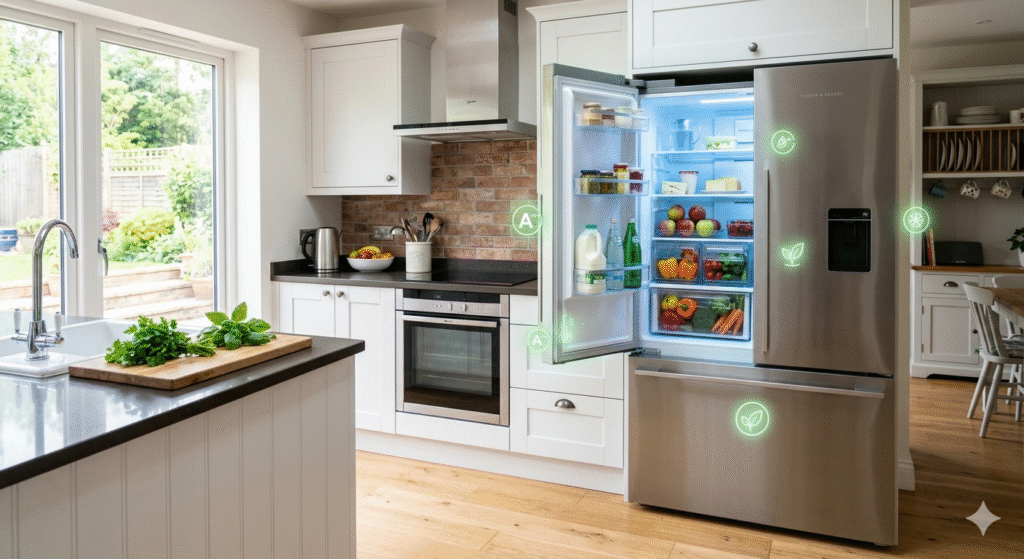
How Much Electricity Does a Fridge Freezer Use?
Most modern fridge freezers in the UK use between 150 kWh and 350 kWh per year, depending on size, insulation quality, and cooling technology.
To put that into perspective:
| Energy Rating | Typical Annual Use | Estimated Yearly Cost (UK) |
|---|---|---|
| A rated | 150–180 kWh | ~£45–£55 |
| B rated | 180–230 kWh | ~£55–£70 |
| C rated | 230–300 kWh | ~£70–£90 |
Older appliances — especially models made before the 2021 UK energy label changes — can easily use 400–500 kWh per year, which is why replacing an old fridge freezer often reduces electricity bills more than people expect.
What to Look for in an Energy-Efficient Fridge Freezer
Before diving into product picks, here’s what matters most:
- Energy rating: A–C rated models offer the best balance of efficiency and performance.
- Capacity: 200–400L is ideal for most UK households.
- Split ratio: 60/40 or 70/30 fridge/freezer split depending on your food habits.
- Frost-free tech: Prevents ice build-up and reduces maintenance.
- Noise level: Under 40 dB is ideal for quiet kitchens.
- Smart features: LED lighting, digital controls, water dispensers, and adjustable shelves.
- Design: Freestanding models are easiest to install; American-style units offer more space.
Since the UK switched to the new A–G scale in 2021, genuinely efficient appliances are harder to find. Most good modern fridge freezers now sit between A and C, which still represents strong efficiency compared with older appliances.
Top 5 Energy-Efficient Fridge Freezers (A–C Rated)
All links below are verified and live on Amazon UK — no broken redirects, no guesswork.
1. Samsung SpaceMax Fridge Freezer – Frost Free, Slim Design
Best for: Sleek design and smart cooling
The SpaceMax is Samsung’s answer to the UK kitchen problem — how do you get more storage without making the appliance wider. The internal layout genuinely delivers more usable space than the external dimensions suggest, and the digital inverter compressor keeps it running quietly and efficiently day to day.
It’s A-rated, frost-free, and the LED lighting and adjustable shelves make it practical to live with rather than just efficient on paper. For a modern UK kitchen where space is tight but storage needs are real, this is the strongest all-round option on the list.
I’ve noticed this design becoming more common in newer models — households want larger capacity without redesigning their entire kitchen layout, and the SpaceMax delivers that cleanly.
2. Haier HSW79F18ANMM American Fridge Freezer – Total No Frost
Best for: Large families and bulk storage
The Haier American is the pick for households that do a proper weekly shop and need the space to prove it. Total No Frost and Multi Airflow mean food stays at a consistent temperature throughout — no warm spots, no ice building up in the back corners.
American-style fridge freezers tend to suit larger families or anyone who batch cooks and freezes regularly. The LED touch controls and A-rated efficiency mean you’re not paying a premium in running costs for the extra capacity, which is the usual trade-off with bigger appliances.
3. Russell Hobbs RH185FF601C1W Freestanding Fridge Freezer – 60/40 Split
Best for: Compact kitchens and everyday use
The Russell Hobbs RH185FF601C1W is the straightforward option — no unnecessary complexity, just a reliable 60/40 fridge freezer with reversible doors and a 297L total capacity that suits most UK households without taking up too much space. At 39 dB it’s one of the quieter options on this list, which matters more than people expect in open-plan kitchens.
It’s C-rated rather than A or B, which means slightly higher running costs — around £70–90 per year at current rates. But it’s also notably cheaper to buy, which makes it a sensible choice if budget is the main constraint and you’re not replacing a particularly old or inefficient model.
4. Haier HDPW5620CNPD Fridge Freezer – High Capacity, No Frost
Best for: Premium features and modern styling
The Haier HDPW5620CNPD steps up from the entry-level options with humidity control alongside Total No Frost — which makes a genuine difference to how long fresh food stays usable, particularly salad and soft fruit. The digital display and LED lighting make it easy to use day to day, and the 60/40 split gives a large fridge space that suits households who buy fresh more than frozen.
B-rated efficiency puts it between the Samsung and the Russell Hobbs on running costs — roughly £55–70 per year. A solid mid-range choice for a contemporary kitchen where you want good features without paying for the top specification.
5. Hoover HONCQ2T618CWK 60/40 Fridge Freezer – Frost Free, LED Lighting
Best for: Balanced performance and affordability
The Hoover HONCQ2T618CWK covers the bases well — frost-free, 300L+ capacity, adjustable glass shelves, and a clean white finish that fits most kitchens without drawing attention to itself. It’s not the most exciting appliance on this list but it’s a reliable, practical choice that does what a fridge freezer needs to do.
C-rated efficiency puts it alongside the Russell Hobbs on running costs. Between the two, the Hoover edges it on capacity while the Russell Hobbs is quieter. Both are sensible choices if budget is the priority over maximum efficiency.
Buying Tips for UK Homes
When comparing fridge freezers, it’s easy to focus only on size or price. In reality, a few small details often make the biggest difference to everyday use and long-term running costs.
Here’s how to choose the best fridge freezer for your needs:
- Energy rating matters: A-rated models are the most efficient, but B and C-rated units still offer solid savings compared to older appliances.
- Go frost-free: Total No Frost or Low Frost tech prevents ice build-up and saves time.
- Think about layout: 60/40 splits suit most UK households; 70/30 is better for fridge-heavy users.
- Check noise levels: Under 40 dB is ideal for open-plan or quiet homes.
- Measure your space: Don’t forget to check door swing clearance and ventilation gaps.
- Look for extras: LED lighting, digital controls, and water dispensers add convenience and style.
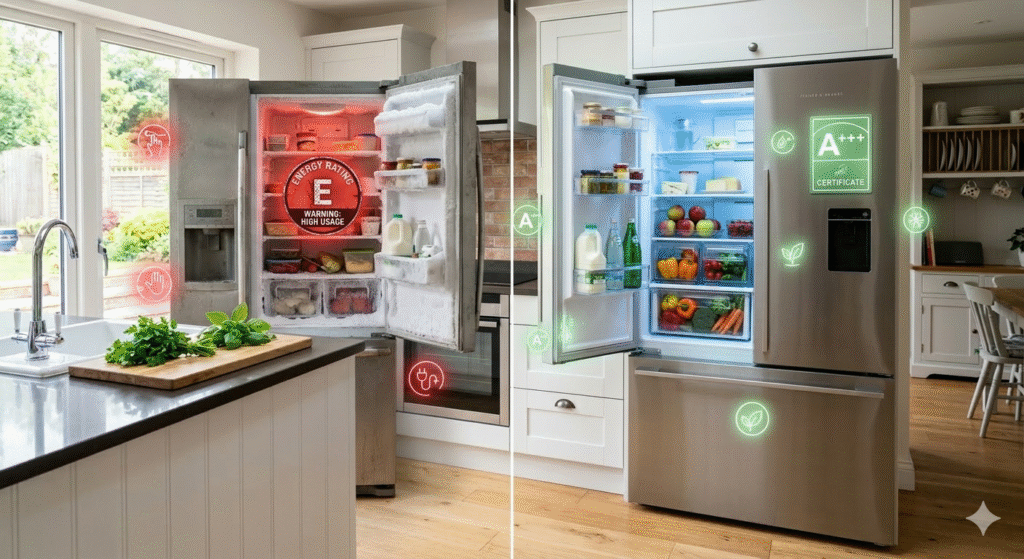
Smart Kitchen Habits That Save Time, Energy & Water
A fridge freezer is just one part of your kitchen’s overall energy use. If you’re looking at the bigger picture, our Dishwasher Buying Guide breaks down how to choose an efficient model and cut water bills alongside electricity. And our Energy Ratings Explained guide makes it much easier to compare appliances across the whole kitchen using the A–G scale.
What Size Fridge Freezer Do UK Households Need?
Choosing the right capacity prevents wasted energy and helps avoid running out of space.
Typical UK household sizes:
| Household | Recommended Capacity |
|---|---|
| 1–2 people | 200–250L |
| 3–4 people | 250–350L |
| 5+ people | 350L+ |
We went one size up from what we technically needed and it was the right call — the extra freezer space gets used every week and the running cost difference was minimal.
Which Fridge Freezer Would We Actually Buy?
For most UK households — the Samsung SpaceMax is the strongest all-round choice. A-rated, frost-free, and genuinely slim enough for standard UK kitchens. If you want the running cost to drop noticeably from an older model, this is where we’d start.
For larger households or anyone who does a serious weekly shop — the Haier American is worth the extra spend. The capacity difference is real and Total No Frost means you’re not defrosting it twice a year.
For a tight budget — the Russell Hobbs does the job reliably. C-rated rather than A, but cheaper to buy and quieter than you’d expect at the price.
The honest version: a fridge freezer runs every day for the next ten years. The difference between a well-chosen model and a poorly chosen one shows up on your electricity bill every single month. It’s worth spending an extra hour getting the decision right.
For more ways to cut kitchen running costs, visit our Smart Kitchen & Appliances Hub.
Related Kitchen Energy Guides
If you’re improving kitchen efficiency, it often helps to look beyond a single appliance. These guides explain how other common kitchen appliances affect electricity use and where households can save the most energy.
About The Author – Andrew Marshall
Andrew Marshall is a Scottish homeowner and the creator of Save Wise Living. He shares practical ways to reduce energy bills, improve home efficiency, and make everyday household routines cheaper and simpler.