

Written by Andrew Marshall
Scottish homeowner sharing practical ways to reduce energy bills and improve everyday home efficiency.
Last Updated: 14th March 2026
The kettle is one of those appliances that gets used several times a day without much thought. Boil, pour, repeat. But across a typical UK household, that casual habit adds up to a meaningful annual electricity cost — and most of the waste comes not from the kettle itself but from how it’s used.
Overfilling is the main culprit. Boiling a full 1.7-litre kettle for one cup uses roughly five times more electricity than it needs to. A low-energy kettle addresses this through better design — clearer minimum-fill markings, rapid single-cup boil zones, and insulated walls that retain heat so you’re not reboiling the same water twenty minutes later.
We’re on a standard electricity tariff and the kettle in our kitchen gets used constantly — multiple cups a day across the family, plus tea for visitors, water for cooking. When I started actually measuring what it cost to run using an energy monitor, the annual figure was higher than I expected. Switching to a more efficient model and changing how we fill it made a noticeable difference within the first month. Everything else we’ve done to cut our kitchen energy bills is in our Smart Kitchen & Appliances Hub.
What Actually Makes a Kettle Low-Energy?
Before looking at specific models, it’s worth understanding what the efficiency features actually do — because not all of them matter equally.
Minimum fill markings
The single most impactful change anyone can make is boiling only the water they need. A kettle with a clear, accurate minimum-fill line makes this easy. A kettle without one — or with markings that are hard to read — leads to overfilling by default.
Rapid-boil zones
Some kettles have a separate heating element or concentrated boil area designed for one or two cups. This heats a smaller volume of water faster and uses less electricity than heating the full element to boil a larger quantity. The Russell Hobbs rapid-boil design works on this principle.
Double-wall insulation
An insulated kettle retains heat significantly longer than a standard single-wall model. If you’re making several drinks in a row — or you’re the kind of household where someone makes tea and then forgets about it and has to reboil — double-wall insulation means the water is still hot enough to pour twenty to thirty minutes later without a full reboil. This is a genuine efficiency gain for households that reboil frequently.
Auto shut-off and boil-dry protection
These are standard on most modern kettles but worth confirming. Auto shut-off prevents unnecessary energy use if the kettle is left on after boiling. Boil-dry protection prevents element damage if the kettle is switched on empty.
Variable temperature
Not strictly a low-energy feature but worth knowing about. Boiling water to 80°C rather than 100°C — appropriate for green tea, some coffee brewing, and instant formula — uses meaningfully less energy per boil than reaching full boil. Variable temperature kettles add cost but pay back over time for households that use them correctly. If you’re weighing up the cost of running different cooking appliances alongside the kettle, how much an electric oven costs to run per hour puts the numbers in useful context.
The “Just Boil Less Water” Question
Before spending money on a new kettle, it’s worth being honest about this: if you’re currently filling your kettle to the top for one cup, the single most effective efficiency improvement is simply not doing that.
Filling to the minimum line on your existing kettle reduces energy use per boil by 60–70% immediately, costs nothing, and requires no new purchase. If your current kettle is less than three or four years old and has clear minimum markings, changing behaviour may deliver more savings than changing the appliance.
The case for a new low-energy kettle becomes compelling when your current model is old, has no clear minimum-fill line, has significant limescale buildup, or lacks the double-wall insulation that prevents constant reboiling. If any of those apply, a modern efficient model earns its cost relatively quickly.
The same logic applies across the kitchen — our guide to smart kitchen gadgets that actually save electricity covers the appliances worth upgrading and the ones where behaviour change matters more than new kit.
Limescale and Efficiency — The Hidden Cost
Limescale on a kettle’s heating element is one of the most overlooked causes of energy waste in UK kitchens. A heavily scaled element takes longer to heat water and uses more electricity doing it — the scale acts as insulation between the element and the water, forcing the element to work harder.
In hard water areas — most of England, particularly the South East, Midlands, and East Anglia — kettles scale up significantly faster than in soft water areas like Scotland and the North West. If you’re in a hard water area and your kettle hasn’t been descaled recently, doing so before or alongside buying a new model is worth the five minutes it takes.
Standard white vinegar or proprietary descaler tablets work fine on all modern kettles. Descaling every one to three months in hard water areas maintains efficiency and extends element life. The same principle of maintenance over replacement applies to every kitchen appliance — how to use induction hobs efficiently is a good example of how small habit changes outperform buying new kit.
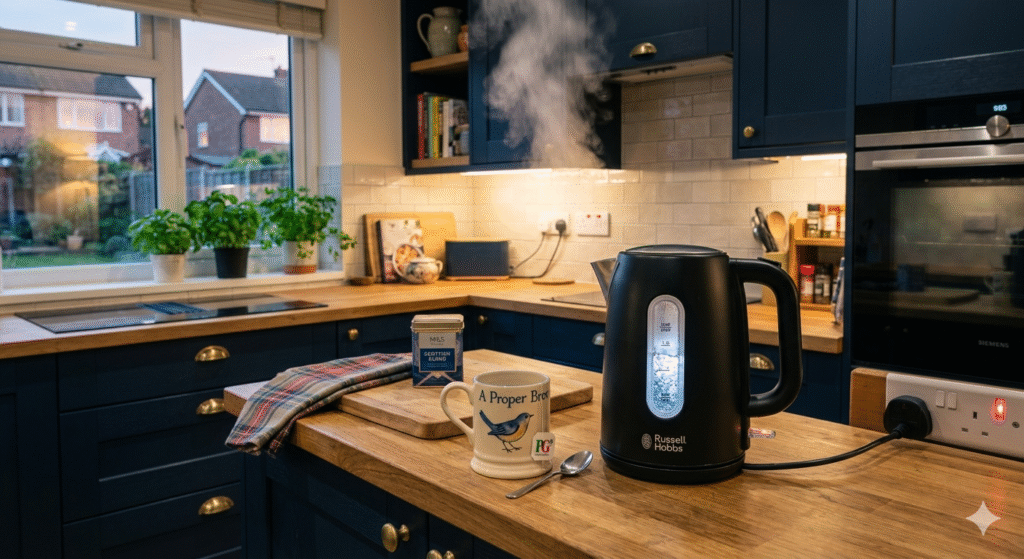
Best Low-Energy Kettles Under £50
Russell Hobbs Energy Efficient Kettle — Rapid Boil 1.7L (26051) — around £35–45
Best for: households who want the fastest single-cup boil and the most direct energy saving per use.
The Russell Hobbs 26051 is the most straightforward efficiency pick on this list. The rapid-boil feature concentrates heat for single-cup volumes — boiling roughly 250ml in under 45 seconds and using less than 1p of electricity per boil at current UK rates. For households where the majority of kettle use is one or two cups at a time, this is where the saving is most direct and most consistent.
The 1.7-litre capacity is standard, the clear water window makes accurate filling easy, and the stainless-steel element resists limescale accumulation better than exposed plastic elements. Build quality is solid for the price point and Russell Hobbs has a reliable track record for kettle longevity.
The difference in wait time for a single cup compared to a standard kettle is noticeable from the first use. It’s a small thing but when you’re making the first cup of the morning before you’re properly awake, faster genuinely matters — and using less electricity doing it means the saving happens without any conscious effort.
Philips Eco Conscious Edition Kettle 5000 Series (HD9365/11) — around £45–50
Best for: households who want sustainability credentials built into the product itself rather than just the packaging — the most genuinely eco-conscious option under £50 on this list.
The Philips HD9365 is built from 100% bio-based plastics derived from renewable sources including plant oils — a meaningful material choice that reduces its production carbon footprint by around 25% compared to standard virgin plastic construction. For households who want the environmental credentials to be real rather than marketing language, this is the kettle where they are.
Practically, it performs well. The 2200W element is slightly lower wattage than most 3kW competitors, which means it draws less power per boil — a genuine efficiency difference for households that boil frequently throughout the day. The 1.7-litre capacity with a clear one-cup indicator makes accurate filling straightforward, the removable anti-limescale filter keeps the element clean, and the auto shut-off activates immediately when the water reaches boiling or when the kettle is lifted from the base.
The 360° pirouette base and cordless design are standard at this price point, and the silk white matte finish with wood-effect detachable lid gives it a noticeably more considered aesthetic than most budget kettles — it looks like a deliberate kitchen choice rather than a functional afterthought.
One honest note: at 2200W rather than 3000W, it takes slightly longer to reach boiling for larger volumes than the Russell Hobbs rapid-boil model. For single-cup use the difference is minimal.
Taylor Swoden Hedy Double Wall Insulated Kettle — 1.5L 2200W — around £25–35 (Amazon)
Best for: households that make several drinks in a row and want to avoid reboiling — the double-wall insulation is the standout feature here.
The Taylor Swoden Hedy is the pick for households where the reboiling habit is the main source of energy waste. The double-wall stainless steel construction — inner and outer shell both in 304 food-grade stainless steel — retains heat significantly longer than a single-wall kettle. Water boiled and left in this kettle stays hot enough to pour considerably longer than in a standard model, which removes the need to reboil when the next cup happens twenty minutes after the first.
Every surface that contacts water is stainless steel — inner pot, inner lid, and spout — with no plastic in the water path at all. For households who have been avoiding cheap kettles specifically because of plastic contact with boiling water, this construction addresses that concern directly.
At 2200W rather than 3000W, it draws less power per boil than the Russell Hobbs — a modest but genuine efficiency difference for households that boil frequently. The 1.5-litre capacity nudges toward filling less per boil naturally, and the cool-touch exterior means the outer surface stays safe to handle even immediately after boiling — useful in households with children around.
The quiet boil is a practical benefit for early morning use, and the 360° base works cleanly for both left and right-handed use. Auto shut-off and boil-dry protection are both present as standard.
One thing worth checking before ordering: confirm the listing specifies a UK plug. Taylor Swoden sell this model through multiple Amazon marketplace sellers and the overwhelming majority of UK listings are correct — but it’s worth a quick check on the listing page before adding to basket. We’ve used all-stainless kettles for a few years now and the absence of any plastic taste in boiling water is one of those improvements you notice immediately and then can’t go back from.
How Much Can You Actually Save?
At the current UK electricity rate of approximately 24p per kWh, here’s what kettle use actually costs:
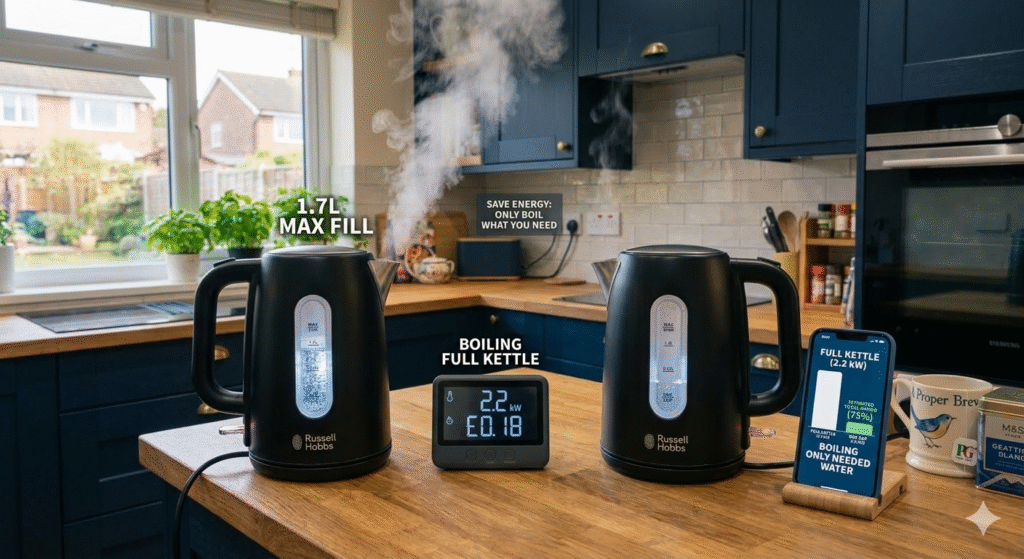
A standard kettle boiling a full 1.7 litres uses roughly 0.13 kWh per boil — approximately 3p. Boiled three times a day, every day, that’s around £33 per year.
The same kettle filled to the minimum line for one cup (250ml) uses approximately 0.019 kWh per boil — under 0.5p. Three single cups per day costs around £5 per year.
The gap between those two numbers — roughly £28 per year — is almost entirely recoverable through accurate filling rather than appliance replacement. This is why the behaviour change matters as much as the purchase.
Where a low-energy kettle adds value on top of correct filling behaviour is in the features that standard kettles don’t have: rapid-boil elements that heat small volumes faster, insulation that prevents reboiling, and clearer fill markings that make accurate filling easier by default.
A realistic annual saving from switching to an efficient model and changing filling habits combined: £15–30 per year depending on current habits and household usage. Over five years that covers the cost of any kettle on this list. For a full picture of what your kitchen appliances cost to run, energy ratings explained breaks down what the A to G label actually means in real money terms.
Frequently Asked Questions
Do energy-efficient kettles boil faster than standard ones? For small volumes, yes — particularly models with rapid-boil features like the Russell Hobbs 26051. For full-capacity boils, the difference is less significant because the same wattage element is heating more water. The speed advantage is most pronounced for one to two cup volumes.
Is it worth buying an eco kettle if I already have a working kettle? If your current kettle is less than four years old and works properly, the efficiency gain from replacing it may not justify the cost immediately. The better starting point is changing how you fill it. If it’s older, heavily scaled, or lacks insulation, a modern model earns its cost relatively quickly.
How often should I descale my kettle? In soft water areas like Scotland, every three to six months is sufficient. In hard water areas — most of England — every one to two months maintains efficiency and element life. A kettle that takes noticeably longer to boil than it used to is almost always scaling rather than a fault.
Can I use a smart plug with my kettle? A smart plug can handle the wattage of a standard 3kW kettle, so it’s technically compatible. However, scheduling a kettle via a smart plug isn’t practical in the way it is for a television or games console — you can’t pre-fill and schedule a boil in advance safely. The more useful application is using an energy monitoring smart plug to measure exactly what your kettle costs to run, then using that data to inform how you use it. Our guide to best smart plugs for energy monitoring covers the options worth buying
Does water temperature matter for energy use? Yes. Boiling to 80°C uses less energy than boiling to 100°C because less heat input is required. For green tea, white tea, and some coffee preparations, 80°C is actually preferable — so a variable temperature kettle saves energy while also improving the drink. For standard black tea and instant coffee, 100°C is needed.
Which Kettle Should You Buy?
For most households, the Russell Hobbs 26051 is the straightforward starting point — the rapid-boil feature delivers the most direct per-cup saving and the price sits comfortably within budget.
If sustainability is a priority alongside efficiency, the Philips Eco Conscious is the considered choice — the bio-based construction is meaningful rather than cosmetic and the 2200W element draws less power per boil than standard 3kW models.
If your household makes several drinks in a row and reboiling is the main habit you want to break, the Taylor Swoden Hedy’s double-wall insulation addresses that specific problem better than either alternative — and the all-stainless water path is a bonus for households who care about what touches their boiling water.
Whichever you choose, pairing the new kettle with the habit of filling to the minimum line covers most of the available saving. The kettle provides the better conditions — the behaviour makes the difference.
Related Guides
About The Author – Andrew Marshall
Andrew Marshall is a Scottish homeowner and the creator of Save Wise Living. He shares practical ways to reduce energy bills, improve home efficiency, and make everyday household routines cheaper and simpler.
Pingback: Smart Kitchen Savings Guide UK 2025 | Cook Smarter
Pingback: Best Induction Hobs for Energy Savings UK 2025 | Save Wise Living
Pingback: Best Mini Ovens & Grills UK 2025 – Low-Energy Cooking Picks