
Last Updated: 17th March 2026
Boiling water is something most UK households do without thinking — several times a day, every day, for tea, coffee, cooking, and hot drinks. It feels like such a small thing that it barely registers as an energy cost.
But small things done repeatedly add up. A household that boils water four or five times a day, every day of the year, is running that process somewhere between 1,400 and 1,800 times annually. The method you use each time — and crucially how much water you boil — determines whether that habit costs you around £7 a year or closer to £52.
This comparison looks at the three most common methods UK households use: electric kettle, electric hob, and microwave. All costs are calculated at the current UK electricity rate of approximately 24p per kWh. Everything else we’ve done to reduce our kitchen energy costs is in our Smart Kitchen & Appliances Hub.
The Short Answer
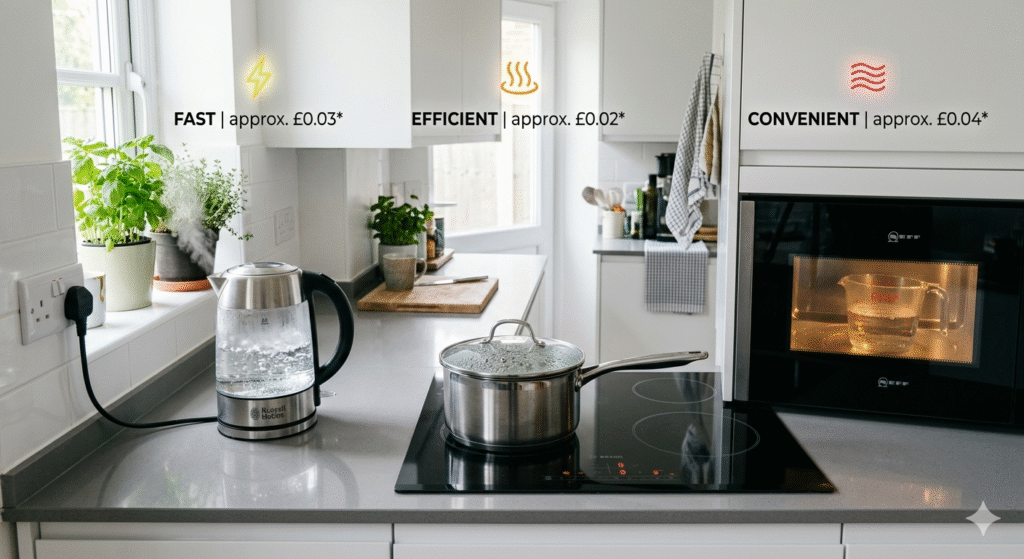
For boiling a single cup of water, a modern electric kettle is the cheapest method — particularly one with a rapid-boil feature or clear minimum-fill markings. The microwave comes second for small volumes. The hob is the most expensive method for boiling water and the least practical for anything other than cooking pasta or large quantities.
If that’s all you needed, you have your answer. But the fuller picture is worth understanding because the gap between methods is smaller than most people assume — and the amount of water you boil matters far more than which appliance you use.
How the Costs Break Down
Electric Kettle
A standard electric kettle uses a 3kW element. The time it takes to boil depends entirely on how much water you put in it.
Boiling a full 1.7-litre kettle takes roughly 3 minutes and uses approximately 0.15 kWh — about 3.6p per boil at current rates.
Boiling just one cup — around 250ml — takes under a minute and uses approximately 0.022 kWh — under 0.6p per boil.
That gap between a full kettle and a single cup is the most important number in this article. If you’re filling the kettle to the top every time you make one drink, you’re using roughly six times more electricity than you need to. No appliance switch will save you as much as simply filling the kettle correctly.
It’s also worth knowing that limescale buildup on a kettle’s element increases the energy needed per boil — in hard water areas using a kettle descaler every couple of months maintains efficiency as much as any appliance upgrade.
Electric Hob
A standard electric hob ring uses between 1,000 and 2,500 watts depending on the ring size and setting. Boiling 250ml of water in a small saucepan on a medium-high ring takes around 4–5 minutes and uses approximately 0.1–0.15 kWh — roughly 2.5–3.5p per boil.
That might look comparable to a kettle on paper, but the hob is slower, uses more energy bringing the pan itself up to temperature, and wastes heat into the kitchen rather than directly into the water. In practice the hob consistently costs more per boil than a correctly filled kettle — and considerably more if you’re using a larger pan or a higher ring setting.
The one scenario where the hob makes sense is when you’re already cooking and need boiling water as part of that process — pasta, blanching vegetables, making sauces. In that context you’re using the hob anyway and the marginal cost of adding water to an already-hot ring is minimal. For making a cup of tea, the hob is the wrong tool.
For households with a gas hob rather than electric, the calculation is slightly different. Gas is currently priced at approximately 6–7p per kWh in the UK — cheaper per unit than electricity. However gas hobs are less efficient at transferring heat to a pan than electric or induction, and the time taken to boil water on gas is longer than a kettle regardless. For single-cup boiling, a kettle still wins on both cost and speed even against a gas hob. The full gas vs electric running cost difference is worth understanding if you’re weighing up both.
I tested this on our induction hob out of curiosity — boiling 300ml in a small pan on the highest setting. It took longer than the kettle, the pan lost heat quickly when I poured, and the whole process felt inefficient compared to the kettle doing the same job in 45 seconds. The numbers confirmed what the experience suggested. There are five common induction hob mistakes worth knowing about if you want to get the most from it for actual cooking.
Microwave
A standard microwave uses between 700 and 1,000 watts. Heating 250ml of water to boiling in a microwave takes approximately 2–3 minutes and uses roughly 0.04–0.05 kWh — about 1–1.2p per boil.
On pure energy cost per boil of a single cup, the microwave is actually cheaper than both the kettle and the hob. That surprises most people.
I tried microwaved water for tea for a week out of curiosity after seeing the cost figures. The saving is real but the tea wasn’t right — there’s something flat about it that’s hard to describe but immediately noticeable. For anything other than tea though, the microwave is genuinely underused as a heating method.
The practical limitations are real. A microwave heats water unevenly — the surface can reach boiling point while the water below is still cooler, which means you need to stir it before using and be careful about superheating, where water heats beyond boiling without bubbling and then erupts when disturbed. For tea specifically, microwaved water produces a noticeably different result because it doesn’t reach a consistent rolling boil throughout. For instant coffee, hot chocolate, or warming liquid for cooking, the microwave is a genuinely efficient option. Whether the microwave or air fryer works out cheaper for cooking tasks more broadly is a question worth answering separately.
Side-by-Side Comparison
At current UK rates of 24p per kWh, boiling one cup (250ml) of water:
Kettle (filled to minimum) — approximately 0.5p per boil. Annual cost at 4 boils per day: approximately £7.
Kettle (filled to maximum 1.7L) — approximately 3.6p per boil. Annual cost at 4 boils per day: approximately £52.
Electric hob — approximately 2.5–3.5p per boil. Annual cost at 4 boils per day: approximately £36–51.
Microwave — approximately 1–1.2p per boil. Annual cost at 4 boils per day: approximately £14–17.
The numbers make the case clearly: a correctly filled kettle is the cheapest method. A badly filled kettle is one of the most expensive. The microwave sits comfortably in the middle and is underrated as an efficient option for small volumes.
The Filling Habit Is Everything
The single most impactful thing any UK household can do to reduce the cost of boiling water has nothing to do with which appliance they use. It’s filling the kettle correctly.
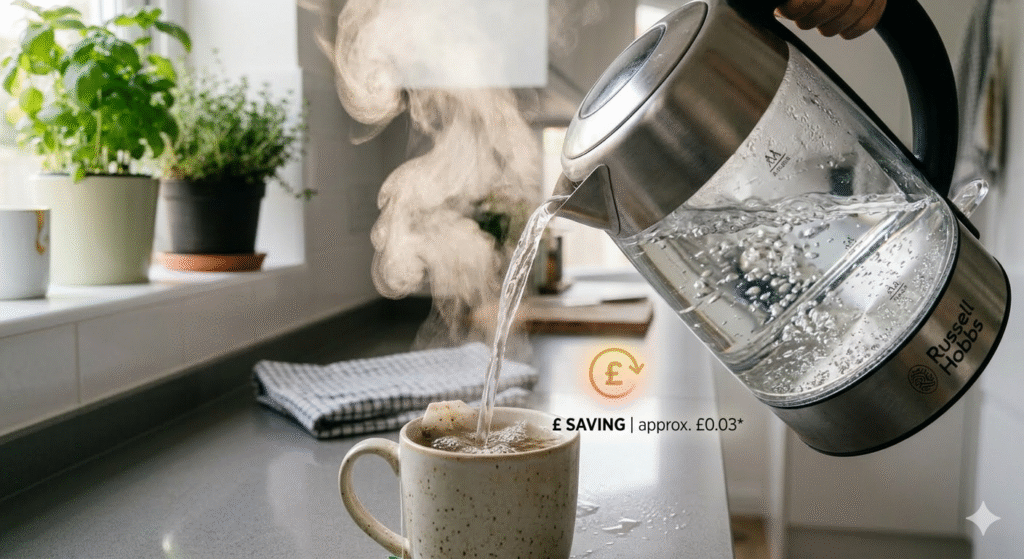
Boiling one cup of water in a kettle filled to the minimum line costs roughly 0.5p. Boiling the same kettle filled to the top costs roughly 3.6p — seven times more, for the same result. Over a year at four boils a day, that difference is approximately £45.
No appliance upgrade delivers that saving. Switching from a standard kettle to an eco kettle with a rapid-boil feature saves a meaningful amount — but only because it makes correct filling easier and faster, not because the underlying physics are dramatically different.
We made this change about two years ago — started actually looking at the minimum line rather than filling out of habit — and it was one of those small adjustments that compounds quietly over months. The low-energy kettles worth buying under £50 are the ones that make correct filling easiest by design.
What About a Dedicated Hot Water Dispenser?
Worth addressing because they’ve become more common in UK kitchens. Hot water dispensers — countertop appliances that keep water at near-boiling temperature — use a heating element that runs continuously to maintain temperature, drawing a small but constant trickle of power throughout the day.
For households that make a very high volume of hot drinks — an office kitchen, a large family, or anyone boiling water more than eight to ten times daily — the per-boil cost of a dispenser can undercut a kettle because there’s no heating cycle for each boil. For average household use of three to five boils a day, the standing power draw of a dispenser typically outweighs the per-boil saving and makes it more expensive overall.
They’re worth knowing about but rarely the right choice for a typical UK home on a standard tariff.
Does It Matter What Tariff You’re On?
Yes — if you’re on a time-of-use tariff like Economy 7 or a smart tariff like Octopus Agile, the cheapest way to boil water shifts depending on when you’re doing it. During off-peak hours, even a full kettle boil costs a fraction of the daytime rate. If your household’s heaviest hot drink consumption happens in the morning — which for most families it does — and your off-peak window covers the early morning hours, the cost difference between methods becomes negligible.
For households on a standard single-rate tariff, the comparison above stands. For time-of-use tariff households, the time of day matters more than the appliance choice.
Frequently Asked Questions
Is it cheaper to boil water in a kettle or on the hob? A correctly filled electric kettle is cheaper than a hob for boiling small volumes of water. The kettle heats water directly and efficiently. The hob heats the pan first and loses more energy to the surrounding air. For quantities up to about one litre, the kettle wins on both cost and speed.
Is it cheaper to boil pasta water in a kettle first then transfer to the pan? Yes — significantly. Boiling water in a kettle and transferring it to a pan on the hob uses less energy than heating a pan of cold water on the hob from scratch. The kettle boils water faster and more efficiently than the hob can. Fill the kettle to the amount you need, boil it, transfer to the pan, then use the hob only to maintain the simmer once the pasta goes in. It’s one of those kitchen habits that costs nothing to change and makes a small but consistent difference to the monthly bill.
Is microwaving water to boil it safe? Yes, with one caveat. Superheating — where water heats past boiling point without bubbling — can occur in a very clean microwave-safe container. Stirring the water before use and using a container with a small imperfection like a ceramic mug rather than a glass beaker prevents this. For everyday use in a standard mug, microwaving water is safe.
Does the type of kettle matter? Yes — kettles with rapid-boil zones or lower wattage elements make a genuine difference for single-cup boiling. The most important feature is clear minimum-fill markings that make accurate filling easy by default. A double-wall insulated kettle also keeps water hotter for longer, reducing the need to reboil if you get distracted between cups.
How much does it cost to boil a full kettle? At the current UK rate of approximately 24p per kWh, boiling a full 1.7-litre kettle costs roughly 3.5–4p. Boiled four times a day every day that’s approximately £50–58 per year — most of which is recoverable simply by not overfilling.
Does an induction hob use less energy than an electric hob for boiling water? Yes — induction hobs are significantly more efficient than standard electric hobs because they heat the pan directly through magnetic induction rather than heating a ring that then transfers heat to the pan. For boiling water as part of cooking, an induction hob is the most efficient hob option. For boiling a cup of water for a drink, a kettle is still faster and more practical.
Is a gas hob cheaper than an electric kettle for boiling water? No — even though gas is cheaper per unit than electricity at current UK rates, a kettle filled correctly to the minimum line still costs less per boil than a gas hob. The kettle is more direct and faster, losing less energy in the process. The gas hob only becomes competitive when boiling large quantities as part of cooking where the hob is already in use.
The Verdict
For most UK households the answer is simple: use the kettle, fill it to the minimum line, and don’t overfill it. That combination is cheaper per boil than any other method and faster than either the hob or microwave for typical drink-making volumes.
Use the microwave if you’re heating a small amount of liquid for cooking or a single drink and your kettle isn’t nearby — the energy cost is low and it’s a genuinely underrated option for small volumes where tea quality isn’t the priority.
Avoid the hob for boiling water unless you’re cooking and need it as part of that process. It’s the slowest, least efficient method for drink-making and the numbers don’t justify it.
The bigger picture: the appliance matters less than the habit. A household that fills the kettle correctly every time will spend less on boiling water annually than one that uses a premium eco kettle but fills it to the top out of habit. Fix the behaviour first, then consider the appliance.
Related Guides
About The Author – Andrew Marshall
Andrew Marshall is a Scottish homeowner and the creator of Save Wise Living. He shares practical ways to reduce energy bills, improve home efficiency, and make everyday household routines cheaper and simpler.