
Last Updated: April 2026
The cupboard under the kitchen sink is one of those spaces that starts as a simple storage area and quietly becomes a problem. Cleaning sprays that have fallen over. Bin liners that have unravelled into an impenetrable nest. A bottle of something that might be limescale remover or might be fabric softener — you’ve stopped checking because it doesn’t matter until you need it.
In a UK kitchen, particularly in a flat, a rental, or any home where the kitchen was designed with efficiency rather than generosity in mind, the under-sink cupboard is almost always smaller than it looks and more awkward than it should be. The pipes take up a significant portion of the usable space, the depth makes anything stored at the back invisible until you need it urgently, and the low ceiling height means stacking sensibly is harder than it should be.
The good news is that a decent organiser solves most of this quickly and cheaply — not by making the cupboard bigger, but by making you use what’s actually there properly. This covers what to look for before you buy anything, the products that are genuinely worth ordering on Amazon UK, and how to set it up in a way that actually stays organised.
If the under-sink cupboard is just one part of a wider kitchen organisation problem, making the most of every cupboard in a small UK kitchen is worth thinking about at the same time — the same principles apply throughout.
What to Look For Before You Buy
Before spending anything, there are five things worth understanding about this specific space. Miss one and you’ll likely end up returning the organiser.
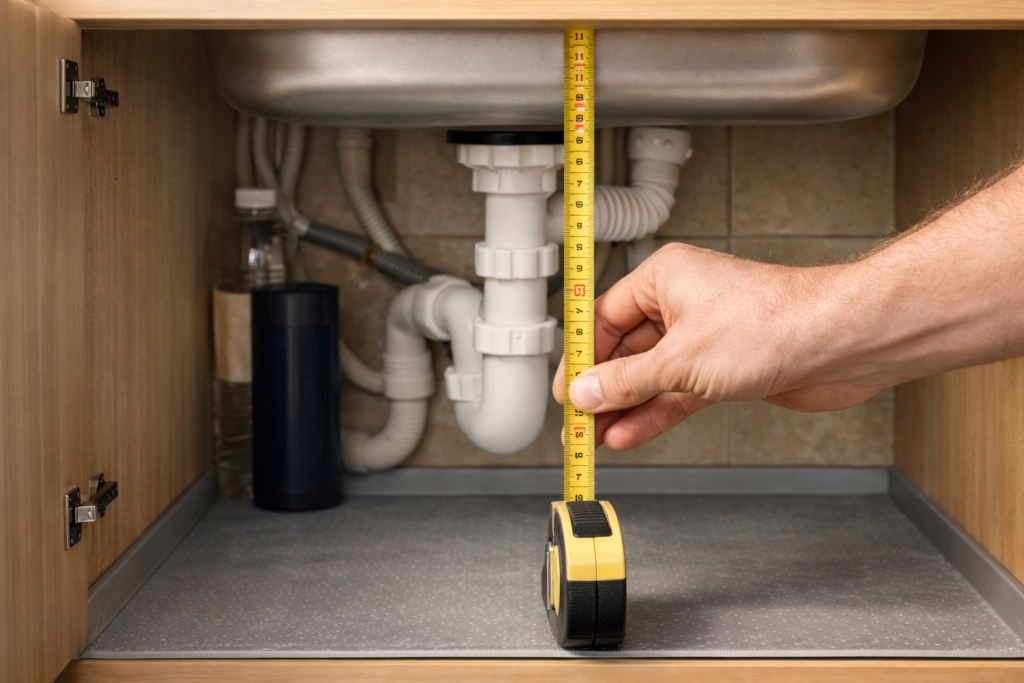
Measure before you order — specifically. This is the most consistently skipped step and the most consistently regretted one. Measure the internal height from the cupboard floor to the underside of the sink basin — not to the top of the cupboard door opening, which is higher. Measure the depth front to back and the width between any plumbing. A product that looks right in the photograph but arrives 4cm too tall for your specific cupboard is the most common complaint in this category. Five minutes with a tape measure before buying saves a return trip.
The pipe problem. Almost every UK under-sink cupboard has a waste pipe, a supply pipe, or both running through the storage area. Any organiser needs to work around these rather than pretending they don’t exist. This means either a unit with adjustable shelves that can be reconfigured around your specific pipe position, or a two-pack that splits across either side of the plumbing. Fixed-dimension organisers that assume a clear unobstructed floor often don’t fit and often get returned.
Pull-out access. The single biggest improvement a good organiser makes to this space is pull-out drawer access. Without it, you’re reaching into a dark cupboard every time you need something. With it, the whole cupboard comes to you. It sounds like a minor convenience until you’ve experienced it consistently — after a week it’s one of those things you can’t imagine going back from. Moisture and rust resistance are the other non-negotiable — under the sink is a damp environment and any untreated metal or wood will show it within a season.
No tools, no drilling. Most UK renters can’t drill into cupboard walls or floors. The better organisers are entirely freestanding or use suction cups to hold position without any fixings. Check for this before buying if you’re renting.
The damp smell. Older UK kitchens and rentals often have a slight musty smell under the sink from pipe sweating, occasional drips, or general cupboard mustiness. An organiser won’t fix this on its own — a moisture absorber for cupboards placed in the corner and a waterproof mat on the cupboard floor underneath the organiser will deal with most of it. Sort the smell at the same time as the organisation and the cupboard stays in much better condition.
Moisture under the sink is part of a broader kitchen damp problem that a few simple kitchen habits can reduce significantly without spending anything.
The Products Worth Buying
Housolution 2-Tier Pull-Out Under-Sink Organiser
The Housolution is the current bestseller in this category on Amazon UK and it earns that position for practical rather than marketing reasons. The height of both tiers is adjustable — you physically move the upper shelf up or down depending on what your pipe arrangement needs — which is the feature that makes it genuinely suitable for the variety of UK under-sink configurations rather than just the straightforward ones.
Four suction cups on the base hold the unit in position without drilling or fixing, which matters considerably in a rented kitchen. The mesh drawer construction means you can see what’s in each tier without pulling everything out to find one bottle. UK buyers specifically mention it holding heavy cleaning products and laundry bottles without the base bowing — which is a real concern with the cheaper all-plastic alternatives that flex under load.
The honest caveat worth knowing: the rail clips that the drawers run on are plastic rather than metal. They function well and hold up across reviews but they’re the component most likely to show wear with heavy daily use over several years. For a kitchen that sees the organiser opened and closed multiple times every day, keep an eye on them after the first year.
For most UK kitchens — particularly rentals, flats, and anything with offset pipe placement — this is the organiser to start with. It handles the awkward configurations that standard units don’t.
SONGMICS 2-Tier Under-Sink Storage with Sliding Drawers
SONGMICS is a well-established home organisation brand with genuine UK warehouse presence and the 2-tier under-sink unit is one of their most consistently reviewed products. The key practical difference from the Housolution is that the SONGMICS comes as a set of two separate sliding drawer units rather than one single unit — and that difference matters for a specific and very common UK kitchen situation.
If your waste pipe runs roughly centrally through the cupboard, a single organiser has to sit awkwardly to one side or straddle the pipe in a way that wastes space on both sides. Two separate units — one either side of the plumbing — solve this cleanly. You get a properly functioning drawer unit on each side with nothing having to work around anything. The baskets are height-adjustable within their frames, and the four clips on the base allow both units to be stacked vertically if your cupboard height allows it.
The powder-coated steel construction and smooth drawer track action are consistently noted in UK reviews. SONGMICS HOME UK is a verified Amazon seller with genuine UK support — relevant if something arrives damaged or doesn’t fit your space.
One honest note: the individual baskets are narrower than the single Housolution unit, which means less per shelf but more flexibility around pipe configurations. If your pipe runs dead centre, the SONGMICS two-pack is the better choice. If your pipe is offset to one side, the Housolution handles that configuration cleanly with less faff.
Expandable Under-Sink Shelf with Adjustable Panels
This one is for a specific situation that the two options above don’t serve as well: deep UK under-sink cupboards where you’re storing bulk items — spare bottles, extra bin liners, cleaning product multipacks — alongside the daily-use kit, and where the pipe configuration is particularly complex or central.
Expandable shelf units typically adjust from around 42cm to 78cm in width, with removable ABS panels that create custom gaps wherever your pipes run. Rather than configuring a fixed unit around your plumbing, you configure the gaps in the shelf to match your specific pipe positions exactly. For an older UK kitchen with central plumbing and no obvious way to split the space, this is the solution that actually fits.
The trade-off is access — expandable shelves without pull-out drawers are less convenient for daily-use items than the sliding designs above. They suit occasional-access storage better than daily-use storage. The most practical approach in a cupboard with complex plumbing is an expandable shelf for the back half of the cupboard and a smaller pull-out unit at the front where you need regular access.
Setting It Up So It Stays Organised
Buying the organiser is the straightforward part. The part that most setups get wrong is what goes where — and it’s simpler than most organisation advice makes it sound.
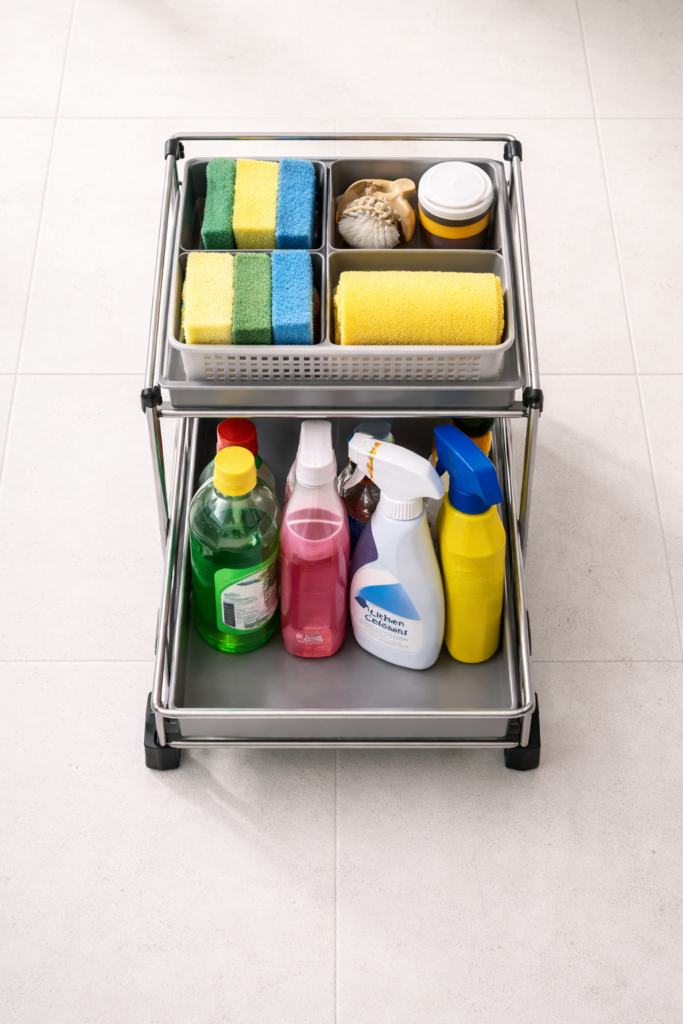
Organise by frequency of use rather than by category. It’s instinctive to group all the cleaning products together and all the bin liners together. In practice what works better is everything you use daily on the top tier — sponges, washing up liquid, the spray you reach for every surface wipe — and everything you use occasionally on the bottom tier or at the back, regardless of type. The organisation that actually stays consistent is the one where daily items are immediately visible and reachable without any searching.
The bottom tier should hold the tall items: spray bottles, large cleaning bottles, anything that can’t lay on its side without leaking. Most UK under-sink cupboards have enough internal height for bottles up to around 25–30cm standing upright on the lower shelf. If you’re not sure, measure a few of your tallest bottles before configuring the shelf heights.
A waterproof under-sink mat placed on the cupboard floor before the organiser goes in is genuinely worth adding — a few pounds, catches drips, protects the cupboard base, wipes clean. Put it down first and the organiser sits on top of it.
Don’t overfill. This is the instruction that sounds obvious and gets ignored most consistently. An under-sink cupboard that’s organised but completely packed returns to chaos faster than one that has slightly less in it — because there’s no room to put things back properly when you’re in a hurry. The spare bottles bought in bulk sit better in a utility cupboard elsewhere. Under the sink is for the active-use items you reach for every day, not for overflow storage.
If you’re reorganising the wider kitchen or utility area at the same time, choosing the right compact washing machine for a small UK space is worth sorting alongside the storage.
And if you’re also sorting out waste and recycling storage at the same time, the kitchen bins worth buying for UK recycling setups covers the options that fit in smaller kitchens
The SWL Smart Kitchen Hub
For more practical kitchen organisation and appliance tips, the Smart Kitchen and Appliances hub covers space-saving ideas, energy-efficient kitchen gear, and the upgrades worth making in a UK home.
Related Guides

About The Author – Andrew Marshall
Andrew Marshall is a Scottish homeowner and the creator of Save Wise Living. He shares practical ways to reduce energy bills, improve home efficiency, and make everyday household routines cheaper and simpler.