
Last Updated: 6th March 2026
When our local council cut the number of general waste collections, the weekly bin situation at home became something that needed actual thought. One general waste collection a fortnight means anything that can be recycled needs to go somewhere else — and a single bin with a single compartment doesn’t cut it when you’re trying to keep general waste, recycling, and food scraps separated across two weeks rather than one.
A decent kitchen recycling bin doesn’t sound like a significant purchase until you’ve spent a fortnight managing without the right one. Then it becomes fairly obvious fairly quickly. The Smart Kitchen & Appliances Hub covers the broader range of kitchen upgrades worth making for UK households — this article focuses specifically on recycling and waste separation bins that make the reduced-collection reality more manageable.
Why the Right Bin Actually Matters
The practical case for a decent recycling bin has strengthened considerably as UK councils have reduced collection frequencies. When general waste is collected fortnightly rather than weekly, the amount of space in the general waste bin matters more — and anything that can be diverted into recycling or food waste collections directly reduces how quickly that space fills up.
A well-designed bin makes the separation automatic rather than effortful. When the compartments are clearly defined, correctly sized for your household’s actual output, and positioned so that sorting takes one second rather than ten, recycling happens consistently rather than only when someone makes the effort. That consistency is what produces the actual benefit — both for the household managing its general waste allocation and for the recycling itself.
Beyond the collection frequency argument, there’s a straightforward cost case. Recycling correctly means buying fewer bin bags for general waste — the bags themselves cost money, and reducing general waste volume directly reduces how many you go through. If reducing kitchen waste more broadly is something you’re working on, the vacuum seal food storage gadgets worth considering for UK kitchens covers the options that keep food fresh for longer — directly reducing the food waste that ends up in the bin in the first place.
Food waste separation, where a council collection exists, removes the heaviest and most odour-producing element from the general waste bin, which makes fortnightly general waste collection genuinely manageable rather than unpleasant by week two.
What to Look for Before Buying
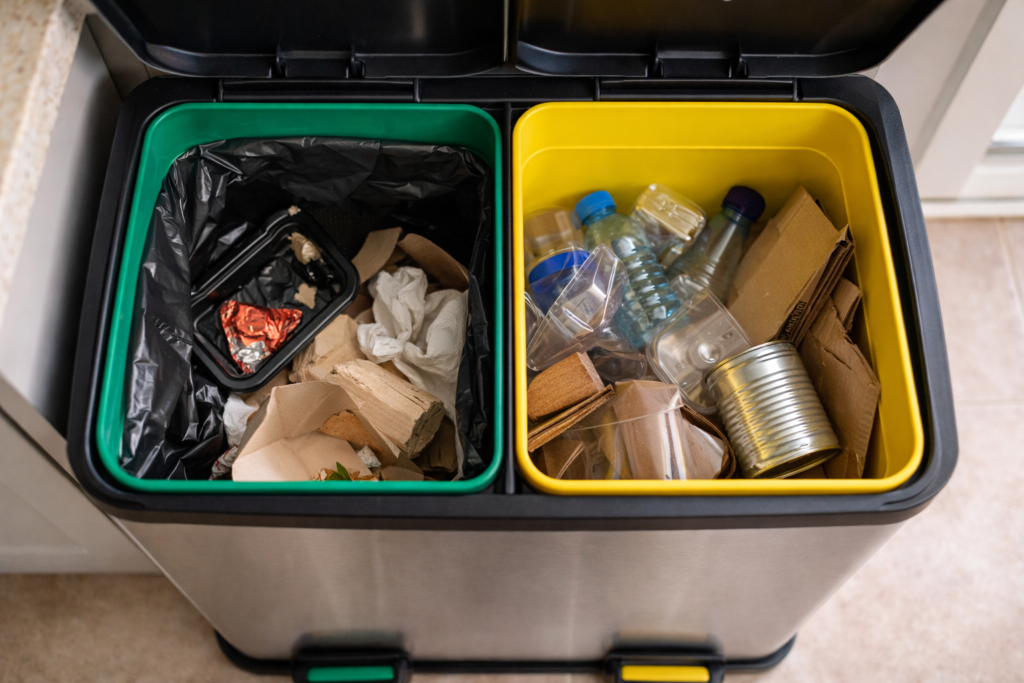
Number of compartments is the starting point. A two-compartment bin separates general waste from recycling — adequate for households where food waste goes in a separate council-provided caddy. A three-compartment bin adds food waste separation within the main bin, which suits households without a separate caddy or those who want everything in one place.
Capacity needs to match household size and collection frequency. A couple managing fortnightly collection can work with a 40–50 litre total capacity across compartments. A family of four or five managing the same collection frequency needs 55–70 litres — the recycling compartment in particular fills quickly with cardboard, plastic, and glass across two weeks.
Lid mechanism determines whether the bin gets used consistently. A pedal-operated lid keeps hands free and prevents cross-contamination when hands are full or dirty. A motion-activated lid removes physical contact entirely — useful at the kitchen counter where hands are frequently carrying food waste. Soft-close mechanisms prevent the slamming that becomes irritating within a week and disturbing late at night.
Odour control matters significantly for fortnightly collection. A bin that contains food waste for up to two weeks without adequate sealing produces smells that affect the whole kitchen. Charcoal filters in the lid or inner food caddy compartment address this effectively. If the kitchen setup more broadly needs attention — storage, organisation, and the habits that reduce waste before it reaches the bin — the kitchen hacks that genuinely make a difference covers the practical changes worth making alongside any bin upgrade.
Removable inner buckets make emptying and cleaning practical rather than awkward. A bin without removable buckets requires the whole unit to be moved to the bin outside — which nobody does consistently. Removable buckets that lift out, carry to the outdoor bin, and return to the unit take ten seconds and get done every time.
Five Kitchen Recycling Bins Worth Buying
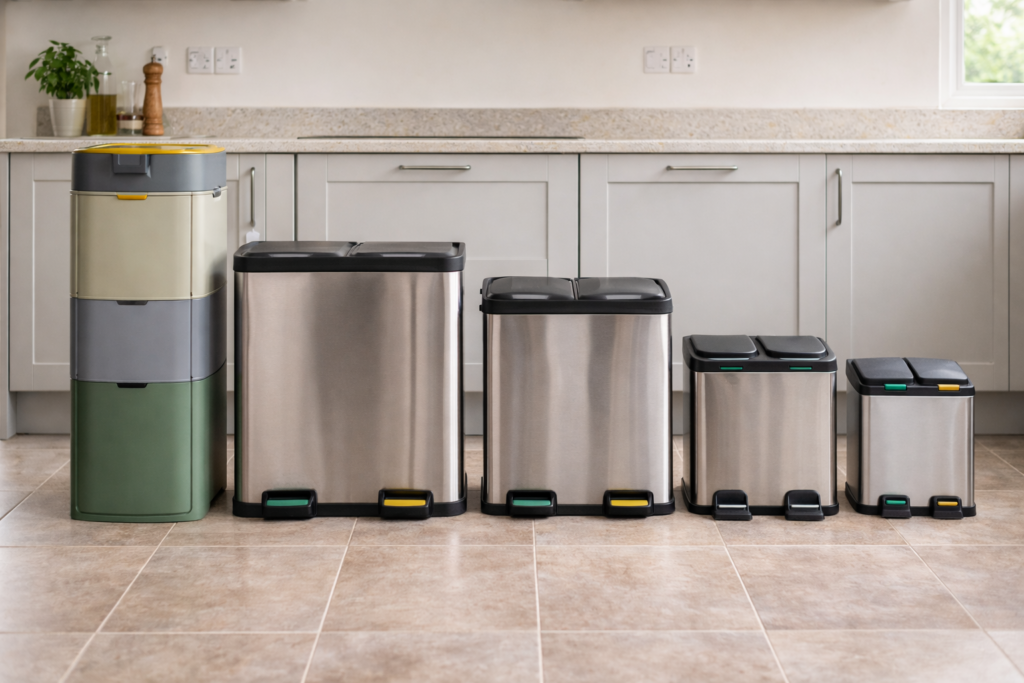
EKO 50L Motion-Activated Recycling Bin
The EKO is the premium option on this list and it earns that position with a feature that’s genuinely useful rather than a gimmick — the motion-activated lid opens with a wave of the hand and closes automatically after a set delay. For a household that’s constantly moving food waste and packaging from counter to bin with hands that are full or wet, removing the need to touch the bin at all changes the experience in a way that’s immediately noticeable.
The dual compartment design separates general waste and recycling across 50 litres total, with a fingerprint-resistant stainless steel exterior that stays presentable in a kitchen where it’s in daily use. Soft-close mechanism on both compartments means no slamming regardless of how the lid is nudged closed.
The honest caveat: the motion sensor requires batteries and occasionally triggers unexpectedly. For households that find sensor technology more frustrating than convenient, the pedal options below are a better fit. For everyone else, the EKO produces a bin experience that’s noticeably better than anything without the sensor.
Joseph Joseph Totem Max 60L
The Joseph Joseph Totem Max is the most space-efficient bin on this list — its vertical stacking design means it occupies the smallest possible floor footprint for its 60 litre total capacity. For kitchens where floor space is the constraint rather than storage, this is the answer.
The design stacks two compartments vertically with a removable food caddy integrated at the top — general waste at the bottom, recycling above it, food waste accessible at counter height. Colour-coded inner buckets make the separation obvious and the odour filters in the lid address the food waste smell problem directly.
At 60 litres this is the largest capacity option on the list, which makes it particularly suited to families managing fortnightly collection — the additional volume in the recycling compartment specifically means less frequent trips to the outdoor recycling bin mid-fortnight. The vertical design does mean the bin is taller than standard — worth checking clearance if it’s going under a counter or in a utility cupboard.
SONGMICS 2-Compartment Recycling Bin 48L
The SONGMICS is the best mid-range option on this list — pedal-operated dual lids, soft-close mechanism, removable inner buckets, and brushed stainless steel finish at a price point significantly below the EKO. For households that want a genuinely functional recycling bin without the premium cost of motion sensing or the design premium of Joseph Joseph, this is the straightforward answer.
The 48 litre total capacity across two compartments suits couples and small families managing standard fortnightly collection. The pedal mechanism is solid rather than flimsy — a common failure point on cheaper dual-lid bins where the pedal connection to the lid loosens over time. The removable inner buckets are genuinely easy to extract and replace rather than the awkward sliding arrangements some competitors use.
No odour control filter is included — a minor gap for a bin that might contain food scraps in the general waste compartment. A bin odour filter purchased separately and placed in the lid addresses this straightforwardly.
VonHaus 2-Compartment Recycling Bin 48L
The VonHaus 2-compartment is the most compact option on this list and the one that suits smaller kitchens or utility rooms where a larger bin simply doesn’t fit. Two compartments, foot pedals, and a straightforward design that does the job without the additional features — or cost — of the options above.
For a couple in a flat managing fortnightly collection with a council food caddy already in use, this covers the general waste and recycling separation requirement at the lowest price point on the list. The absence of odour filters and motion sensing isn’t a gap at this price — it’s an appropriate specification for the use case and the budget.
The stainless steel exterior is fingerprint-prone compared to the brushed finish on the SONGMICS — worth knowing before buying for a kitchen where the bin is prominently placed.
VonHaus 3-Compartment Recycling Bin 54L
The three-compartment VonHaus is the option for households that want full waste separation in a single unit — general waste, recycling, and food waste each in their own compartment without needing a separate council caddy on the counter alongside the main bin.
Three pedal-operated lids, removable inner buckets for all three compartments, and a stainless steel body at a mid-range price point. The 54 litre total splits across three compartments which means each individual section is smaller than the equivalent two-compartment models — the food waste compartment in particular is compact and will need emptying more frequently than the others for a household of four or more.
For a family managing fortnightly general waste collection where keeping the general waste volume down is the priority, the three-compartment design gives the most control over what goes where and reduces the risk of recyclable or compostable waste ending up in the general waste compartment by default.
The Money Angle — Worth Thinking About Before Buying
Bin bags are a household cost that compounds quietly across the year. A family going through two general waste bin bags per week spends roughly £25–40 per year on bags alone depending on the brand. Reducing general waste volume through effective recycling separation — particularly diverting food waste and dry recycling away from general waste — directly reduces how often those bags are used.
A recycling bin with compartments that makes separation automatic reduces general waste bag usage more consistently than one that requires conscious effort. Across a year of fortnightly collection that reduction is meaningful — and it’s worth factoring alongside the purchase price when comparing options.
The larger upfront cost of a Joseph Joseph or EKO model versus a VonHaus entry-level option looks different when considered across three to five years of use rather than as a single purchase. A bin that lasts five years and reduces general waste bag usage consistently costs less in total than a cheaper bin replaced after two years plus the additional bag cost from less effective separation. The same logic applies to kitchen appliances — what energy ratings actually mean for kitchen appliances is worth reading before any kitchen purchase, bin or otherwise, to understand which upfront costs pay back over time and which don’t.
Which One Is Right for Your Household
For most families managing fortnightly collection with a food caddy already provided by the council — the Joseph Joseph Totem Max is the best overall choice. The capacity, the vertical design, and the integrated food caddy slot make it the most complete solution at the price.
For households without a council food caddy and wanting full separation in one unit — the VonHaus 3-Compartment covers the requirement at the most accessible price point.
For a couple or small household where space is the primary constraint — the VonHaus 2-Compartment is compact, functional, and fairly priced.
For households that want a premium daily experience and find the motion sensor genuinely useful — the EKO is worth the additional cost.
For households that want solid mid-range functionality at a mid-range price — the SONGMICS is the answer.
If you’re reorganising the kitchen more broadly at the same time, the under-sink storage solutions worth considering for UK kitchens covers the options that work well alongside a new bin setup — particularly for households where cleaning supplies and the bin occupy the same awkward corner.
FAQ
How many compartments do I actually need?
It depends on your council’s collection setup. If your council provides a separate food waste caddy, two compartments — general waste and recycling — cover the requirement. If there’s no separate food waste collection in your area or you’d rather contain everything in one unit, three compartments give you full separation. Check what your council collects before buying.
What size bin do I need for fortnightly collection?
For a couple, 40–50 litres total is generally sufficient. For a family of three or four, 55–65 litres is more comfortable — particularly in the recycling compartment which fills quickly with cardboard and plastic across two weeks. If general waste is consistently full before the fortnight is up, more aggressive recycling separation into the second compartment is usually more effective than buying a larger bin.
Do kitchen recycling bins smell?
Food waste is the source of most bin odour. A sealed inner bucket for the food waste compartment and a charcoal filter in the lid manage the smell effectively for fortnightly collection. Without these features, a bin containing food waste for two weeks in a kitchen will produce noticeable odour by the second week. Prioritise odour control features if fortnightly collection is your situation.
Can I use any bin bag in a recycling bin?
Standard bin bags fit most inner buckets — but check the dimensions of the inner bucket before buying bags in bulk. Some recycling bins use non-standard bucket sizes that don’t take off-the-shelf bags cleanly. Compostable bin bags are worth considering for the food waste compartment — many UK councils accept food waste in compostable liners rather than requiring it to be loose in the caddy.
Is stainless steel worth paying extra for?
For a bin in daily use in a busy kitchen it’s generally worth it — stainless steel cleans more easily than plastic, lasts longer, and stays presentable over years of use. Brushed stainless is more fingerprint-resistant than polished. For a utility room or less visible location, a plastic bin at a lower price point is a perfectly reasonable choice.
How do I stop the bin smelling between emptying?
Charcoal filters in the lid, sealed inner buckets for food waste, and a bin deodoriser placed in the base of the inner bucket are the three most effective measures. Rinsing the inner buckets when emptying rather than just replacing the bag prevents residue buildup that contributes to persistent smell regardless of what’s currently in the bin.
Related Guides

About The Author – Andrew Marshall
Andrew Marshall is a Scottish homeowner and the creator of Save Wise Living. He shares practical ways to reduce energy bills, improve home efficiency, and make everyday household routines cheaper and simpler.