
Last Updated: April 2026
The dish drainer is one of those objects most people don’t think about until they replace it — and then immediately wonder why they put up with the old one for so long. The previous one pooled water across the worktop for eighteen months and you just accepted it as a fact of life. A decent rack with a proper swivel spout drains into the sink. That’s it. That one change makes the area next to the sink noticeably less annoying every single day.
In most UK kitchens — particularly flats, rentals, and anything built before generous worktop space became an architectural priority — the area next to the sink is already doing three jobs at once. The dish drainer is part of a negotiation between you and the available surface, and if it’s the wrong size, the wrong shape, or pooling water where it shouldn’t, it loses that negotiation daily. Getting the right one is a small decision with an outsized effect on a routine that happens in most households at least once a day.
This covers everything that matters when choosing one for a small UK kitchen — what to look for, which specific models are worth ordering on Amazon UK, and how to keep whichever one you choose in good condition longer than the last one lasted.
For more space-saving and organisation ideas across the whole kitchen, the Smart Kitchen and Appliances hub covers practical UK home upgrades that don’t require a renovation.
What Actually Matters When Choosing a Dish Rack
Most dish rack articles focus on looks. The things that affect daily life are slightly different.
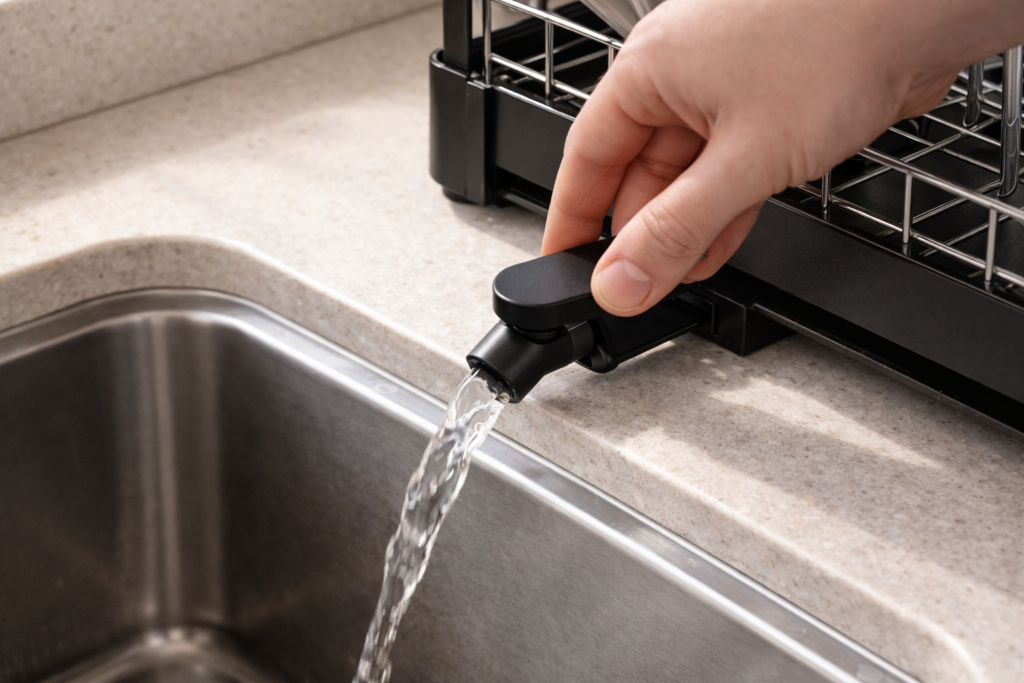
Drainage design — the most important feature. A rack with a swivel or rotatable drainage spout channels water directly into the sink regardless of where on the worktop you position it. You can place it left, right, or at an angle and adjust the spout to point over the sink edge. A rack without this feature drains into a drip tray that needs emptying manually — which sounds trivial until you’ve knocked a full drip tray across a clean worktop for the third time in a week. For a UK kitchen where the rack sits in a fixed position next to the sink permanently, a swivel spout is the feature worth paying for. It’s the single upgrade that makes the most difference to day-to-day use.
Rust resistance — and why it matters more in the UK specifically. A dish rack lives in one of the dampest environments in the house. In a hard water area — which covers most of southern and central England, and affects water hardness across much of Scotland too — limescale deposits build on the metal frame within weeks and accelerate surface degradation. Cheap chrome-plated wire rusts within a season in these conditions. It starts as small brown spots at the wire tips and spreads from there. Stainless steel or powder-coated carbon steel are the correct materials. Anything described simply as “metal” or “chrome-plated” without further specification should be treated with scepticism. A stainless steel dish drainer costs a few pounds more and lasts several years longer.
Actual footprint vs advertised dimensions. UK worktops beside a sink are rarely the generous expanse product photography suggests. Most UK sink areas have 30–45cm of clear width before hitting a wall, hob, or another appliance. Measure the available space — specifically the width and depth beside the sink — and compare against product dimensions before ordering. A rack that’s 5cm too wide to clear the tap is going back.
Cutlery holder placement. Detachable or repositionable cutlery holders make a real difference across different UK sink configurations. Fixed-position holders that protrude in the wrong direction for your specific layout can mean the rack either doesn’t fit or blocks tap access. Small thing that causes a surprising number of returns.
How easy it is to clean. Dish racks accumulate limescale, food residue, and kitchen grime faster than almost anything else in the kitchen. Designs that come apart fully — rack, drip tray, cutlery holder all separate — clean properly in the sink or dishwasher. Those that don’t disassemble properly just get wiped inadequately and gradually become a hygiene problem. This is consistently one of the most-cited frustrations in real UK buyer reviews and it’s worth checking before buying a compact dish drying rack that looks good in the photograph but can’t be properly cleaned.
If you’re also looking at how your kitchen kit stacks up on energy and running costs, the smart kitchen habits that actually move the needle on electricity bills are worth a read alongside the organisation upgrades.
If Your Current Rack Is Already Rusting
Worth addressing before the product recommendations, because a significant number of people arrive here because their existing rack has started to go.
If rust is only appearing at the wire tips — the very ends of the individual wires — a white vinegar soak for an hour followed by a scrub with an old toothbrush will usually remove the surface rust and slow the spread. Dry it thoroughly after and it can last another season. If the structural wires or the base frame are rusting, it’s time to replace rather than repair. A rusting frame contaminates clean dishes and the rust spreads into the drip tray and onto the worktop surface.
The Dish Racks Worth Buying
Joseph Joseph Duo Expanding Dish Drainer — Best Overall
Joseph Joseph Duo Expanding Dish Drainer on Amazon UK
With over 11,000 UK reviews at consistently high ratings, the Joseph Joseph Duo has become the default recommendation for UK kitchens where the dish drainer is a permanent worktop fixture. It earns that position genuinely.
The expandable design is the headline feature — the rack compresses to a compact size for light daily use and extends when a larger wash-up needs it. For a household that alternates between rinsing a few mugs in the morning and a full post-dinner session in the evening, this covers both without needing a permanently oversized rack taking up worktop space that isn’t being used. The stainless steel and grey plastic combination is fingerprint-resistant and holds up in damp UK kitchen conditions without the surface degradation that cheaper chrome designs show within months. The draining spout adjusts and channels water directly into the sink. The cutlery holder is removable and repositionable.
The honest caveat from UK reviews: at full extension, the rack can feel slightly top-heavy when loaded with large plates. The draining spout connector has been noted by some buyers as a weak point that loosens with time. For most households it’s a non-issue; for very heavy daily use, it’s worth being aware of.
For a single person, a couple, or a household that uses the dishwasher for most things and just needs somewhere for the items that won’t go in — this is the one.
niffgaff 2-Tier Black Dish Drainer — Best Value Two-Tier
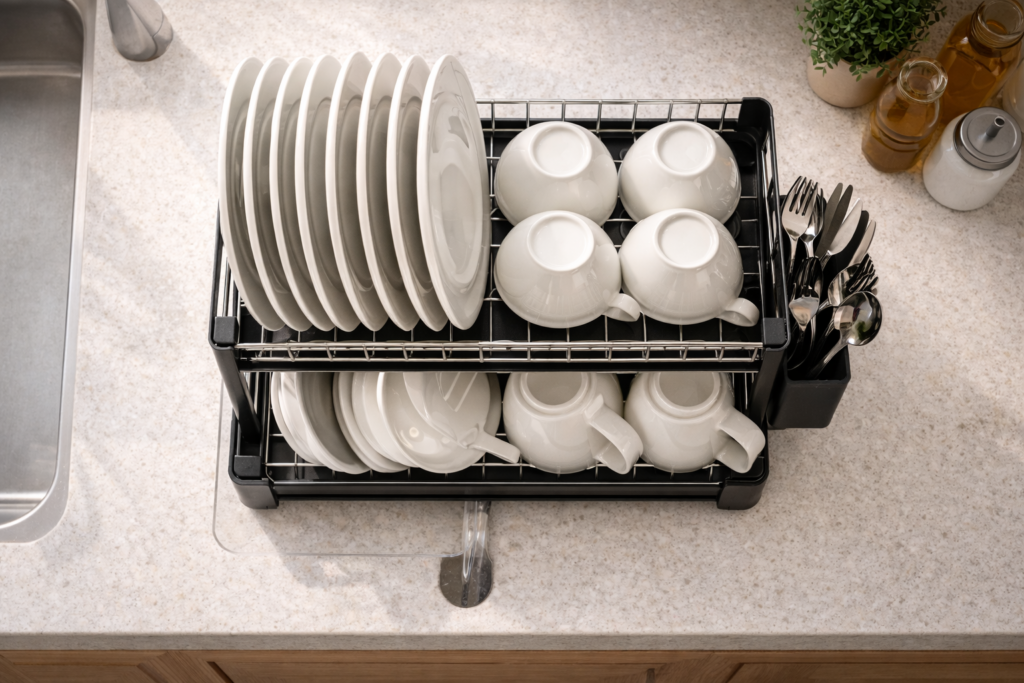
Over 6,500 UK reviews and the mid-range option that most households doing regular hand-washing will find sits in the right place on price, capacity, and build quality. The two-tier design makes efficient use of vertical space rather than spreading across the worktop — plates and larger items on the top tier, bowls, cups, and glasses below. For a UK kitchen where worktop width is limited but there’s reasonable clearance above the drainer, a vertical design reclaims surface area that a wide flat rack would occupy.
The H-shaped frame is noticeably more stable than cheaper wire constructions — UK buyers specifically note it doesn’t wobble under heavier loads, which is the primary failure mode of budget drainers. One UK reviewer noted it surpasses their previous Joseph Joseph model for capacity. The drip tray sits underneath and catches drainage without requiring constant emptying. Assembly takes around ten minutes with an Allen key included.
The honest caveat: the cutlery holder runs on the small side — fine for a standard household but limiting if you have a lot of cutlery. Some buyers report slightly uneven legs on arrival, which the adjustable feet compensate for but worth checking immediately.
For families doing full regular hand-washes, this is the rack that holds everything without dominating the kitchen.
If you’re hand-washing because your kitchen doesn’t have room for a dishwasher, whether a dishwasher actually costs less than washing by hand is a question worth answering before writing one off entirely.
Kitsure Compact 2-Tier Dish Drainer — Best for Very Tight Spaces
The Kitsure compact model sits at 38cm × 29cm — meaningfully smaller than most 2-tier options — which makes it the right choice when even a standard rack is a squeeze. The kind of kitchen this suits is a rented flat with a single drainer width of roughly 30cm beside the sink and about 40cm of usable worktop depth before the wall. In that situation most racks don’t fit cleanly. The Kitsure does.
It holds 6 plates, a selection of bowls and glasses, and has a separate cutlery holder — which covers one to two people’s washing-up without requiring space the kitchen simply doesn’t have. The stainless steel is rust-resistant and the 360° rotatable drainage spout is the feature that makes the compact dimensions work practically — you can position it wherever the limited space allows and adjust the spout to reach the sink regardless of the angle.
Honest assessment: a family doing full washes will outgrow it in one session. For one person’s flat, a small rental kitchen, or anything with a genuinely restricted worktop, it does its job without making the space feel smaller than it already is.
SONGMICS Dish Drying Rack — Best for Open-Plan Kitchens Where Appearance Matters
The SONGMICS earns its place for a specific type of UK kitchen that the other racks on this list don’t serve quite as well — the open-plan kitchen-diner where the rack is in sightline from the main living space for much of the day. The fingerprint-resistant coating on the stainless steel frame is the feature that matters here. Most racks look fine when you first put them on the worktop and start looking grubby within a week. The SONGMICS coating genuinely reduces fingerprint and water mark visibility, which in a kitchen that opens onto a living area makes a real difference to how the space looks between cleans.
The 360° rotatable and extendable drainage spout clears the lip of most UK kitchen sinks cleanly and the capacity at 31 × 42 × 36.5cm covers a standard household wash-up comfortably. The cutlery holder is included and removable. SONGMICS has genuine UK fulfilment and customer support — relevant if something arrives damaged.
The honest note: it runs slightly larger than the Kitsure compact and slightly less vertical in design than the niffgaff 2-tier. It’s the right choice when the look of the rack in an open kitchen matters as much as the purely practical considerations.
Joseph Joseph Y-Rack — Best When Width Is Genuinely the Constraint
Joseph Joseph Y-Rack on Amazon UK
Most dish racks trade width for capacity. The Y-Rack trades width for height instead. The vertical 2-tier design stacks a traditional plate rack above a wide base for bowls, pots, and cups — the footprint on the worktop is genuinely small. Joseph Joseph describe it as holding 4 full place settings in a very small space, and UK buyers broadly confirm that. Our kitchen has a draining board that’s barely wider than the sink itself and the Y-Rack is the only option that actually sat within it without overhanging.
The fixed drainage spout empties into the sink and the non-slip base keeps it stable on a flat surface. The whole unit disassembles for cleaning — a detail worth more than it sounds for a product that gets wet every single day. The honest caveat: it can feel top-heavy when the upper plate section carries large or heavy plates. Place it on a flat worktop surface rather than on an angled draining board if stability is a concern — a couple of UK reviewers found it less secure on a sloped surface.
For a studio flat, a compact rental kitchen, or any situation where width genuinely is the constraint, the Y-Rack makes the most efficient use of a very small footprint.
Keeping Any Dish Rack in Better Condition
In a hard water area, limescale is the main enemy of a dish rack’s appearance and longevity. A soak in white vinegar solution for an hour every few weeks dissolves limescale deposits from the metal frame without damaging the finish. It’s the same principle as descaling a kettle — the white vinegar for cleaning that handles limescale everywhere else in the kitchen works here too. Five minutes’ effort, noticeable difference.
Don’t leave standing water in the drip tray for extended periods. Empty it at the end of each day — it’s a ten-second habit that prevents staining, limescale rings, and the faint smell that builds up in racks that sit in pooled water. Racks that disassemble fully are worth putting through the dishwasher once a month — the drip tray in particular benefits from a proper wash.
While you’re thinking about the sink area, making the most of the cupboard space underneath it is worth doing at the same time — the two upgrades together make the whole sink area noticeably more functional
If rust spots appear despite the stainless steel or coated construction, a stainless steel cleaner spray applied promptly usually stops the spread. Left untreated in UK kitchen conditions, rust spreads quickly.
The Right Rack for Your Kitchen
One to two people, mixed use, wants flexibility — Joseph Joseph Duo. The expandable design covers both light and heavy wash-ups and the build quality justifies the price.
Family doing regular full hand-washes — niffgaff 2-Tier. Holds everything, stable under load, good value for the capacity.
Very small kitchen with genuinely limited worktop width — Kitsure compact if width is the issue; Y-Rack if you have height available and almost no width at all.
Open-plan kitchen where the rack is visible from the living area — SONGMICS. The fingerprint-resistant finish stays looking cleaner between wipes in a way that matters when the kitchen is on show.
Related Guides

About The Author – Andrew Marshall
Andrew Marshall is a Scottish homeowner and the creator of Save Wise Living. He shares practical ways to reduce energy bills, improve home efficiency, and make everyday household routines cheaper and simpler.